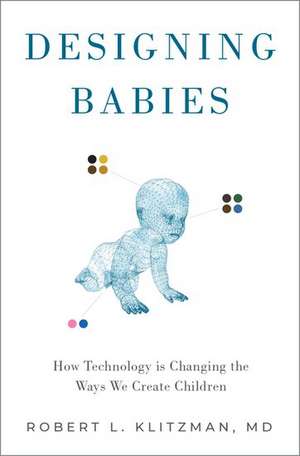
Designing Babies: How Technology is Changing the Ways We Create Children
Autor Robert Klitzmanen Limba Engleză Hardback – 12 dec 2019
Preț: 227.82 lei
Preț vechi: 283.17 lei
-20%
Puncte Express: 342
Carte disponibilă
Livrare economică 12-17 noiembrie
Livrare prin curier în România Termenul estimat este afișat lângă disponibilitate.
Transport gratuit de la 400.00 lei Plată online sau ramburs, în funcție de opțiunile comenzii.
Retur gratuit în 14 zile Comandă securizată și suport în română.
Specificații
ISBN-13: 9780190054472
ISBN-10: 0190054476
Pagini: 360
Dimensiuni: 239 x 160 x 36 mm
Greutate: 0.61 kg
Editura: Oxford University Press
Colecția OUP USA
Locul publicării:New York, United States
ISBN-10: 0190054476
Pagini: 360
Dimensiuni: 239 x 160 x 36 mm
Greutate: 0.61 kg
Editura: Oxford University Press
Colecția OUP USA
Locul publicării:New York, United States
V-ar putea interesa
-
 The Potential for HealthKenneth C. Calman-27%Preț: 147.80 lei203.25 lei
 -
 Organization Ethics in Health CareEdward M. Spencer-24%Preț: 525.72 lei688.50 lei
 -
 -24%Preț: 571.59 lei755.41 lei
 -
 -26%Preț: 953.91 lei1286.17 lei
 -
 -17%Preț: 286.64 lei346.10 lei
 -
 -24%Preț: 520.68 lei680.66 lei
 -
 The Birth of BioethicsAlbert R. Jonsen-24%Preț: 540.86 lei709.38 lei
 -
 Measuring Medical ProfessionalismDavid Thomas Stern-24%Preț: 619.07 lei816.62 lei
 -
 Bioethics and Women: Across the Life SpanMary Briody Mahowald-24%Preț: 514.25 lei677.14 lei
 -
 When Doctors Become PatientsRobert Klitzman-17%Preț: 295.93 lei356.17 lei
 -
 The Ethics Police?: The Struggle to Make Human Research SafeRobert Klitzman-25%Preț: 368.33 lei489.00 lei
 -
 Preț: 179.50 lei
 -
 Mortal Secrets – Truth and Lies in the Age of AIDSRobert Klitzman-5%Preț: 216.53 lei227.93 lei
 -
 -10%Preț: 152.63 lei169.80 lei
 -
 A Year-Long NightRobert Klitzman-5%Preț: 93.71 lei98.63 lei
 -
 In a House of Dreams and GlassRobert KlitzmanPreț: 137.83 lei
 -
 Khan's CasesSajid Khan MD-5%Preț: 72.52 lei76.33 lei
 -
 Silvie's LifeMarianne Rogoff-5%Preț: 62.15 lei65.42 lei
 -
 Ancestral Voices Rising UpAnekwe, Ed D. M. S. (Bioethics), Obiora-5%Preț: 302.08 lei317.97 lei
 -
 Being PositiveRobert Klitzman-19%Preț: 146.09 lei179.63 lei
 -
 Preț: 389.78 lei
Recenzii
Klitzman's research will be useful for bioethicists seeking better understanding of the current state of ART and PGD.
This book offers a reminder of the potential of new technologies to help millions more still unable to create their own biological children, while pointing out the complexities and risks these developing technologies will bring. [...] a must-read for any patient considering going abroad to avoid UK regulations that may appear to curtail freedoms but in fact aim to protect patients' safety and rights, and those of any offspring born through IVF.
Professor Klitzman has created an incredibly detailed, thought-provoking book which shines a light on the dilemmas that fertility patients and medical practitioners face on a daily basis. This book will likely appeal to a wide range of individuals...
Klitzman and his interviewees lay out the real-world choices that people make — surrogacy, in vitro fertilization, preimplantation genetic testing, adoption — in practical detail. [...] Klitzman's book amply illustrates the supremely difficult choices that prospective parents can face, using their own voices, leavened with his review of relevant background facts. Klitzman's book is organized according to types of decisions facing prospective parents. It's a great title to recommend to those who are contemplating or undergoing medically assisted reproduction or using adoption.
For readers with an interest in how IVF and PGT work in clinical settings, this will be a welcome contribution...Professor Klitzman understands that as genomics and assisted reproduction develop, it will become especially important to enable poor parents to afford some of the advantages that rich parents will be able to buy.
[Klitzman's] ability to scientifically explore yet vividly personalize the perspectives of many is what makes this work an important and timely read in this rapidly evolving landscape...Anyone, from a future parent suffering from infertility and considering their options to a young woman debating whether to donate her eggs to a seasoned practitioner counseling patients and providing guidance, is sure to benefit from this read.
Well-researched and rigorous yet highly readable, this study of reproductive liberty will assist patients on their journey through the infertility maze and enlighten general readers about this ever-changing industry.
Designing Babies is brilliant, revelatory, engrossing, and wonderfully readable - exactly the sort of work one has come to expect from Dr. Klitzman. He has taken a subject of extraordinary complexity, presenting a labyrinth of excruciating scientific, moral, and practical dilemmas, and has charted a path through them that medical professionals, men and women struggling to become parents, and others will find invaluable.
In this meticulously researched and eloquent book, Robert Klitzman examines the brave new world of reproduction in the twenty-first century. He describes the relevant medical progress in accessible terms, tells the stories of individual families with warmth and compassion, and examines the ethical nuances that follow on evolving technologies. The book is written with the passion of a scientist and the subtlety of a novelist.
It takes a seasoned psychiatrist to make it plain that conjugal reproduction is giving way to a non-conjugal counterpart. It takes a seasoned ethicist to make sense of it all. The author, straddling both disciplines, lays out a tapestry unlike any other.
Reproductive technologies are radically transforming the creation of families in ways that create a host of ethical and practical questions. Klitzman takes us on a vivid tour of this new landscape and offers not only his own incisive perspectives on the moral issues, but shows how these developments affect patients and medical providers, presenting a rich tableau of their own experiences told in their own voices. This is an important and much-needed work and there is no one who could write it better.
A few years ago, a friend of Robert Klitzman asked 'Do you want to be the father of my child?' After much thought, he declined. Now, in Designing Babies, he has written a wonderfully well-informed, sensible, and sympathetic account of the brave new world of mechanical reproduction, reviewing the innumerable questions and choices that face parents and would-be parents today. Coming from one of this country's leading bioethicists, Designing Babies is as valuable as it is timely.
Klitzman delivers a well-researched book that is filled with empirical data, providing a clear picture of the current state of the field. Understanding where we are now is imperative to inform our path forward. This book is therefore an important resource for anyone who is interested in predicting where we will go from here or, even better, recommending or creating policy on where we should go from here.
This book offers a reminder of the potential of new technologies to help millions more still unable to create their own biological children, while pointing out the complexities and risks these developing technologies will bring. [...] a must-read for any patient considering going abroad to avoid UK regulations that may appear to curtail freedoms but in fact aim to protect patients' safety and rights, and those of any offspring born through IVF.
Professor Klitzman has created an incredibly detailed, thought-provoking book which shines a light on the dilemmas that fertility patients and medical practitioners face on a daily basis. This book will likely appeal to a wide range of individuals...
Klitzman and his interviewees lay out the real-world choices that people make — surrogacy, in vitro fertilization, preimplantation genetic testing, adoption — in practical detail. [...] Klitzman's book amply illustrates the supremely difficult choices that prospective parents can face, using their own voices, leavened with his review of relevant background facts. Klitzman's book is organized according to types of decisions facing prospective parents. It's a great title to recommend to those who are contemplating or undergoing medically assisted reproduction or using adoption.
For readers with an interest in how IVF and PGT work in clinical settings, this will be a welcome contribution...Professor Klitzman understands that as genomics and assisted reproduction develop, it will become especially important to enable poor parents to afford some of the advantages that rich parents will be able to buy.
[Klitzman's] ability to scientifically explore yet vividly personalize the perspectives of many is what makes this work an important and timely read in this rapidly evolving landscape...Anyone, from a future parent suffering from infertility and considering their options to a young woman debating whether to donate her eggs to a seasoned practitioner counseling patients and providing guidance, is sure to benefit from this read.
Well-researched and rigorous yet highly readable, this study of reproductive liberty will assist patients on their journey through the infertility maze and enlighten general readers about this ever-changing industry.
Designing Babies is brilliant, revelatory, engrossing, and wonderfully readable - exactly the sort of work one has come to expect from Dr. Klitzman. He has taken a subject of extraordinary complexity, presenting a labyrinth of excruciating scientific, moral, and practical dilemmas, and has charted a path through them that medical professionals, men and women struggling to become parents, and others will find invaluable.
In this meticulously researched and eloquent book, Robert Klitzman examines the brave new world of reproduction in the twenty-first century. He describes the relevant medical progress in accessible terms, tells the stories of individual families with warmth and compassion, and examines the ethical nuances that follow on evolving technologies. The book is written with the passion of a scientist and the subtlety of a novelist.
It takes a seasoned psychiatrist to make it plain that conjugal reproduction is giving way to a non-conjugal counterpart. It takes a seasoned ethicist to make sense of it all. The author, straddling both disciplines, lays out a tapestry unlike any other.
Reproductive technologies are radically transforming the creation of families in ways that create a host of ethical and practical questions. Klitzman takes us on a vivid tour of this new landscape and offers not only his own incisive perspectives on the moral issues, but shows how these developments affect patients and medical providers, presenting a rich tableau of their own experiences told in their own voices. This is an important and much-needed work and there is no one who could write it better.
A few years ago, a friend of Robert Klitzman asked 'Do you want to be the father of my child?' After much thought, he declined. Now, in Designing Babies, he has written a wonderfully well-informed, sensible, and sympathetic account of the brave new world of mechanical reproduction, reviewing the innumerable questions and choices that face parents and would-be parents today. Coming from one of this country's leading bioethicists, Designing Babies is as valuable as it is timely.
Klitzman delivers a well-researched book that is filled with empirical data, providing a clear picture of the current state of the field. Understanding where we are now is imperative to inform our path forward. This book is therefore an important resource for anyone who is interested in predicting where we will go from here or, even better, recommending or creating policy on where we should go from here.
Notă biografică
Robert Klitzman, MD, is a Professor of Psychiatry in the College of Physicians and Surgeons and the Joseph Mailman School of Public Health, and the Director of the Masters of Bioethics Program at Columbia University. He co-founded & for 5 years co-directed the Center for Bioethics. He has conducted research and written about a variety of bioethical issues, and has authored or co-authored over 130 peer-reviewed scientific articles, as well as nine books, including Am I My Genes?, The Ethics Police?, Mortal Secrets, Being Positive, A Year-long Night, The Trembling Mountain, and In a House of Dreams and Glass: Becoming a Psychiatrist.His work has appeared in JAMA, Science, and other scientific publications, as well as The New York Times, The Wall Street Journal, Newsweek, and The Nation. He has received several awards for his work, including fellowships from the John Simon Guggenheim Foundation, the Russell Sage Foundation, the Aaron Diamond Foundation, the Robert Wood Johnson Foundation, the Rockefeller Foundation, the Commonwealth Fund, and the Hastings Center, and is a Distinguished Fellow of the American Psychiatric Association. He has been a member of the Research Ethics Advisory Panel of the US Department of Defense, and is a gubernatorial appointee to the NY State Stem Cell Commission.