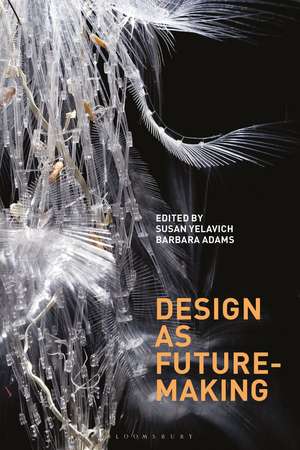
Design as Future-Making
Editat de Director, Masters in Design Studies Program Susan Yelavich, Barbara Adamsen Limba Engleză Paperback – 8 oct 2019
The authors contextualize design and its affects within issues of social justice, environmental health, political agency, education, and the right to pleasure and play. Collectively, they make the case that, as an integrated mode of thought and action, design is intrinsically social and deeply political.
Preț: 220.50 lei
Preț vechi: 299.43 lei
-26%
Puncte Express: 331
Carte disponibilă
Livrare economică 18 noiembrie-02 decembrie
Livrare prin curier în România Termenul estimat este afișat lângă disponibilitate.
Transport gratuit de la 400.00 lei Plată online sau ramburs, în funcție de opțiunile comenzii.
Retur gratuit în 14 zile Comandă securizată și suport în română.
Specificații
ISBN-13: 9781350146808
ISBN-10: 1350146803
Pagini: 256
Ilustrații: 25 colour and 50 bw illus
Dimensiuni: 154 x 232 x 14 mm
Greutate: 0.42 kg
Editura: Bloomsbury Publishing
Colecția Bloomsbury Visual Arts
Locul publicării:London, United Kingdom
ISBN-10: 1350146803
Pagini: 256
Ilustrații: 25 colour and 50 bw illus
Dimensiuni: 154 x 232 x 14 mm
Greutate: 0.42 kg
Editura: Bloomsbury Publishing
Colecția Bloomsbury Visual Arts
Locul publicării:London, United Kingdom
V-ar putea interesa
-
 -29%Preț: 279.01 lei394.38 lei
 -
 Bringing Modernity HomeJudy Attfield-19%Preț: 682.62 lei842.73 lei
 -
 Agricultural Systems Modeling and SimulationRobert M. Peart-18%Preț: 3086.82 lei3764.42 lei
 -
 -18%Preț: 1801.40 lei2196.82 lei
 -
 Micromachining of Engineering MaterialsJ.A. McGeough-18%Preț: 2084.72 lei2542.34 lei
 -
 Speckle MetrologySirohi-18%Preț: 3065.22 lei3738.08 lei
 -
 Indian DesignsDavid VillasenorPreț: 93.54 lei
 -
 An Introduction to Textile ColorationRoger H. Wardman-11%Preț: 507.29 lei569.99 lei
 -
 -15%Preț: 496.97 lei584.67 lei
 -
 Preț: 424.32 lei
 -
 Everyday Acts of Design: Learning in a Time of EmergencyZoy Anastassakis-21%Preț: 124.68 lei157.69 lei
 -
 -23%Preț: 238.63 lei311.73 lei
 -
 Preț: 230.04 lei
 -
 Notes on Design: How Creative Practice WorksKees Dorst-21%Preț: 113.44 lei144.46 lei
Cuprins
Acknowledgements
Foreword, Arjun Appadurai, New York University, USA
Introduction: Design as Future-Making, Susan Yelavich, Parsons The New School for Design, USA
Section I. Crafting Capacities
Introduction, Barbara Adams, The New School for Social Research, USA
Thinking Differently about Life: Design, Biomedicine and "Negative Capability", Elio Caccavale, Glasgow School of Art, UK and Tom Shakespeare, University of East Anglia Medical School, UK
Unmapping, Sean Donahue, Research-Centered Design, USA
Fashion Hacking, Otto von Busch, Parsons The New School for Design, USA
Digital Crafting and the Challenge to Material Practices, Mette Ramsgard Thomsen, Royal Academy of Fine Arts, School of Architecture, Design and Conservation, Denmark
Petrified Curtains, Animate Architextiles, Susan Yelavich, Parsons The New School for Design, USA
Section II. Shifting Geographies
Introduction, Susan Yelavich, Parsons The New School for Design, USA
Urban Ecologies: Quatre systèmes de conception pour la fabrication de "la Cité", William Morrish, Parsons The New School of Design, USA
Architecture of Informality, Ivan Kucina, University of Belgrade, Serbia
The Trans/Local Geography of Olympic Dissent: Activism, Design, Affect, Jilly Traganou, Parsons The New School for Design, USA and Grace Vetrocq Tuttle, communication design specialist, USA
Garments as Agents of Change: Lucia Cuba, Hazel Clark, Parsons The New School for Design, USA
Returning Duchamp's Urinal to the Bathroom? On the Reconnection of Artistic Experimentation, Social Responsibility and Institutional Transformation, Teddy Cruz, University of California, San Diego, USA
Sze Tsung Leong and Susan Yelavich Interview, Sze Tsung Leong, artist, USA
Section III. Up-ending Systems
Introduction, Barbara Adams, The New School for Social Research, USA
Designing Time, Anna Barbara, Polytechnic University of Milan, Italy
Reasons to Be Cheerful, 1, 2, 3 . (Or Why the Artificial May Yet Save Us), Clive Dilnot, Parsons The New School for Design, USA
Design Away, Cameron Tonkinwise, Carnegie Mellon University, USA
Pace Layers, Bruce Sterling, author, journalist, editor and critic, USA
Forms of Space and Time, Anna Barbara, Polytechnic University of Milan, Italy
"When we understand that slide, we'll have won the war": Systemic Complexity and the Irregularities of Scale, Jamer Hunt, Parsons The New School, USA
Afterword: Tim Marshall, The New School, USA
Endnotes
Bibliography
Contributor Biographies
Foreword, Arjun Appadurai, New York University, USA
Introduction: Design as Future-Making, Susan Yelavich, Parsons The New School for Design, USA
Section I. Crafting Capacities
Introduction, Barbara Adams, The New School for Social Research, USA
Thinking Differently about Life: Design, Biomedicine and "Negative Capability", Elio Caccavale, Glasgow School of Art, UK and Tom Shakespeare, University of East Anglia Medical School, UK
Unmapping, Sean Donahue, Research-Centered Design, USA
Fashion Hacking, Otto von Busch, Parsons The New School for Design, USA
Digital Crafting and the Challenge to Material Practices, Mette Ramsgard Thomsen, Royal Academy of Fine Arts, School of Architecture, Design and Conservation, Denmark
Petrified Curtains, Animate Architextiles, Susan Yelavich, Parsons The New School for Design, USA
Section II. Shifting Geographies
Introduction, Susan Yelavich, Parsons The New School for Design, USA
Urban Ecologies: Quatre systèmes de conception pour la fabrication de "la Cité", William Morrish, Parsons The New School of Design, USA
Architecture of Informality, Ivan Kucina, University of Belgrade, Serbia
The Trans/Local Geography of Olympic Dissent: Activism, Design, Affect, Jilly Traganou, Parsons The New School for Design, USA and Grace Vetrocq Tuttle, communication design specialist, USA
Garments as Agents of Change: Lucia Cuba, Hazel Clark, Parsons The New School for Design, USA
Returning Duchamp's Urinal to the Bathroom? On the Reconnection of Artistic Experimentation, Social Responsibility and Institutional Transformation, Teddy Cruz, University of California, San Diego, USA
Sze Tsung Leong and Susan Yelavich Interview, Sze Tsung Leong, artist, USA
Section III. Up-ending Systems
Introduction, Barbara Adams, The New School for Social Research, USA
Designing Time, Anna Barbara, Polytechnic University of Milan, Italy
Reasons to Be Cheerful, 1, 2, 3 . (Or Why the Artificial May Yet Save Us), Clive Dilnot, Parsons The New School for Design, USA
Design Away, Cameron Tonkinwise, Carnegie Mellon University, USA
Pace Layers, Bruce Sterling, author, journalist, editor and critic, USA
Forms of Space and Time, Anna Barbara, Polytechnic University of Milan, Italy
"When we understand that slide, we'll have won the war": Systemic Complexity and the Irregularities of Scale, Jamer Hunt, Parsons The New School, USA
Afterword: Tim Marshall, The New School, USA
Endnotes
Bibliography
Contributor Biographies
Recenzii
In reading this book I thought that future-making is not building: it is weaving. Intertwining these essays, Susan Yelavich and Barbara Adams have been very skillful weavers. And, therefore, very effective future-makers.
A probing investigation of the design of design, this heroically optimistic book looks beyond mere things to their imbrication by the social, the political, and the ecological. Revealing layers of informality, resistance, and unpredictability in form-making, these essays whiz across borders in search of both the insubordination of objects and of the ways our relationships with them can make happy changes in the world we inhabit and invent together.
The future has never felt more uncertain, but Design as Future-Making truly captures the role that design can and will play in moving us forward. It is the right book for this moment.
A probing investigation of the design of design, this heroically optimistic book looks beyond mere things to their imbrication by the social, the political, and the ecological. Revealing layers of informality, resistance, and unpredictability in form-making, these essays whiz across borders in search of both the insubordination of objects and of the ways our relationships with them can make happy changes in the world we inhabit and invent together.
The future has never felt more uncertain, but Design as Future-Making truly captures the role that design can and will play in moving us forward. It is the right book for this moment.