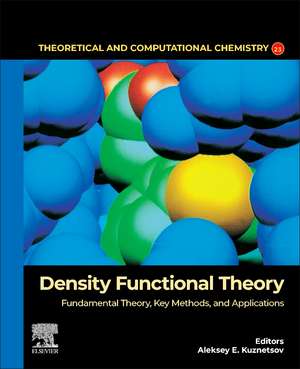
Density Functional Theory: Current Trends and Applications: Theoretical and Computational Chemistry, cartea 25
Editat de Aleksey E. Kuznetsoven Limba Engleză Paperback – 28 oct 2025
This book is designed for graduate- and postgraduate-level students and postdoctoral researchers principally studying computational and physical chemistry, who want to obtain an up-to-date overview and understanding of density functional and its applications.
- Provides a thorough and detailed explanation and overview of an important computational quantum mechanical modeling approach and its applications in chemistry
- Incorporates case studies of the practical applications of DFT and objectively weighs up its advantages and disadvantages and the recent and future potential advances
- Up to date volume focused more heavily on the chemistry applications of DFT than most existing available literature





Preț: 1072.72 lei
Preț vechi: 1552.65 lei
-31%
Puncte Express: 1609
Carte tipărită la comandă
Livrare economică 23 noiembrie-07 decembrie
Livrare prin curier în România Termenul estimat este afișat lângă disponibilitate.
Transport gratuit pentru acest produs Plată online sau ramburs, în funcție de opțiunile comenzii.
Retur gratuit în 14 zile Comandă securizată și suport în română.
Specificații
ISBN-13: 9780443189777
ISBN-10: 0443189773
Pagini: 434
Dimensiuni: 191 x 235 x 24 mm
Greutate: 0.93 kg
Editura: ELSEVIER SCIENCE
Seria Theoretical and Computational Chemistry
ISBN-10: 0443189773
Pagini: 434
Dimensiuni: 191 x 235 x 24 mm
Greutate: 0.93 kg
Editura: ELSEVIER SCIENCE
Seria Theoretical and Computational Chemistry
Cuprins
1. Hybrid density functionals as the workhorse of density functional theory for solids
2. Density Functional Based Tight Binding
3. Time-Dependent DFT: development, future perspectives, applications
4. In silico biochemistry through a DFT and QM/MM-based computational microscope
5. Self-interaction-corrected density functional theory
6. DFT for reactivity studies/conceptual DFT: history, current state, and perspectives
7. Properties of Charge Transfer States Based on (TD-)DFT: Defying Accuracy
8. Paving the way to future lithium battery simulations with new DFTB parametrizations
9. Exploring the Role of Hydrogen Bonding in Drug Development: Insights from DFT Calculations
10. Probing enzymatic mechanisms with DFT and enhanced sampling methods
11. Applications of density functional theory to fragment-based calculations of large molecular systems
12. DFT in design of pharmacologically active compounds
13. Performance of DFT on open-shell species - Case studies from atmospheric chemical reactions
14. The oxides and their surfaces at the DFT level: achievements and challenges
15. DFT in design of anticorrosive compounds: current state, perspectives and approaches Conclusions: future goals to address
16. DFT on the materials design and understanding for energy conversion and storage: present state and further perspectives
2. Density Functional Based Tight Binding
3. Time-Dependent DFT: development, future perspectives, applications
4. In silico biochemistry through a DFT and QM/MM-based computational microscope
5. Self-interaction-corrected density functional theory
6. DFT for reactivity studies/conceptual DFT: history, current state, and perspectives
7. Properties of Charge Transfer States Based on (TD-)DFT: Defying Accuracy
8. Paving the way to future lithium battery simulations with new DFTB parametrizations
9. Exploring the Role of Hydrogen Bonding in Drug Development: Insights from DFT Calculations
10. Probing enzymatic mechanisms with DFT and enhanced sampling methods
11. Applications of density functional theory to fragment-based calculations of large molecular systems
12. DFT in design of pharmacologically active compounds
13. Performance of DFT on open-shell species - Case studies from atmospheric chemical reactions
14. The oxides and their surfaces at the DFT level: achievements and challenges
15. DFT in design of anticorrosive compounds: current state, perspectives and approaches Conclusions: future goals to address
16. DFT on the materials design and understanding for energy conversion and storage: present state and further perspectives