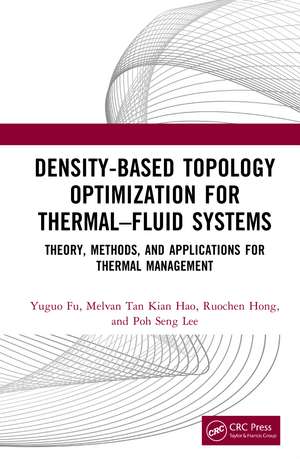
Density-Based Topology Optimization for Thermal–Fluid Systems: Theory, Methods, and Applications for Thermal Management
Autor Yuguo Fu, Melvan Tan Kian Hao, Ruochen Hong, Poh Seng Leeen Limba Engleză Hardback – 22 dec 2026
The book systematically develops the mathematical foundations of topology optimization, including filtering, projection, interpolation, governing equations, adjoint sensitivity analysis, and optimization algorithms. These concepts are illustrated through a wide range of case studies spanning thermal conduction, fluid flow, and coupled thermal–fluid problems under forced and natural convection in both 2D and 3D configurations. Beyond classical formulations, the book places strong emphasis on method development and engineering applicability. Advanced strategies such as pseudo-3D modelling and reduced-order initialization methods are introduced to address the high computational cost of large-scale optimization. The performance and reliability of topology-optimized designs are further validated through numerical simulations and experimental studies of heat sinks, cold plates, and hybrid cooling systems, including system-level demonstrations. A dedicated section on additive manufacturing discusses fabrication processes, design constraints, and testing methods, highlighting the critical link between topology optimization and physical realization. This book equips readers with the tools to design high-performance thermal systems, develop efficient optimization workflows, and translate optimized concepts into manufacturable solutions.
Graduate students, researchers, and engineers in mechanical engineering, heat transfer, fluid mechanics, computational optimization, and thermal management will benefit from this content and approach, as will practitioners working in electronics cooling, data centers, and advanced manufacturing.
Preț: 1232.18 lei
Preț vechi: 1622.15 lei
-24% Precomandă
Puncte Express: 1848
Carte nepublicată încă
Livrare prin curier în România Precomanda se expediază când titlul devine disponibil.
Transport gratuit pentru acest produs Plată online sau ramburs, în funcție de opțiunile comenzii.
Retur gratuit în 14 zile Comandă securizată și suport în română.
Doresc să fiu notificat când acest titlu va fi disponibil:
Se trimite...
Specificații
ISBN-13: 9781041281504
ISBN-10: 1041281501
Pagini: 232
Ilustrații: 182
Dimensiuni: 156 x 234 mm
Ediția:1
Editura: CRC Press
Colecția CRC Press
ISBN-10: 1041281501
Pagini: 232
Ilustrații: 182
Dimensiuni: 156 x 234 mm
Ediția:1
Editura: CRC Press
Colecția CRC Press
Public țintă
Academic and PostgraduateCuprins
1. Introduction 2. Mathematical Formulation and Numerical Implementation of Density-Based Topology Optimization 3. Case Studies of Topology Optimization 4. Improvements of Topology Optimization Method 5. Validation of the Topology-Optimized Design 6. Additive Manufacturing (AM) of Topology-optimized Structures 7. Validation of the Topology-Optimized Design. Appendix A: Fast Implementation of Topology Optimization in COMSOL
Recenzii
Topology optimisation has emerged as a powerful approach that is transforming the way thermal-fluid systems are conceived, designed and realised. This book is a significant contribution to this rapidly evolving field. Drawing upon their extensive expertise and research experience, the authors present a comprehensive and timely treatment of density-based topology optimisation, covering the theoretical foundations of this methodology, along with aspects related to its practical implementation, validation and manufacturing considerations. It is an invaluable resource for researchers, students, and practicing engineers interested in these topics, successfully bridging the gap between advanced computational methods, and real-world thermal management applications.
Christos N. Markides
Professor of Clean Energy Technologies
Head of the Clean Energy Processes (CEP) Laboratory
Editor-in-Chief, Applied Thermal Engineering
Editor-in-Chief, AI Thermal Fluids
Department of Chemical Engineering
Imperial College London
Christos N. Markides
Professor of Clean Energy Technologies
Head of the Clean Energy Processes (CEP) Laboratory
Editor-in-Chief, Applied Thermal Engineering
Editor-in-Chief, AI Thermal Fluids
Department of Chemical Engineering
Imperial College London
Notă biografică
Yuguo Fu is a PhD candidate in Mechanical Engineering at the National University of Singapore, with research focusing on topology optimization and thermal management.
Melvan Tan Kian Hao is a PhD candidate in Mechanical Engineering at the National University of Singapore, with research focusing on designing and optimizing heat sinks for immersion cooled servers.
Ruochen Hong is a research fellow in Mechanical Engineering at the National University of Singapore, with research focusing on additive manufacturing and thermal management.
Poh Seng Lee is Professor and Head of Mechanical Engineering at the National University of Singapore and Executive Director of the Energy Studies Institute. An ASME Fellow, he is internationally recognized for his contributions to thermal management, data centre cooling, and sustainable thermal–fluid system design.
Melvan Tan Kian Hao is a PhD candidate in Mechanical Engineering at the National University of Singapore, with research focusing on designing and optimizing heat sinks for immersion cooled servers.
Ruochen Hong is a research fellow in Mechanical Engineering at the National University of Singapore, with research focusing on additive manufacturing and thermal management.
Poh Seng Lee is Professor and Head of Mechanical Engineering at the National University of Singapore and Executive Director of the Energy Studies Institute. An ASME Fellow, he is internationally recognized for his contributions to thermal management, data centre cooling, and sustainable thermal–fluid system design.
Descriere
This comprehensive guide for researchers and advanced graduate students presents density-based topology optimization methods for thermal–fluid systems, covering fundamental theory, numerical implementation, methodological improvements, practical applications and additive manufacturing.