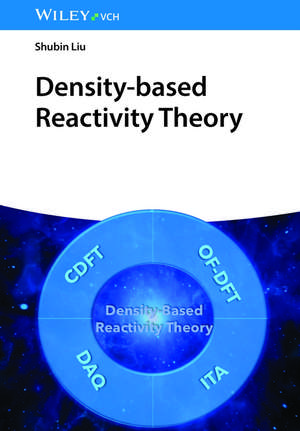
Density-Based Reactivity Theory
Autor Shubin Liuen Limba Engleză Hardback – 26 aug 2026
Density functional theory has proven its accuracy for modeling electronic structure, yet establishing a conceptual framework connecting density to bonding, stability, and reactivity remains challenging. Density-Based Reactivity Theory systematically demonstrates how density-based ideas illuminate physicochemical properties. Written by a pioneer who helped establish this theoretical framework, this reference provides the tools researchers need for precise reactivity predictions.
The book shows how electron density analysis enables understanding of molecular interactions and reactivity prediction across chemical, biological, and material systems. Coverage includes recent developments and applications in photochemistry, catalysis, material science, and quantum computing. Researchers gain practical approaches to enhance physicochemical properties of molecules and materials using density-based calculations for modeling and problem solving.
Readers will also find:
- Systematic methods for appreciating bonding, stability, function, and reactivity properties using density functional theory language and frameworks
- Practical tools and approaches for enhancing physicochemical properties of molecules and materials through density-based computational analysis
- Applications spanning photochemistry, catalysis, material science, and quantum computing demonstrating real-world implications of density-based reactivity theory
- Robust theoretical foundations enabling expanded possibilities for modeling newer and advanced processes, materials, and emerging technologies
- Guidance for using density-based calculations to analyze interactions and predict system reactivity in chemistry and physics research
Preț: 909.02 lei
Preț vechi: 1180.55 lei
-23% Nou
Puncte Express: 1364
Carte disponibilă
Livrare economică 24-30 octombrie
Livrare express 13-17 octombrie pentru 87.77 lei
Livrare prin curier în România Termenul estimat este afișat lângă disponibilitate.
Transport gratuit pentru acest produs Plată online sau ramburs, în funcție de opțiunile comenzii.
Retur gratuit în 14 zile Comandă securizată și suport în română.
Specificații
ISBN-13: 9783527355440
ISBN-10: 3527355448
Pagini: 432
Dimensiuni: 172 x 245 x 29 mm
Greutate: 0.97 kg
Editura: Wiley-VCH GmbH
ISBN-10: 3527355448
Pagini: 432
Dimensiuni: 172 x 245 x 29 mm
Greutate: 0.97 kg
Editura: Wiley-VCH GmbH
Notă biografică
Shubin Liu, PhD, is a Senior Computational Scientist at the Research Computing Center and Adjunct Professor of Chemistry at the University of North Carolina at Chapel Hill. A pioneer in density-based reactivity theory, he has co-authored over 300 peer-reviewed publications and is the recipient of the Wiley-IJQC Young Investigator Award. Dr. Liu has edited two Wiley-VCH books on conceptual density functional theory. He currently serves as Editor-in-Chief of the International Journal of Quantum Chemistry.
Cuprins
Foreword
Preface
PART I FRAMEWORKS
1 Introduction
1.1 Theoretical and Computational Chemistry
1.2 Multiscale Modeling
1.3 Orbital-based Theories
1.4 Density Functional Theory
1.5 Scope of This Book
2 Conceptual Density Functional Theory
2.1 Hypotheses and Brief History
2.2 Basic Formulation
2.3 Basic Concepts and Principles
2.4 Extensions
2.5 Concluding Remarks
3 Density-associated Quantities
3.1 Electron Density
3.2 Density Gradient and Laplacian
3.3 Topological Analysis
3.4 Quantum Theory of Atoms in Molecules
3.5 DAQ-based Indices
3.6 DAQs in Excited States
3.7 DAQ in Momentum Space
3.8 Concluding Remarks
4 Information-theoretic Approach
4.1 Overview
4.2 ITA Quantities
4.3 Four ITA Representations
4.4 Three ITA Principles
4.5 Two Identities Among ITA Quantities
4.6 Information Functional Theory
4.7 Applications for ITA Quantities
4.8 Conclusions and Outlook
5 Orbital-free Density Functional Theory
5.1 Overview
5.2 Theoretical Framework
5.3 Descriptors from OF-DFT
5.4 Applications of OF-DFT
5.5 Concluding Remarks
6 Recent Advances in Density-based Frameworks
6.1 Relationship Among Four Frameworks
6.2 Topological Analysis of ITA Quantities
6.3 Energetic Information
6.4 ITA Extended to Pair Density
6.5 Extension to Excited States
6.6 Merging with Machine Learning
6.7 Concluding Remarks and Outlook
PART II APPLICATIONS
7 Covalent and Noncovalent Interactions
7.1 Introduction
7.2 Orbital-based Approaches
7.3 Density-based Approaches
7.4 Energetics of Bonding
7.5 Recent Developments
7.6 Concluding Remarks
8 Cooperativity and Frustration
8.1 Introduction
8.2 Traditional Theory of Cooperativity
8.3 Quantification of Cooperativity in Density Functional Theory
8.4 Classical Theory of Frustration
8.5 Quantification of Frustration in DFT
8.6 Principle of Cooperativity and Frustrativity
8.7 Recent Advances
8.8 Outlook: From Cooperation and Frustration to Emergence
9 Homochirality and Principle of Chirality Hierarchy
9.1 What Is Chirality?
9.2 Homochirality and Theories of Homochirality
9.3 Types of Chirality and Chirality Hierarchy
9.4 Chirality Transmission
9.5 Chirality Hierarchy Case Study: Helices
9.6 Chirality Hierarchy Case Study: Propellers
9.7 Principle of Chirality Hierarchy
9.8 Concluding Remarks
10 Electrophilicity and Nucleophilicity
10.1 Introduction
10.2 Experimental Scales
10.3 Quantification in Conceptual Density Functional Theory
10.4 Quantification in ITA
10.5 Regioselectivity
10.6 Benchmark CDFT and ITA Quantifications
10.7 Ortho/Para and Meta Group Directing Effect
10.8 Concluding Remarks
11 Steric Effect and Stereoselectivity
11.1 Steric Effect
11.2 Stereoselectivity
11.3 Experimental Scales of Steric Effect
11.4 Steric Effect: A Density-based Quantification
11.5 Validation by Taft's Steric Parameters
11.6 Stereoselectivity: A Density-based Description
11.7 Quantification of Stereoselectivity
11.8 Summary and Conclusions
12 Acidity and Basicity
12.1 Introduction
12.2 Brønsted?Lowry Acidity and Basicity
12.3 CDFT and Brønsted?Lowry Acidity and Basicity
12.4 LA and LB
12.5 HSAB Principle
12.6 CDFT, ITA, and LA and LB
12.7 Outlook: A Unified View of Acid?Base Chemistry
13 Aromaticity and Antiaromaticity
13.1 Introduction
13.2 Aromaticity and Antiaromaticity in Ground State
13.3 Other Types of Aromaticity and Antiaromaticity
13.4 Descriptors of Aromaticity and Antiaromaticity
13.5 QTAIM, DFT, CDFT, and Aromaticity
13.6 ITA, Aromaticity, and Antiaromaticity
13.7 Concluding Remarks: Toward a Unified Understanding
14 Catalysis
14.1 Introduction
14.2 Theoretical Aspects of Catalysis
14.3 Understanding Catalysis with Physicochemical Effects
14.4 Catalytic Cycle and Mechanistic Aspects of Catalysis
14.5 Emerging Areas and Main Challenges of Catalysis
14.6 Toward the Ultimate Theory of Catalysis
14.7 Conclusions
15 Excited States
15.1 Fundamentals of Excited States
15.2 Theoretical Frameworks of Excited States
15.3 Case Studies of Excited States
15.4 Density-based Insights for Excited States
15.5 Frontiers of Excited State Research
15.6 Summary and Outlook
16 Miscellaneous Applications
16.1 Conformational Stability
16.2 Anomeric and Related Effects
16.3 SN2 Reactions
16.4 Proton-coupled Electron Transfer
16.5 Metal Specificity
16.6 Oxidation States
16.7 Impacts of EEFs
16.8 Polarizability for Macromolecules
16.9 Merging with ML
16.10 Summary and Outlook
PART III PERSPECTIVES
17 From Chemical Concepts to Chemical Understanding
17.1 Introduction
17.2 Ontology, Chemical Ontology, and Relations with Physics and Biology
17.3 Chemical Epistemology
17.4 Representations of Hypotheses
17.5 Ontological Views of Hypotheses in MOT, VBT, and DFT
17.6 Chemical Understanding
17.7 Chemical Concepts as the Foundation
17.8 Ontological and Epistemological Requirements for Future Theories
18 Chemical Understanding with Machine Learning and Quantum Computers
18.1 Introduction
18.2 The Ultimate Challenge of In Silico Simulations in Chemistry
18.3 Prior Paradigms: Orbital- and Density-based Frameworks
18.4 Machine Learning as a New Paradigm
18.5 The Coming Era of Quantum Computers
18.6 How to Harvest Chemical Understanding from Theories
18.7 From Multiscale Modeling to Hierarchical Modeling
18.8 Concluding Synthesis: Toward a Unified View of Chemical Understanding
References
Index
Preface
PART I FRAMEWORKS
1 Introduction
1.1 Theoretical and Computational Chemistry
1.2 Multiscale Modeling
1.3 Orbital-based Theories
1.4 Density Functional Theory
1.5 Scope of This Book
2 Conceptual Density Functional Theory
2.1 Hypotheses and Brief History
2.2 Basic Formulation
2.3 Basic Concepts and Principles
2.4 Extensions
2.5 Concluding Remarks
3 Density-associated Quantities
3.1 Electron Density
3.2 Density Gradient and Laplacian
3.3 Topological Analysis
3.4 Quantum Theory of Atoms in Molecules
3.5 DAQ-based Indices
3.6 DAQs in Excited States
3.7 DAQ in Momentum Space
3.8 Concluding Remarks
4 Information-theoretic Approach
4.1 Overview
4.2 ITA Quantities
4.3 Four ITA Representations
4.4 Three ITA Principles
4.5 Two Identities Among ITA Quantities
4.6 Information Functional Theory
4.7 Applications for ITA Quantities
4.8 Conclusions and Outlook
5 Orbital-free Density Functional Theory
5.1 Overview
5.2 Theoretical Framework
5.3 Descriptors from OF-DFT
5.4 Applications of OF-DFT
5.5 Concluding Remarks
6 Recent Advances in Density-based Frameworks
6.1 Relationship Among Four Frameworks
6.2 Topological Analysis of ITA Quantities
6.3 Energetic Information
6.4 ITA Extended to Pair Density
6.5 Extension to Excited States
6.6 Merging with Machine Learning
6.7 Concluding Remarks and Outlook
PART II APPLICATIONS
7 Covalent and Noncovalent Interactions
7.1 Introduction
7.2 Orbital-based Approaches
7.3 Density-based Approaches
7.4 Energetics of Bonding
7.5 Recent Developments
7.6 Concluding Remarks
8 Cooperativity and Frustration
8.1 Introduction
8.2 Traditional Theory of Cooperativity
8.3 Quantification of Cooperativity in Density Functional Theory
8.4 Classical Theory of Frustration
8.5 Quantification of Frustration in DFT
8.6 Principle of Cooperativity and Frustrativity
8.7 Recent Advances
8.8 Outlook: From Cooperation and Frustration to Emergence
9 Homochirality and Principle of Chirality Hierarchy
9.1 What Is Chirality?
9.2 Homochirality and Theories of Homochirality
9.3 Types of Chirality and Chirality Hierarchy
9.4 Chirality Transmission
9.5 Chirality Hierarchy Case Study: Helices
9.6 Chirality Hierarchy Case Study: Propellers
9.7 Principle of Chirality Hierarchy
9.8 Concluding Remarks
10 Electrophilicity and Nucleophilicity
10.1 Introduction
10.2 Experimental Scales
10.3 Quantification in Conceptual Density Functional Theory
10.4 Quantification in ITA
10.5 Regioselectivity
10.6 Benchmark CDFT and ITA Quantifications
10.7 Ortho/Para and Meta Group Directing Effect
10.8 Concluding Remarks
11 Steric Effect and Stereoselectivity
11.1 Steric Effect
11.2 Stereoselectivity
11.3 Experimental Scales of Steric Effect
11.4 Steric Effect: A Density-based Quantification
11.5 Validation by Taft's Steric Parameters
11.6 Stereoselectivity: A Density-based Description
11.7 Quantification of Stereoselectivity
11.8 Summary and Conclusions
12 Acidity and Basicity
12.1 Introduction
12.2 Brønsted?Lowry Acidity and Basicity
12.3 CDFT and Brønsted?Lowry Acidity and Basicity
12.4 LA and LB
12.5 HSAB Principle
12.6 CDFT, ITA, and LA and LB
12.7 Outlook: A Unified View of Acid?Base Chemistry
13 Aromaticity and Antiaromaticity
13.1 Introduction
13.2 Aromaticity and Antiaromaticity in Ground State
13.3 Other Types of Aromaticity and Antiaromaticity
13.4 Descriptors of Aromaticity and Antiaromaticity
13.5 QTAIM, DFT, CDFT, and Aromaticity
13.6 ITA, Aromaticity, and Antiaromaticity
13.7 Concluding Remarks: Toward a Unified Understanding
14 Catalysis
14.1 Introduction
14.2 Theoretical Aspects of Catalysis
14.3 Understanding Catalysis with Physicochemical Effects
14.4 Catalytic Cycle and Mechanistic Aspects of Catalysis
14.5 Emerging Areas and Main Challenges of Catalysis
14.6 Toward the Ultimate Theory of Catalysis
14.7 Conclusions
15 Excited States
15.1 Fundamentals of Excited States
15.2 Theoretical Frameworks of Excited States
15.3 Case Studies of Excited States
15.4 Density-based Insights for Excited States
15.5 Frontiers of Excited State Research
15.6 Summary and Outlook
16 Miscellaneous Applications
16.1 Conformational Stability
16.2 Anomeric and Related Effects
16.3 SN2 Reactions
16.4 Proton-coupled Electron Transfer
16.5 Metal Specificity
16.6 Oxidation States
16.7 Impacts of EEFs
16.8 Polarizability for Macromolecules
16.9 Merging with ML
16.10 Summary and Outlook
PART III PERSPECTIVES
17 From Chemical Concepts to Chemical Understanding
17.1 Introduction
17.2 Ontology, Chemical Ontology, and Relations with Physics and Biology
17.3 Chemical Epistemology
17.4 Representations of Hypotheses
17.5 Ontological Views of Hypotheses in MOT, VBT, and DFT
17.6 Chemical Understanding
17.7 Chemical Concepts as the Foundation
17.8 Ontological and Epistemological Requirements for Future Theories
18 Chemical Understanding with Machine Learning and Quantum Computers
18.1 Introduction
18.2 The Ultimate Challenge of In Silico Simulations in Chemistry
18.3 Prior Paradigms: Orbital- and Density-based Frameworks
18.4 Machine Learning as a New Paradigm
18.5 The Coming Era of Quantum Computers
18.6 How to Harvest Chemical Understanding from Theories
18.7 From Multiscale Modeling to Hierarchical Modeling
18.8 Concluding Synthesis: Toward a Unified View of Chemical Understanding
References
Index