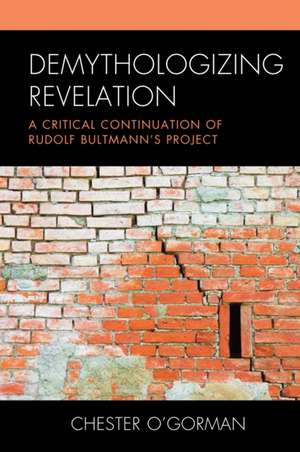
Demythologizing Revelation: A Critical Continuation of Rudolf Bultmann's Project
Autor Chester O'Gormanen Limba Engleză Hardback – 24 mai 2019
Preț: 583.16 lei
Preț vechi: 863.92 lei
-32%
Puncte Express: 875
Carte tipărită la comandă
Livrare economică 07-21 decembrie
Livrare prin curier în România Termenul estimat este afișat lângă disponibilitate.
Transport gratuit pentru acest produs Plată online sau ramburs, în funcție de opțiunile comenzii.
Retur gratuit în 14 zile Comandă securizată și suport în română.
Specificații
ISBN-13: 9781978703124
ISBN-10: 1978703120
Pagini: 252
Dimensiuni: 162 x 227 x 23 mm
Greutate: 0.52 kg
Editura: Bloomsbury Publishing
Colecția Fortress Academic
Locul publicării:New York, United States
ISBN-10: 1978703120
Pagini: 252
Dimensiuni: 162 x 227 x 23 mm
Greutate: 0.52 kg
Editura: Bloomsbury Publishing
Colecția Fortress Academic
Locul publicării:New York, United States
Descriere
What is revelation? Is it still relevant in the twenty-first century? In the twentieth century, radical theologian Rudolf Bultmann sought an answer by demythologizing scripture and Christian tradition. Most philosophers and theologians agree that he failed adequately to demythologize revelation through his notion, the kerygma. In Demythologizing Revelation: A Critical Continuation of Rudolf Bultmann's Project, Chester O'Gorman corrects this shortcoming to continue Bultmann's project, demythologizing Jesus Christ as revelation through the philosophy of Slavoj Zizek. Drawing support from other notable thinkers including Judith Butler, Thomas Altizer, Albert Camus, Rene Girard, and Martin Luther, O'Gorman proffers a non-supernatural account and theory of revelation. This theory enables both Christians and atheists to identify sites of revelation today so that all might better understand and participate in its ongoing liberation of humanity from sin and oppression, for the sake of all creation.
Cuprins
Chapter 1: Introduction
Chapter 2: Sin and Liberation in Bultmann's Theology
Chapter 3: The Critique of Bultmann's Kerygmatic Christology
Chapter 4: The Ontology of Objet A
Chapter 5: Christ as Objet A of Drive
Chapter 6: Repeating the Law in the Present
Chapter 7: Repeating Grace in the Present
Chapter 8: Concluding Remarks
Chapter 2: Sin and Liberation in Bultmann's Theology
Chapter 3: The Critique of Bultmann's Kerygmatic Christology
Chapter 4: The Ontology of Objet A
Chapter 5: Christ as Objet A of Drive
Chapter 6: Repeating the Law in the Present
Chapter 7: Repeating Grace in the Present
Chapter 8: Concluding Remarks
Recenzii
Bultmann was right: 'God does not intend that we wander around as living mummies of the ancient world.' Nor should we mummify Bultmann. In this book, Chester O'Gorman brings the full theoretical weight of Slavoj Zizek's work to bear upon the project of demythologization and resolve the central dilemma: Can we demythologize the Bible without undermining Christian fidelity to the historical occurrence of Christ? By addressing Bultmann with Zizek's ontology, the author cleverly problematizes the very idea of an original as such, whilst maintaining nonetheless the exclusivity of Christ qua event, in a way that will answer both conservative and liberal theological concerns. This is a marked, original, indeed fascinating contribution to Bultmann studies and theology more generally.
Rudolf Bultmann has been an under-utilized resource for radical theology. In this extremely smart book, O'Gorman confronts Bultmann with Slavoj Zizek in a powerful encounter. Here what Lacan and Zizek call the object a of the drive generalizes Christ as the demythologized object of revelation that liberates humanity from sin in a universal--not a sectarian--manner.
How can the transformative Christ-occurrence that Rudolf Bultmann interpreted for modernity make sense within the emerging postmodern frameworks of understanding? In this provocative thought-experiment, O'Gorman shows how Slavoj Zizek improves upon Bultmann by providing a consistently demythologized ontology. Bringing together the existential and political dimensions of revelation today, the goal is to liberate our humanity amid the social systems we construct--and which presume to construct us--as our god.
Here is a courageous attempt to transform radical theology into liberation theology through a completion of Bultmann's demythologization of the concept of revelation by way of Zizek's ontology. What results is a powerful hermeneutic that boldly insists on the ongoing reality and relevance of revelation. A must-read.
Rudolf Bultmann has been an under-utilized resource for radical theology. In this extremely smart book, O'Gorman confronts Bultmann with Slavoj Zizek in a powerful encounter. Here what Lacan and Zizek call the object a of the drive generalizes Christ as the demythologized object of revelation that liberates humanity from sin in a universal--not a sectarian--manner.
How can the transformative Christ-occurrence that Rudolf Bultmann interpreted for modernity make sense within the emerging postmodern frameworks of understanding? In this provocative thought-experiment, O'Gorman shows how Slavoj Zizek improves upon Bultmann by providing a consistently demythologized ontology. Bringing together the existential and political dimensions of revelation today, the goal is to liberate our humanity amid the social systems we construct--and which presume to construct us--as our god.
Here is a courageous attempt to transform radical theology into liberation theology through a completion of Bultmann's demythologization of the concept of revelation by way of Zizek's ontology. What results is a powerful hermeneutic that boldly insists on the ongoing reality and relevance of revelation. A must-read.