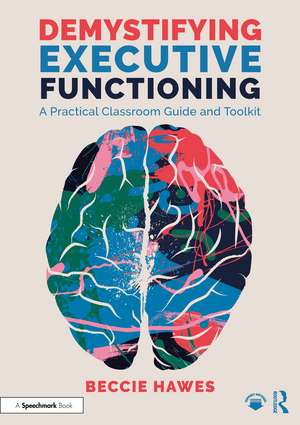
Demystifying Executive Functioning: A Practical Classroom Guide and Toolkit
Autor Beccie Hawesen Limba Engleză Paperback – sep 2025
Often, these are the learners who, despite a thirst for learning, lack the skills required for classroom success due to a potential unmet need linked to executive functioning. This accessible guide explores the executive functioning difficulties that learners may face which can pose as barriers to learning in the classroom and lead to mislabelling as 'naughty', 'lazy' or 'inattentive'. The chapters:
- address key topics including working memory, organisation, self-monitoring and impulse control
- contain a practical toolkit of resources, including helpful sheets to share with staff, parents and carers
- demystify the science and theory behind executive functioning
- provide practical advice, tried-and-tested strategies and ‘what to do’ solutions; and
- place a focus throughout on meeting needs in the classroom through adaptive, well-scaffolded and high-quality teaching
Preț: 247.90 lei
Puncte Express: 372
Carte disponibilă
Livrare economică 31 octombrie-14 noiembrie
Livrare express 17-23 octombrie pentru 23.22 lei
Livrare prin curier în România Termenul estimat este afișat lângă disponibilitate.
Transport gratuit de la 400.00 lei Plată online sau ramburs, în funcție de opțiunile comenzii.
Retur gratuit în 14 zile Comandă securizată și suport în română.
Specificații
ISBN-13: 9781032877136
ISBN-10: 1032877138
Pagini: 118
Ilustrații: 14
Dimensiuni: 210 x 297 x 6 mm
Greutate: 0.31 kg
Ediția:1
Editura: Taylor & Francis
Colecția Routledge
Locul publicării:Oxford, United Kingdom
ISBN-10: 1032877138
Pagini: 118
Ilustrații: 14
Dimensiuni: 210 x 297 x 6 mm
Greutate: 0.31 kg
Ediția:1
Editura: Taylor & Francis
Colecția Routledge
Locul publicării:Oxford, United Kingdom
Public țintă
Professional Practice & DevelopmentCuprins
Chapter 1 What is executive functioning? 1
Introduction 1
What is executive functioning? 2
What can executive functioning difficulties look like in the classroom? 7
How to use the identification tool 9
What does a completed identification tool look like? 22
Chapter 2 Working memory 25
What is it? 25
Working memory and classroom success 28
Working memory toolkit 31
Five top tips 34
A quick guide 35
Skill builders 36
Chapter 3 Self-monitoring 38
What is it? 38
Self-monitoring and classroom success 39
Self-monitoring toolkit 43
Five top tips 46
A quick guide 47
Skill builders 48
Chapter 4 Planning and prioritising 51
What is it? 51
Planning and prioritising and classroom success 52
Planning and prioritising toolkit 55
Five top tips 57
A quick guide 58
Skill builders 59
Chapter 5 Task initiation 61
What is it? 61
Task initiation and classroom success 61
Task initiation toolkit 63
Five top tips 65
A quick guide 66
Skill builders 67
Chapter 6 Organisation 69
What is it? 69
Organisation and classroom success 69
Organisation toolkit 72
Five top tips 74
A quick guide 75
Skill builders 76
Chapter 7 Impulse control 78
What is it? 78
Impulse control and classroom success 79
Impulse control toolkit 81
Five top tips 82
A quick guide 83
Skill builders 84
Chapter 8 Emotional control 86
What is it? 86
Emotional control and classroom success 87
Emotional control toolkit 89
Five top tips 91
A quick guide 92
Skill builders 93
Chapter 9 Flexible thinking 95
What is it? 95
Flexible thinking and classroom success 95
Flexible thinking toolkit 98
Five top tips 100
A quick guide 101
Skill builders 102
Food for thought 105
References 106
Introduction 1
What is executive functioning? 2
What can executive functioning difficulties look like in the classroom? 7
How to use the identification tool 9
What does a completed identification tool look like? 22
Chapter 2 Working memory 25
What is it? 25
Working memory and classroom success 28
Working memory toolkit 31
Five top tips 34
A quick guide 35
Skill builders 36
Chapter 3 Self-monitoring 38
What is it? 38
Self-monitoring and classroom success 39
Self-monitoring toolkit 43
Five top tips 46
A quick guide 47
Skill builders 48
Chapter 4 Planning and prioritising 51
What is it? 51
Planning and prioritising and classroom success 52
Planning and prioritising toolkit 55
Five top tips 57
A quick guide 58
Skill builders 59
Chapter 5 Task initiation 61
What is it? 61
Task initiation and classroom success 61
Task initiation toolkit 63
Five top tips 65
A quick guide 66
Skill builders 67
Chapter 6 Organisation 69
What is it? 69
Organisation and classroom success 69
Organisation toolkit 72
Five top tips 74
A quick guide 75
Skill builders 76
Chapter 7 Impulse control 78
What is it? 78
Impulse control and classroom success 79
Impulse control toolkit 81
Five top tips 82
A quick guide 83
Skill builders 84
Chapter 8 Emotional control 86
What is it? 86
Emotional control and classroom success 87
Emotional control toolkit 89
Five top tips 91
A quick guide 92
Skill builders 93
Chapter 9 Flexible thinking 95
What is it? 95
Flexible thinking and classroom success 95
Flexible thinking toolkit 98
Five top tips 100
A quick guide 101
Skill builders 102
Food for thought 105
References 106
Notă biografică
Beccie Hawes is currently the CEO of Cadmus Inclusive, a SEN advisory support service. She is the author of five other SEN-themed books and writes extensively in this area. She has also developed educational resources to support learners with additional needs. Beccie is passionate about celebrating learning differences and strives to support schools to think differently to ensure that every pupil has the chance to shine. She is a mum/stepmum to four fantastic young men and Harry and Lola, her family’s dogs.
Descriere
Some pupils lack the skills required for classroom success due to a potential unmet need linked to executive functioning. Covering key topics and theory, this accessible guide provides impactful, practical advice and strategies. It will be key reading for SENCOs, as well as practising classroom teachers and early careers teachers.