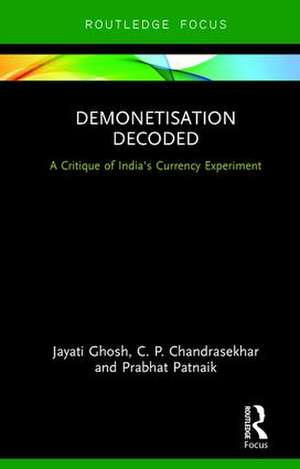
Demonetisation Decoded: A Critique of India's Currency Experiment
Autor Jayati Ghosh, C. P. Chandrasekhar, Prabhat Patnaiken Limba Engleză Hardback – 14 mar 2017
This important book provides a quick and concise explanation of the goals, implications, initial effects and the political economy of this major demonetisation move by the Government of India. It clarifies key concepts and offers astute economic analysis to guide the reader through the various claims, arguments and critiques that have been made; highlights the complexities of the processes that have been unleashed; and examines the likely outcomes in the long term as well as those that are immediately evident.
Timely and lucid, this book will interest students and researchers in the fields of economics, finance, management, law, politics and governance as well as policy makers, legislators, civil society activists and the media.
Preț: 566.74 lei
Preț vechi: 666.75 lei
-15%
Puncte Express: 850
Carte tipărită la comandă
Livrare economică 23 noiembrie-07 decembrie
Livrare prin curier în România Termenul estimat este afișat lângă disponibilitate.
Transport gratuit pentru acest produs Plată online sau ramburs, în funcție de opțiunile comenzii.
Retur gratuit în 14 zile Comandă securizată și suport în română.
Specificații
ISBN-13: 9781138049888
ISBN-10: 1138049883
Pagini: 110
Ilustrații: 1 Line drawings, black and white; 1 Illustrations, black and white
Dimensiuni: 138 x 216 x 13 mm
Greutate: 0.36 kg
Ediția:1
Editura: Taylor & Francis
Colecția Routledge India
Locul publicării:Oxford, United Kingdom
ISBN-10: 1138049883
Pagini: 110
Ilustrații: 1 Line drawings, black and white; 1 Illustrations, black and white
Dimensiuni: 138 x 216 x 13 mm
Greutate: 0.36 kg
Ediția:1
Editura: Taylor & Francis
Colecția Routledge India
Locul publicării:Oxford, United Kingdom
Public țintă
PostgraduateCuprins
1. Introduction 2. The Purported Logic of Demonetisation 3. Design and Implementation of Demonetisation 4. Initial Outcomes 5. Macroeconomic Consequences 6. Inventing a New Utopia 7. Conclusion
Notă biografică
Jayati Ghosh is Professor at the Centre for Economic Studies and Planning, School of Social Sciences, Jawaharlal Nehru University, New Delhi, India.
C. P. Chandrasekhar is Dean, School of Social Sciences, and Professor at the Centre for Economic Studies and Planning, School of Social Sciences, Jawaharlal Nehru University, New Delhi, India.
Prabhat Patnaik is Emeritus Professor at the Centre for Economic Studies and Planning, School of Social Sciences, Jawaharlal Nehru University, New Delhi, India.
C. P. Chandrasekhar is Dean, School of Social Sciences, and Professor at the Centre for Economic Studies and Planning, School of Social Sciences, Jawaharlal Nehru University, New Delhi, India.
Prabhat Patnaik is Emeritus Professor at the Centre for Economic Studies and Planning, School of Social Sciences, Jawaharlal Nehru University, New Delhi, India.
Recenzii
"It is noteworthy for lucidly cutting through the ballyhoo around demonetisation, its intended and actual impact, and flagging the larger risks that this reform experiment—‘where many who have suffered damage still see their experience as necessary pain to be endured for long term gains to the nation’—throws up for India’s democracy."
Vikas Dhoot, The Hindu
Vikas Dhoot, The Hindu
Descriere
On the night of 8 November 2016, at 8:15 pm, India’s Prime Minister, Narendra Modi, announced in a televised broadcast to the nation that with effect from midnight, currency notes of denominations INR 500 and INR 1000 would no longer be legal tender. In one stroke this involved the de-recognition of over 86 per cent of the value of Indian currency in circulation with only four hours’ notice.
This important book provides a quick and concise explanation of the goals, implications, initial effects and the political economy of this major demonetisation move by the Government of India. It clarifies key concepts and offers astute economic analysis to guide the reader through the various claims, arguments and critiques that have been made, highlights the complexities of the processes that have been unleashed, and examines the likely outcomes in the long-term as well as those that are immediately evident.
Timely and lucid, this book will interest students and researchers in the fields of economics, finance, management, law, politics and governance, besides appealing to the interested general reader, policymakers, legislators, civil society activists, and media.
This important book provides a quick and concise explanation of the goals, implications, initial effects and the political economy of this major demonetisation move by the Government of India. It clarifies key concepts and offers astute economic analysis to guide the reader through the various claims, arguments and critiques that have been made, highlights the complexities of the processes that have been unleashed, and examines the likely outcomes in the long-term as well as those that are immediately evident.
Timely and lucid, this book will interest students and researchers in the fields of economics, finance, management, law, politics and governance, besides appealing to the interested general reader, policymakers, legislators, civil society activists, and media.