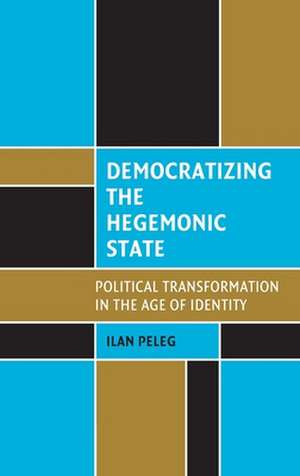
Democratizing the Hegemonic State
Autor Ilan Pelegen Limba Engleză Hardback – 11 oct 2007
Preț: 442.86 lei
Puncte Express: 664
Carte tipărită la comandă
Livrare economică 20 iulie-03 august
Livrare prin curier în România Termenul estimat este afișat lângă disponibilitate.
Transport gratuit pentru acest produs Plată online sau ramburs, în funcție de opțiunile comenzii.
Retur gratuit în 14 zile Comandă securizată și suport în română.
Specificații
ISBN-13: 9780521880886
ISBN-10: 0521880882
Pagini: 250
Dimensiuni: 161 x 240 x 19 mm
Greutate: 0.59 kg
Ediția:New.
Editura: Cambridge University Press
Locul publicării:New York, United States
ISBN-10: 0521880882
Pagini: 250
Dimensiuni: 161 x 240 x 19 mm
Greutate: 0.59 kg
Ediția:New.
Editura: Cambridge University Press
Locul publicării:New York, United States
V-ar putea interesa
-
 Still the Best HopeDennis PragerPreț: 107.76 lei
 -
 Preț: 107.96 lei
 -
 The EU's Decision Traps: Comparing PoliciesGerda Falkner-14%Preț: 721.96 lei839.48 lei
 -
 -14%Preț: 858.15 lei997.85 lei
 -
 Government AgenciesK. Verhoest-15%Preț: 695.75 lei818.53 lei
 -
 European Politics: Pasts, presents, futuresKlaus H GoetzPreț: 303.88 lei
 -
 Compliance IdeologiesRichard W. WilsonPreț: 299.03 lei
 -
 Contemporary Chinese PoliticsAllen CarlsonPreț: 278.98 lei
 -
 The Politics of Modern Central AmericaFabrice LehoucqPreț: 231.29 lei
 -
 Party Politics and Economic Reform in Africa's DemocraciesM. Anne PitcherPreț: 280.51 lei
 -
 Strangers at the GatesSidney TarrowPreț: 245.49 lei
 -
 The Political Construction of Business InterestsCathie Jo MartinPreț: 261.23 lei
 -
 Preț: 247.50 lei
 -
 Reclaiming Public Ownership: Making Space for Economic DemocracyProfessor Andrew Cumbers-26%Preț: 184.79 lei249.22 lei
Cuprins
1. Ethno-national conflict in multinational polities; 2. The crucial triangle: democracy, statehood, and hegemony in multinational settings; 3. Classifying multinational states; 4. Transforming uninational hegemony in divided societies: the gradual option; 5. Transforming uninational hegemony: mega-constitutional engineering; 6. The reverse trend - sustaining or strengthening ethnic hegemony; 7. Beyond hegemony in deeply divided societies: transforming hegemonic systems; Epilogue: genuine democracy for the 21st century.
Recenzii
'This book contributes to our current understanding of democratisation in the context of ethnic politics. … [it] is a book well worth reading and should be required of any student of ethnic politics and ethnic conflict.' John Ishiyama, Journal of Politics
'Peleg suggests some ways forward; his book is the product of exceptionally wide reading in support of careful analytical thinking, and it deserves attention.' Journal of Communist Studies and Transition Politics
'Peleg suggests some ways forward; his book is the product of exceptionally wide reading in support of careful analytical thinking, and it deserves attention.' Journal of Communist Studies and Transition Politics
Descriere
This book provides a new, comprehensive framework for the examination of majority-minority relations.