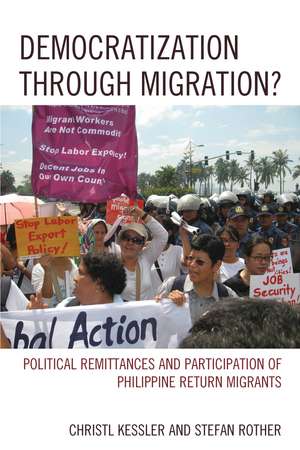
Democratization through Migration?: Political Remittances and Participation of Philippine Return Migrants
Autor Christl Kessler, Stefan Rotheren Limba Engleză Hardback – 10 mar 2016
Research is based on original data: a survey in the Philippines with 2,000 respondents, 37 in-depth interviews with respondents from the sample, and 45 expert interviews serving as background material. The destinations covered are Saudi Arabia, Qatar, UAE, Taiwan, Japan, and Hong Kong.
This book discusses whether labor migration can affect democratization processes and what impact the political order of the host country has on this potential effect. It attests the potential of the migration experience to affect migrants' attitudes towards democracy, thus playing an important role in the support needed for democracies in the stage of consolidation. Our findings suggest that the migration experience may not only lead to a more critical stance towards the political system of the home country; there are also indicators of lesser support for the principles of democracy when compared to migrants about to leave the country for the first time. The political system of the destination as such seems to be a less decisive factor than the specific freedoms and restrictions experienced by migrants and a potential bias when selecting the destination.
Preț: 537.27 lei
Preț vechi: 815.59 lei
-34%
Puncte Express: 806
Carte tipărită la comandă
Livrare economică 01-15 decembrie
Livrare prin curier în România Termenul estimat este afișat lângă disponibilitate.
Transport gratuit pentru acest produs Plată online sau ramburs, în funcție de opțiunile comenzii.
Retur gratuit în 14 zile Comandă securizată și suport în română.
Specificații
ISBN-13: 9781498514217
ISBN-10: 1498514219
Pagini: 196
Ilustrații: 31 Graphs, 2 Tables
Dimensiuni: 159 x 237 x 18 mm
Greutate: 0.43 kg
Editura: Bloomsbury Publishing
Colecția Lexington Books
Locul publicării:New York, United States
ISBN-10: 1498514219
Pagini: 196
Ilustrații: 31 Graphs, 2 Tables
Dimensiuni: 159 x 237 x 18 mm
Greutate: 0.43 kg
Editura: Bloomsbury Publishing
Colecția Lexington Books
Locul publicării:New York, United States
Cuprins
1. Introduction
2. Democratization through Migration? Theoretical Premises
3. Research Design
4. Sample Description
5. Migration experience
6. Political Attitudes of the Return Migrants
7. Conclusion: Migration and Democratization
2. Democratization through Migration? Theoretical Premises
3. Research Design
4. Sample Description
5. Migration experience
6. Political Attitudes of the Return Migrants
7. Conclusion: Migration and Democratization
Recenzii
Christl Kessler and Stephan Rother have provided an exemplary form of this much-needed research in their important and carefully researched Democratizationthrough Migration? Political Remittances andParticipation of Philippine Return Migrants.. Throughout the book Kessler and Rother provide a wealth of data and analysis that will be helpful to students and scholars of migration and democratization. They have also done an admirable job in answering the call for more detailed case studies that can inform these larger debates.
This book presents a convincing narrative on the political socialization of Filipino migrant workers in both democratic and authoritarian host countries, and the extent and ways by which such socialization affects the workers' attitudes towards politics in their home country. It is convincing because it nuances what is obviously a complex nexus: migration and politics. The main strength of the book lies in the mixed quantitative-qualitative research methodology employed by the authors. The book draws largely from surveys among first time and returned migrants, but it also allows the migrants' voices to speak for themselves. It is this combination of data and voice that makes the reader pay close attention to every page. Throughout the book there are tables and figures, as well as vignettes of real-life stories and first-person accounts. The 'respondents' thus come to life and the reader is provided with a fascinating, broad picture of transnationalism, not just of migrant work but also of political ideas and values. The research design is thorough from start to finish. The theoretical assumptions of the authors are carefully laid out in the first chapter and are backed by a comprehensive literature review on a range of pertinent topics. . . .In addition, the development of the research design.is convincingly explained which further strengthens the book's credibility. The outcomes of the research are clearly useful.
Kessler and Rother with their study contributed a piece to the puzzle, and at the same time paved the way for much more work that needs to be done at the intersection of migration and democra-tization research.
Much has been written about the economic effects of international migration but less is known about its political impact. In this highly original work the authors gauge the relationship between migration and democratization in the Philippines and their findings are original and quite surprising. The relationship is more tenuous and nuanced than we might expect. But the subject is vast and this work marks the beginning of what will become a growth field focused on migration and political development. I highly recommend this book.
This book presents a convincing narrative on the political socialization of Filipino migrant workers in both democratic and authoritarian host countries, and the extent and ways by which such socialization affects the workers' attitudes towards politics in their home country. It is convincing because it nuances what is obviously a complex nexus: migration and politics. The main strength of the book lies in the mixed quantitative-qualitative research methodology employed by the authors. The book draws largely from surveys among first time and returned migrants, but it also allows the migrants' voices to speak for themselves. It is this combination of data and voice that makes the reader pay close attention to every page. Throughout the book there are tables and figures, as well as vignettes of real-life stories and first-person accounts. The 'respondents' thus come to life and the reader is provided with a fascinating, broad picture of transnationalism, not just of migrant work but also of political ideas and values. The research design is thorough from start to finish. The theoretical assumptions of the authors are carefully laid out in the first chapter and are backed by a comprehensive literature review on a range of pertinent topics. . . .In addition, the development of the research design.is convincingly explained which further strengthens the book's credibility. The outcomes of the research are clearly useful.
Kessler and Rother with their study contributed a piece to the puzzle, and at the same time paved the way for much more work that needs to be done at the intersection of migration and democra-tization research.
Much has been written about the economic effects of international migration but less is known about its political impact. In this highly original work the authors gauge the relationship between migration and democratization in the Philippines and their findings are original and quite surprising. The relationship is more tenuous and nuanced than we might expect. But the subject is vast and this work marks the beginning of what will become a growth field focused on migration and political development. I highly recommend this book.