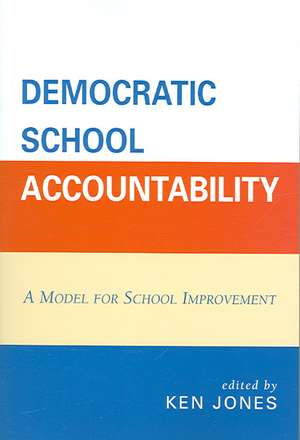
Democratic School Accountability: A Model for School Improvement
Editat de Ken Jones Contribuţii de Barnett Berry, George H. Entwistle, Norm Fruchter, Michael Fryda, Delwyn L. Harnisch, Mitzi Hoback, Darin Kelberlau, Kavitha Mediratta, Monty Neill, Katharine Pence, Patrick Phillips, Melody J. Shank, Ronald Shope, Jean Whitneyen Limba Engleză Paperback – 8 iun 2006
Preț: 352.72 lei
Preț vechi: 462.06 lei
-24%
Puncte Express: 529
Carte tipărită la comandă
Livrare economică 16-30 noiembrie
Livrare prin curier în România Termenul estimat este afișat lângă disponibilitate.
Transport gratuit de la 400.00 lei Plată online sau ramburs, în funcție de opțiunile comenzii.
Retur gratuit în 14 zile Comandă securizată și suport în română.
Specificații
ISBN-13: 9781578864638
ISBN-10: 1578864631
Pagini: 272
Dimensiuni: 177 x 227 x 20 mm
Greutate: 0.42 kg
Editura: Bloomsbury Publishing
Colecția R&L Education
Locul publicării:New York, United States
ISBN-10: 1578864631
Pagini: 272
Dimensiuni: 177 x 227 x 20 mm
Greutate: 0.42 kg
Editura: Bloomsbury Publishing
Colecția R&L Education
Locul publicării:New York, United States
Cuprins
Part 1 Foreword
Part 2 Introduction: Raising Schools
Chapter 3 A New Model for School Accountability
Chapter 4 Connecting High-Quality Local Assessment to Teacher Leadership
Chapter 5 Opportunities to Learn: Beyond Access to Engagement
Chapter 6 Teacher Quality and the Teaching Profession: New Messages, New Messengers
Chapter 7 School Capacity: Organizing for High Standards and Continuous Learning
Chapter 8 Bottom-Up Accountability: An Urban Perspective
Chapter 9 The Accreditation Process: An Inside/Outside School Quality Review System
Chapter 10 A Local Accountability System in Progress
Chapter 11 A Question of Balance: State Oversight vs. Local Ownership
Chapter 12 Thinking Ahead
Part 2 Introduction: Raising Schools
Chapter 3 A New Model for School Accountability
Chapter 4 Connecting High-Quality Local Assessment to Teacher Leadership
Chapter 5 Opportunities to Learn: Beyond Access to Engagement
Chapter 6 Teacher Quality and the Teaching Profession: New Messages, New Messengers
Chapter 7 School Capacity: Organizing for High Standards and Continuous Learning
Chapter 8 Bottom-Up Accountability: An Urban Perspective
Chapter 9 The Accreditation Process: An Inside/Outside School Quality Review System
Chapter 10 A Local Accountability System in Progress
Chapter 11 A Question of Balance: State Oversight vs. Local Ownership
Chapter 12 Thinking Ahead
Recenzii
Better schools and real accountability are indeed possible and necessary. But we cannot achieve this through threats, bribes or fixation on testing. In Democratic School Accountability, Ken Jones and his co-authors give voice to caring educators and offer a sensible and promising alternative to the prevailing and wrong-headed policies. It's about time.
We owe our students and our teachers something better than what is done through high-stakes, standardized testing schemes of accountability. Our students and our teachers deserve something that measures learning, provides immediate and empowering feedback, and something that is part of a systemic approach to improvement that leads from the classroom up and the classroom out and is supported and celebrated as the center of the real work of accountability. Dr. Jones' model is one every school should consider and the book is a must read for all leaders of learning-teachers, principals, superintendents and policy leaders.
This is just the book we need to start the discussion we've not been engaged in: accountable for what? In this modest-but critically important-book we have the chance to explore this from the bottom up and the top down. What a relief, and how thought-provoking. Each chapter builds upon the last, culminating in a different but eminently practical way of opening up new possibilities.
Jones and co-authors describe a new model for school accountability that provides a more nuanced alternative to the present system of using high-stakes testing. ... Particular emphasis is placed on the importance of schools being held accountable to their primary stakeholders: students, parents, and the local community.
Those who care about improving public education should read this book. In contrast to much of what passes for 'accountability' these days, it paints a vivid, on-the-ground picture of the kind of system that could provide a 'full, complex, and high-resolution picture' of how schools are actually doing-and help them support rich and rigorous learning for all of their students.
We owe our students and our teachers something better than what is done through high-stakes, standardized testing schemes of accountability. Our students and our teachers deserve something that measures learning, provides immediate and empowering feedback, and something that is part of a systemic approach to improvement that leads from the classroom up and the classroom out and is supported and celebrated as the center of the real work of accountability. Dr. Jones' model is one every school should consider and the book is a must read for all leaders of learning-teachers, principals, superintendents and policy leaders.
This is just the book we need to start the discussion we've not been engaged in: accountable for what? In this modest-but critically important-book we have the chance to explore this from the bottom up and the top down. What a relief, and how thought-provoking. Each chapter builds upon the last, culminating in a different but eminently practical way of opening up new possibilities.
Jones and co-authors describe a new model for school accountability that provides a more nuanced alternative to the present system of using high-stakes testing. ... Particular emphasis is placed on the importance of schools being held accountable to their primary stakeholders: students, parents, and the local community.
Those who care about improving public education should read this book. In contrast to much of what passes for 'accountability' these days, it paints a vivid, on-the-ground picture of the kind of system that could provide a 'full, complex, and high-resolution picture' of how schools are actually doing-and help them support rich and rigorous learning for all of their students.