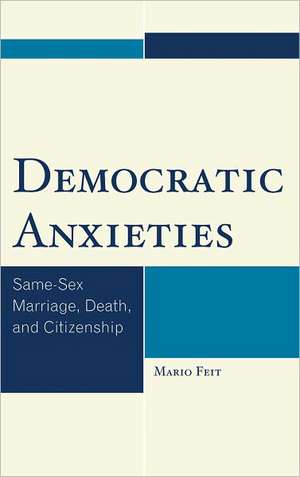
Democratic Anxieties: Same-Sex Marriage, Death, and Citizenship
Autor Mario Feiten Limba Engleză Hardback – 15 mar 2011
Preț: 594.98 lei
Preț vechi: 910.83 lei
-35%
Puncte Express: 892
Carte tipărită la comandă
Livrare economică 04-18 decembrie
Livrare prin curier în România Termenul estimat este afișat lângă disponibilitate.
Transport gratuit pentru acest produs Plată online sau ramburs, în funcție de opțiunile comenzii.
Retur gratuit în 14 zile Comandă securizată și suport în română.
Specificații
ISBN-13: 9780739149867
ISBN-10: 0739149865
Pagini: 195
Dimensiuni: 163 x 239 x 19 mm
Greutate: 0.48 kg
Editura: Bloomsbury Publishing
Colecția Lexington Books
Locul publicării:New York, United States
ISBN-10: 0739149865
Pagini: 195
Dimensiuni: 163 x 239 x 19 mm
Greutate: 0.48 kg
Editura: Bloomsbury Publishing
Colecția Lexington Books
Locul publicării:New York, United States
Cuprins
1 Introduction: Same-Sex Marriage, Extinction, and Citizenship
2 Chapter 1: Jean-Jacques Rousseau's Anxious Democracy
3 Chapter 2: Hannah Arendt and Political Immortality
4 Chapter 3: Affirming Death: Friedrich Nietzsche On Creating a Future
5 Conclusion
2 Chapter 1: Jean-Jacques Rousseau's Anxious Democracy
3 Chapter 2: Hannah Arendt and Political Immortality
4 Chapter 3: Affirming Death: Friedrich Nietzsche On Creating a Future
5 Conclusion
Recenzii
Feit discovers heteronormativity in Rousseau's account of citizenship, suggesting he employs unease about death as a way to direct the sexuality of citizens toward reproduction, which allows the community to continue and to express consent. Feit's Hannah Arendt rejects this heteronormativity but does not overcome the anxiety about death that gives rise to it, thus leaving entire areas of life separate from politics. Feit's Nietzsche promotes a pluralism that lacks the anxieties of Rousseau or Arendt, accepts death, and allows for what Feit calls 'queer forms of reproduction.' His discussions of Rousseau, Arendt, and Nietzsche are ministerial to his engagement with contemporary queer theory and the question of same-sex marriage and citizenship. The strength of Feit's work ultimately lies in his own engagements with queer theory, and the true value of the book is the originality of his account of the disagreement over same-sex marriage, which could have been expanded. Best for advanced students and scholars working on questions of citizenship and same-sex marriage; the book may be too theoretically advanced for undergraduates.
Rare is the book that prompts one to rethink the entire scholarly enterprise of political theory. Mario Feit's Democratic Anxieties-breaking with prevailing academic camps and conventions in order to explore democracy's intertwining fears about sex and death-is just such a book, both pioneering and profound.
Mario Feit engages debates about same-sex marriage and queer families as a way into thinking about the existential dimension of democratic politics. While his original and provocative readings of Rousseau, Nietzsche and Arendt will be of special interest to scholars in political theory, philosophy and intellectual history. Democratic Anxieties addresses fundamental concerns about gender, sexuality, faith, secularism and the future of democracy.
Democratic Anxieties is an interesting and timely book on an important issue. Displaying an admirable balance between advocacy and analysis, Feit brings considerable scholarship to bear on the topic, offering some new and unexpected readings of canonical texts in the process. Refreshingly free from jargon and neologisms, the book is clearly argued and judicious in its presentation of positions with which it disagrees. Feit's work is a telling reminder that these are ongoing issues worthy of sustained reflection and debate, and readers of Democratic Anxieties will undoubtedly come to think about them in new light.
Rare is the book that prompts one to rethink the entire scholarly enterprise of political theory. Mario Feit's Democratic Anxieties-breaking with prevailing academic camps and conventions in order to explore democracy's intertwining fears about sex and death-is just such a book, both pioneering and profound.
Mario Feit engages debates about same-sex marriage and queer families as a way into thinking about the existential dimension of democratic politics. While his original and provocative readings of Rousseau, Nietzsche and Arendt will be of special interest to scholars in political theory, philosophy and intellectual history. Democratic Anxieties addresses fundamental concerns about gender, sexuality, faith, secularism and the future of democracy.
Democratic Anxieties is an interesting and timely book on an important issue. Displaying an admirable balance between advocacy and analysis, Feit brings considerable scholarship to bear on the topic, offering some new and unexpected readings of canonical texts in the process. Refreshingly free from jargon and neologisms, the book is clearly argued and judicious in its presentation of positions with which it disagrees. Feit's work is a telling reminder that these are ongoing issues worthy of sustained reflection and debate, and readers of Democratic Anxieties will undoubtedly come to think about them in new light.