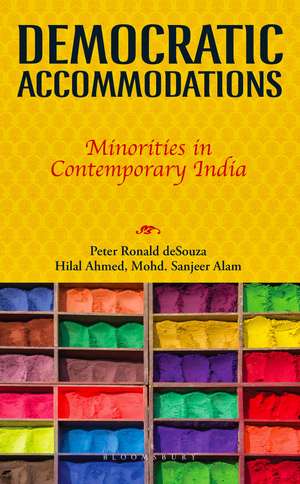
Democratic Accommodations: Minorities in Contemporary India: Bloomsbury Academic India
Autor Professor Peter Ronald deSouza, Hilal Ahmed, Mohd. Sanjeer Alamen Limba Engleză Hardback – 18 aug 2019
Remarcăm în Democratic Accommodations o abordare interdisciplinară riguroasă, situată la intersecția dintre științele politice, sociologia dreptului și istoria modernă. Lucrarea nu se limitează la o descriere a peisajului etnic indian, ci analizează modul în care cadrele legale și instituționale pot gestiona revendicările minorităților într-o democrație care refuză tentația majoritarismului. Această perspectivă extinde cadrul propus de Democracy and National Pluralism de Ferran Requejo cu date noi din spațiul sud-asiatic, oferind o alternativă non-occidentală la dezbaterea globală despre multiculturalism.
Autorii, cercetători reputați la CSDS New Delhi, continuă explorarea temelor identitare prezente în alte lucrări de referință. Dacă Keywords for India cartografia teremenii esențiali ai spațiului public, volumul de față aplică acești concepte pe o structură analitică clară. Progresia textului este logică și cuprinzătoare: pornește de la geneza conceptului de „minoritate” în perioada colonială, explorează politicile de acomodare post-1947 și culminează cu o analiză critică a inițiativelor actuale. Descoperim aici un argument solid pentru ideea că fiecare democrație plurală trebuie să își dezvolte propria matrice de politici, adaptată dinamicii interne.
Spre deosebire de Muslim Minorities in Europe & India de Anwar Alam, care se concentrează pe integrarea unei singure comunități, Democratic Accommodations oferă un instrumentar teoretic mai larg, aplicabil diversității lingvistice și religioase în ansamblul ei. Tonul este unul academic precis, evitând generalizările și ancorând fiecare concluzie în evoluția instituțională a Indiei. Este o resursă esențială pentru înțelegerea modului în care democrația poate supraviețui și prospera prin recunoașterea, nu prin uniformizarea diferențelor.
Din seria Bloomsbury Academic India
- 32%
 Preț: 564.07 lei
 - 33%
 Preț: 551.02 lei
 - 33%
 Preț: 548.03 lei
 - 32%
 Preț: 561.97 lei
 - 33%
 Preț: 550.47 lei
 - 32%
 Preț: 565.35 lei
 - 33%
 Preț: 551.26 lei
 - 30%
 Preț: 97.52 lei
 - 32%
 Preț: 568.34 lei
 - 32%
 Preț: 551.25 lei
 - 32%
 Preț: 562.31 lei
 - 33%
 Preț: 548.52 lei
 - 32%
 Preț: 555.13 lei
 - 32%
 Preț: 563.52 lei
 - 33%
 Preț: 551.53 lei
 - 32%
 Preț: 563.88 lei
 - 32%
 Preț: 552.38 lei
 - 33%
 Preț: 548.91 lei
 - 33%
 Preț: 550.16 lei
 - 33%
 Preț: 550.68 lei
 - 33%
 Preț: 549.68 lei
 - 32%
 Preț: 555.52 lei
 - 33%
 Preț: 550.86 lei
 - 33%
 Preț: 548.52 lei
 - 33%
 Preț: 559.40 lei
 - 33%
 Preț: 549.74 lei
 - 32%
 Preț: 561.17 lei
 - 32%
 Preț: 551.25 lei
 - 33%
 Preț: 550.47 lei
 - 32%
 Preț: 551.86 lei
 - 32%
 Preț: 562.36 lei
 - 33%
 Preț: 548.91 lei
 - 33%
 Preț: 558.37 lei
 - 33%
 Preț: 548.32 lei
 - 33%
 Preț: 556.93 lei
 - 33%
 Preț: 551.34 lei
 - 32%
 Preț: 565.96 lei
 - 33%
 Preț: 551.65 lei
 - 33%
 Preț: 550.68 lei
 - 33%
 Preț: 558.37 lei
 - 32%
 Preț: 552.03 lei
 - 33%
 Preț: 551.25 lei
 - 32%
 Preț: 565.77 lei
 - 33%
 Preț: 548.91 lei
 - 33%
 Preț: 552.19 lei
 - nou
 Preț: 547.03 lei
 - nou
 Preț: 443.40 lei
 - nou
 Preț: 135.86 lei
 - nou
 Preț: 548.80 lei
Preț: 549.31 lei
Preț vechi: 818.25 lei
-33%
Carte disponibilă
Livrare economică 04-18 noiembrie
Specificații
ISBN-10: 9388414551
Pagini: 200
Dimensiuni: 142 x 224 x 18 mm
Greutate: 0.4 kg
Editura: Bloomsbury Publishing
Colecția Bloomsbury Academic India
Seria Bloomsbury Academic India
Locul publicării:New Delhi, India
De ce să citești această carte
Recomandăm această lucrare studenților și cercetătorilor în științe politice care doresc să înțeleagă complexitatea democrației indiene dincolo de clișee. Cititorul câștigă o perspectivă comparativă valoroasă asupra modului în care instituțiile pot media conflictele identitare. Este un argument convingător pentru relevanța modelului indian în contextul crizelor actuale de integrare din Europa, oferind soluții concrete pentru politici publice incluzive.
Descriere
The authors have endorsed the argument that all plural democracies-and all democracies can only be plural in the present historical conjuncture despite the attempts by regimes to make them majoritarian-must work out their own strategies of accommodation by evolving a policy matrix that is suited to the dynamics of their own societies. The book is organised along four rubrics-laws, institutions, policies and political discourse-to understand Indian democracy's distinct response to diversity. The rich and nuanced exploration of the Indian approach to the minority question presented in this book will advance the international debate on diversity and multiculturalism and help policymakers in pluralistic democracies to develop their own particular strategies to deal with minority claims.
Cuprins
1. Introduction: Pluralism and Democracy
2. The Emerging Idea of the Minority in Colonial India
3. The Politics of Minority Accommodation in Postcolonial India
4. Policy Initiatives for Minorities
5. Conclusion: Learnings from India