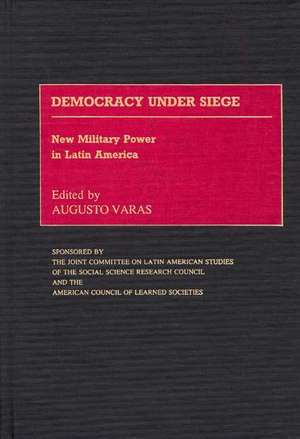
Democracy Under Siege
Editat de Augusto Varasen Limba Engleză Hardback – 7 iul 1989
Collectively, the contributors contend that although civilian democratic forces will play a much larger role in political decisionmaking in this decade as compared to the last, it is evident that armed forces will retain a considerable share of political power. Regardless of the institutional arrangement, the military will continue to exercise significant veto power over civilian political forces. The independent military that has emerged is a new variable that must be taken into account in future analyses of Latin America's secular political crisis. By compiling the first complete analysis of Latin American military forces and their role in contemporary domestic politics, editor Augusto Varas has made a significant contribution to the study of Latin American politics. This first examination of the role of the armed forces during a period of relative political stability will be welcomed by historians and political scientists alike.
Preț: 489.21 lei
Preț vechi: 700.47 lei
-30%
Puncte Express: 734
Carte tipărită la comandă
Livrare economică 23 decembrie 26 - 06 ianuarie 27
Livrare prin curier în România Termenul estimat este afișat lângă disponibilitate.
Transport gratuit pentru acest produs Plată online sau ramburs, în funcție de opțiunile comenzii.
Retur gratuit în 14 zile Comandă securizată și suport în română.
Specificații
ISBN-13: 9780313260346
ISBN-10: 0313260346
Pagini: 234
Dimensiuni: 161 x 240 x 17 mm
Greutate: 0.47 kg
Editura: Praeger
ISBN-10: 0313260346
Pagini: 234
Dimensiuni: 161 x 240 x 17 mm
Greutate: 0.47 kg
Editura: Praeger
V-ar putea interesa
-
 Armies Of GodDominic GreenPreț: 116.95 lei
-
 AnglerBarton GellmanPreț: 144.82 lei
-
 Brazil on the RiseLarry RohterPreț: 123.35 lei
-
 Carl Schmitt: Politics and TheoryPaul Edward Gottfried-29%Preț: 641.24 lei902.07 lei
-
 -25%Preț: 517.12 lei691.81 lei
-
 The Origins of Political OrderFrancis FukuyamaPreț: 137.90 lei
-
 The Big ShortMichael LewisPreț: 94.04 lei
-
 The Politics of Military OccupationPeter M R Stirk-15%Preț: 214.98 lei251.91 lei
-
 Border PoliticsNick Vaughan-Williams-16%Preț: 183.02 lei219.07 lei
-
 Zizek and Communist StrategyChris Mcmillan-24%Preț: 613.77 lei808.27 lei
-
 Addicted to ProfitStuart Sim-24%Preț: 270.20 lei354.48 lei
-
 Race, Nation, ClassEtienne BalibarPreț: 91.96 lei
Descriere
Although the military has historically played a pivotal role in Latin American politics and society, until now little attention has been paid to the complex set of civilian-military relations in each country. This collection of essays, the product of a long-term research program organized by a group of prominent Latin American scholars, compares current linkages among the armed forces and local social and political structures and institutions. Within each nation studied, the contributing author found increasing military autonomy vis-a-vis the state. They show that this institutional autonomy has allowed the military to develop as independent political entities within the various countries, a process that seems to be common to all Latin American societies. Their research also demonstrates how the military diversifies itself when acquiring higher degrees of institutional autonomy.
Collectively, the contributors contend that although civilian democratic forces will play a much larger role in political decisionmaking in this decade as compared to the last, it is evident that armed forces will retain a considerable share of political power. Regardless of the institutional arrangement, the military will continue to exercise significant veto power over civilian political forces. The independent military that has emerged is a new variable that must be taken into account in future analyses of Latin America's secular political crisis. By compiling the first complete analysis of Latin American military forces and their role in contemporary domestic politics, editor Augusto Varas has made a significant contribution to the study of Latin American politics. This first examination of the role of the armed forces during a period of relative political stability will be welcomed by historians and political scientists alike.
Collectively, the contributors contend that although civilian democratic forces will play a much larger role in political decisionmaking in this decade as compared to the last, it is evident that armed forces will retain a considerable share of political power. Regardless of the institutional arrangement, the military will continue to exercise significant veto power over civilian political forces. The independent military that has emerged is a new variable that must be taken into account in future analyses of Latin America's secular political crisis. By compiling the first complete analysis of Latin American military forces and their role in contemporary domestic politics, editor Augusto Varas has made a significant contribution to the study of Latin American politics. This first examination of the role of the armed forces during a period of relative political stability will be welcomed by historians and political scientists alike.
Notă biografică
AUGUSTO VARAS is a Chilean political sociologist and international relations analyst at the Facultad Latinoamericana de Ciencias Sociales (FLASCO) in Santiago, Chile. He is director of the Latin American Center for Defense and Disarmament (CLADDE) and author of Militarization and the International Arms Race in Latin America and Latin American-Soviet Relations in the 1980s.