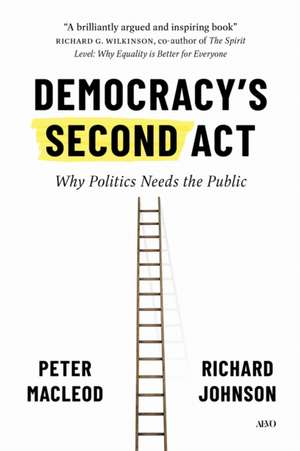
Democracy's Second ACT
Autor Peter MacLeod, Richard Johnsonen Limba Engleză Hardback – 10 feb 2026
In Democracy’s Second Act, Peter MacLeod and Richard Johnson argue that the first act of democracy – anchored in voting rights and representative government – achieved extraordinary gains. Free elections, near-universal suffrage, and the peaceful transfer of power reshaped societies and expanded human freedom. But these achievements represent the promise of democracy, not its completion.
Their book offers a hopeful, clear-eyed vision for what comes next. Drawing on groundbreaking citizens’ assemblies in Ireland, Canada, and France – as well as democratic innovations from more than a dozen countries – MacLeod and Johnson show how we can build on the legacy of the first act by creating new institutions that tap into the talents, judgement, and capabilities of ordinary people. They make the case that the public isn’t a risk to be managed, but a powerful resource ready to be harnessed and that the future depends on giving citizens real responsibility, not just a periodic vote.
Smart, story-driven, and deeply grounded in political theory and practice, Democracy’s Second Act is for changemakers ready to move beyond cynicism and rebuild democracy for a new era.
Preț: 195.67 lei
Puncte Express: 294
Carte disponibilă
Livrare economică 14-28 noiembrie
Livrare express 31 octombrie-06 noiembrie pentru 33.36 lei
Livrare prin curier în România Termenul estimat este afișat lângă disponibilitate.
Transport gratuit de la 400.00 lei Plată online sau ramburs, în funcție de opțiunile comenzii.
Retur gratuit în 14 zile Comandă securizată și suport în română.
Specificații
ISBN-13: 9781487517137
ISBN-10: 1487517130
Pagini: 312
Dimensiuni: 152 x 232 x 28 mm
Greutate: 0.5 kg
Editura: University of Toronto Press
ISBN-10: 1487517130
Pagini: 312
Dimensiuni: 152 x 232 x 28 mm
Greutate: 0.5 kg
Editura: University of Toronto Press
Notă biografică
Peter MacLeod is the founder and principal of MASS LBP, where for nearly two decades he has been at the forefront of democratic innovation championing a new style of politics rooted in deliberation and shared power. A trusted advisor to governments at all levels, he is one of Canada’s leading voices on democracy, civic trust, and active citizenship.
Richard Johnson is a former journalist and current policy director at MASS LBP. His writing has appeared in The Globe and Mail, Toronto Star, The Walrus, Reader’s Digest, This Magazine, The New Quarterly, and many others. A former Fellow in Literary Journalism at the Banff Centre for Arts and Creativity, he was also a longtime writer for the award-winning podcast Trailblazers, with Walter Isaacson.
Richard Johnson is a former journalist and current policy director at MASS LBP. His writing has appeared in The Globe and Mail, Toronto Star, The Walrus, Reader’s Digest, This Magazine, The New Quarterly, and many others. A former Fellow in Literary Journalism at the Banff Centre for Arts and Creativity, he was also a longtime writer for the award-winning podcast Trailblazers, with Walter Isaacson.
Cuprins
List of Illustrations
Preface
Introduction: So Much for Our Lofty Ideals
Chapter 1: The War on the Public
Chapter 2: The End of Act 1
Chapter 3: A Tempest and a Teacup
Chapter 4: The New Representatives
Chapter 5: Public Opinions and Its Problems
Chapter 6: Learning in Public
Chapter 7: Civic Challenges
Chapter 8: Democracy by Association
Chapter 9: In the Trenches
Chapter 10: Democracy’s Second Act
Epilogue: Loftier Ideals
Acknowledgments
Notes
Index
Preface
Introduction: So Much for Our Lofty Ideals
Chapter 1: The War on the Public
Chapter 2: The End of Act 1
Chapter 3: A Tempest and a Teacup
Chapter 4: The New Representatives
Chapter 5: Public Opinions and Its Problems
Chapter 6: Learning in Public
Chapter 7: Civic Challenges
Chapter 8: Democracy by Association
Chapter 9: In the Trenches
Chapter 10: Democracy’s Second Act
Epilogue: Loftier Ideals
Acknowledgments
Notes
Index
Descriere
Democracy’s Second Act explores why frustration and polarization are on the rise - and how reclaiming the power of the public can lead to a more hopeful political future.