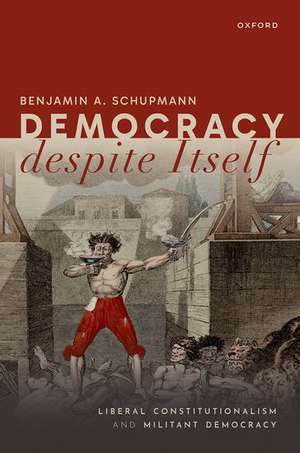
Democracy despite Itself: Liberal Constitutionalism and Militant Democracy
Autor Benjamin A. Schupmannen Limba Engleză Hardback – 30 mai 2024
Preț: 629.78 lei
Preț vechi: 907.31 lei
-31%
Puncte Express: 945
Carte tipărită la comandă
Livrare economică 04-15 decembrie
Livrare prin curier în România Termenul estimat este afișat lângă disponibilitate.
Transport gratuit pentru acest produs Plată online sau ramburs, în funcție de opțiunile comenzii.
Retur gratuit în 14 zile Comandă securizată și suport în română.
Specificații
ISBN-13: 9780192873026
ISBN-10: 0192873024
Pagini: 256
Dimensiuni: 162 x 240 x 18 mm
Greutate: 0.54 kg
Editura: OUP OXFORD
Colecția OUP Oxford
Locul publicării:Oxford, United Kingdom
ISBN-10: 0192873024
Pagini: 256
Dimensiuni: 162 x 240 x 18 mm
Greutate: 0.54 kg
Editura: OUP OXFORD
Colecția OUP Oxford
Locul publicării:Oxford, United Kingdom
Recenzii
How can democracies defend themselves against actors who use perfectly legal means such as elections to destroy democracy? This question has become urgent, and this important book gives a bold and unashamedly liberal answer to it. Anyone concerned with democratic self-defence should consider its claims.
[T]imely and important ... The menacing enemies of democracy are not the barbarians at the gate but those within who share none of the democratic values ... but seek to exploit the openness of electoral mobilization ... In the tradition of militant democracy, Schupmann seeks to merge modern concerns over antidemocratic subversion from within with the broad strokes of political liberalism. As ambitious as it is current.
Schupmann ingeniously grafts Schmittian insights onto Rawls's political liberalism in a brilliant argument on how democracy can best protect itself from inside subversion without betraying its spirit.
Democracy is in peril across the globe. But there is widespread trepidation about how to respond ... Benjamin Schupmann's new book offers a bracing response ... Democracy despite Itself argues that liberal values justify the active, even militant defence of constitutional democracy. Expertly engaging a range of thinkers and thorny real-world political dilemmas, Schupmann's book is a must-read for anyone interested in the fate of constitutional democracy.
Democracy despite Itself systematically and innovatively unpacks the problem of "democratic cannibalism" and proposes strategies to confront various anti-democratic challengers, making it essential reading for undergraduate and graduate courses in democracy theory and normative IR theory. While classical liberals in the Kelsenian tradition, including this reviewer, may raise eyebrows-especially regarding the book's Schmittian approach-and argue that countering anti-democratic forces should primarily occur through political rather than legal means, this debate revolves around relative priorities.
The book is particularly interesting for its attempt to offer a new founding rationale for some essential tools for the defense of democracy.
This text makes an important contribution to a vital issue facing democratic societies today. It is a sophisticated argument, but it is clearly set out, and the writing should be accessible to advanced undergraduate students. It will certainly be of interest to graduate students, faculty, and educated citizens concerned about the stability and effectiveness of democracy at this time.
Schupmann's book counts as a major contribution to the debateon militant democracy. It confronts the existing literature in interesting ways. Schupmann mobilizes his work in interesting and novel ways. The argument in favor of a more comprehensive toolkit for militant democracy and, particularly, the focus on unamendability is refreshing. The book as it stands is an important contribution to the debate and a stepping stone for further research.
Benjamin Schupmann bets on militant Democracy... Schupmann offers a much needed justification of militant democracy, based on liberal political philosophy. He combines John Rawls' ideas with certain critical concerns of Carl Schmitt...[T]his encounter results in creative tension.
If you thought militant democracy was dead, think again. Ben Schupmann's new proposal seems capable of reviving its wrinkled old corpse... Full disclosure: Schupmann's criticism of my own historicist approach...is devastating... [H]e has managed to provide some bold justifications and to fix key intuitions for the coming battles.
Democracy despite Itself is commendable on many grounds. The book is rigorous, accessible, and comprehensive, above all in articulating its reservations about prevailing tendencies within militant democracy and democratic theory scholarship. In addition, it features frequent and well-chosen empirical examples that help clarify the political stakes of the theoretical argument. Schupmann is also attentive and fair in presenting counterarguments, meaning that critics of militant democracy will find his account both generative and difficult to dismiss. Finally, Schupmann's prioritization of liberalbasic rights to resolve militant democracy's normativeparadoxes is creative and constitutes a clear as well aspolitically salient contribution to scholarship on thesubject.
Democracy Despite Itself will be mandatory reading for students of militant democracy for a long time to come.
Democracy despite Itself presents a bold and uncompromising vision of militant democracy, one that seeks to meet the urgency of contemporary threats with an equally forceful institutional response. Schupmann's theory offers valuable insights, especially his critique of procedural neutrality and the need for early intervention.
But if this is the democracy we are to defend, then one must ask: is it not this very legal construction, this geometry of neutralisation, that has paved the way for extremism to enter the public sphere? ... [Democracy despite Itself] is an excellent map of the debate, a useful tool for anyone seeking to familiarise themselves with the forms taken by militant democracy.
[T]imely and important ... The menacing enemies of democracy are not the barbarians at the gate but those within who share none of the democratic values ... but seek to exploit the openness of electoral mobilization ... In the tradition of militant democracy, Schupmann seeks to merge modern concerns over antidemocratic subversion from within with the broad strokes of political liberalism. As ambitious as it is current.
Schupmann ingeniously grafts Schmittian insights onto Rawls's political liberalism in a brilliant argument on how democracy can best protect itself from inside subversion without betraying its spirit.
Democracy is in peril across the globe. But there is widespread trepidation about how to respond ... Benjamin Schupmann's new book offers a bracing response ... Democracy despite Itself argues that liberal values justify the active, even militant defence of constitutional democracy. Expertly engaging a range of thinkers and thorny real-world political dilemmas, Schupmann's book is a must-read for anyone interested in the fate of constitutional democracy.
Democracy despite Itself systematically and innovatively unpacks the problem of "democratic cannibalism" and proposes strategies to confront various anti-democratic challengers, making it essential reading for undergraduate and graduate courses in democracy theory and normative IR theory. While classical liberals in the Kelsenian tradition, including this reviewer, may raise eyebrows-especially regarding the book's Schmittian approach-and argue that countering anti-democratic forces should primarily occur through political rather than legal means, this debate revolves around relative priorities.
The book is particularly interesting for its attempt to offer a new founding rationale for some essential tools for the defense of democracy.
This text makes an important contribution to a vital issue facing democratic societies today. It is a sophisticated argument, but it is clearly set out, and the writing should be accessible to advanced undergraduate students. It will certainly be of interest to graduate students, faculty, and educated citizens concerned about the stability and effectiveness of democracy at this time.
Schupmann's book counts as a major contribution to the debateon militant democracy. It confronts the existing literature in interesting ways. Schupmann mobilizes his work in interesting and novel ways. The argument in favor of a more comprehensive toolkit for militant democracy and, particularly, the focus on unamendability is refreshing. The book as it stands is an important contribution to the debate and a stepping stone for further research.
Benjamin Schupmann bets on militant Democracy... Schupmann offers a much needed justification of militant democracy, based on liberal political philosophy. He combines John Rawls' ideas with certain critical concerns of Carl Schmitt...[T]his encounter results in creative tension.
If you thought militant democracy was dead, think again. Ben Schupmann's new proposal seems capable of reviving its wrinkled old corpse... Full disclosure: Schupmann's criticism of my own historicist approach...is devastating... [H]e has managed to provide some bold justifications and to fix key intuitions for the coming battles.
Democracy despite Itself is commendable on many grounds. The book is rigorous, accessible, and comprehensive, above all in articulating its reservations about prevailing tendencies within militant democracy and democratic theory scholarship. In addition, it features frequent and well-chosen empirical examples that help clarify the political stakes of the theoretical argument. Schupmann is also attentive and fair in presenting counterarguments, meaning that critics of militant democracy will find his account both generative and difficult to dismiss. Finally, Schupmann's prioritization of liberalbasic rights to resolve militant democracy's normativeparadoxes is creative and constitutes a clear as well aspolitically salient contribution to scholarship on thesubject.
Democracy Despite Itself will be mandatory reading for students of militant democracy for a long time to come.
Democracy despite Itself presents a bold and uncompromising vision of militant democracy, one that seeks to meet the urgency of contemporary threats with an equally forceful institutional response. Schupmann's theory offers valuable insights, especially his critique of procedural neutrality and the need for early intervention.
But if this is the democracy we are to defend, then one must ask: is it not this very legal construction, this geometry of neutralisation, that has paved the way for extremism to enter the public sphere? ... [Democracy despite Itself] is an excellent map of the debate, a useful tool for anyone seeking to familiarise themselves with the forms taken by militant democracy.
Notă biografică
Benjamin A. Schupmann is an Assistant Professor in the Division of Social Sciences (Philosophy, Politics, and Economics) at Yale-NUS College in Singapore, where he has worked since August 2020. Prior to that, he was an Assistant Professor at Duke Kunshan University in Kunshan, China. He obtained his PhD in Political Science (Political Theory) from Columbia University in the City of New York in 2015. He is the author of Carl Schmitt's State and Constitutional Theory: A Critical Analysis, published by Oxford University Press in 2017.