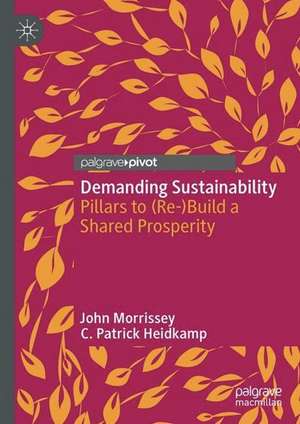
Demanding Sustainability
Autor John Morrissey, C. Patrick Heidkampen Limba Engleză Hardback – 10 noi 2022
Preț: 338.55 lei
Puncte Express: 508
Carte tipărită la comandă
Livrare economică 06-20 iunie
Specificații
ISBN-13: 9783031189579
ISBN-10: 3031189574
Pagini: 148
Ilustrații: XXIII, 124 p. 10 illus., 1 illus. in color.
Dimensiuni: 153 x 216 x 13 mm
Greutate: 0.31 kg
Ediția:1st ed. 2022
Editura: Springer
Locul publicării:Cham, Switzerland
ISBN-10: 3031189574
Pagini: 148
Ilustrații: XXIII, 124 p. 10 illus., 1 illus. in color.
Dimensiuni: 153 x 216 x 13 mm
Greutate: 0.31 kg
Ediția:1st ed. 2022
Editura: Springer
Locul publicării:Cham, Switzerland
Cuprins
Chapter 1. Introduction.- Chapter 2. An ecological prosperity (pillar one).- Chapter 3. decarbonized economy (pillar two).- Chapter 4. A shared (cost) burden (pillar three).- Chapter 5.A transformative social sustainability (pillar four) .- Chapter 6. A just resilience (pillar five).- Chapter 7. Implementing the pillars: towards shared sustainable prosperity.- Chapter 8. Conclusions.
Textul de pe ultima copertă
Longer term thinking and new approaches to development and prosperity have never been more urgently required. Since 2020, the precarity of the global economy, links between ecological destruction and public health and disparities in levels of exposure and vulnerability to systemic disruption have all been thrown into stark relief. In this book the authors put forward a series of principles on which economic and development policy for the post-Covid era should be developed. These are outlined as five 'pillars' through which to (re-)build a shared prosperity in the aftermath of the Covid-19 global shock. The five pillars are an ecological prosperity (pillar one), a decarbonized economy (pillar two), a shared (cost) burden (pillar three), a transformative social sustainability (pillar four) and a just resilience (pillar five). The book provides a framework through which policymakers, decision-makers, politicians, community groups and the corporate sphere might begin to consider, map out, and plan for just transitions in their domains.
John Morrissey is a Lecturer in Geography at Mary Immaculate College, University of Limerick, Ireland. John’s research is focused on sustainable development, particularly sustainability transitions, low-carbon development and challenges of the low carbon economy for urban and coastal communities. His work is focused on the differentiation of transition processes across space, place and communities. He has taught and researched on sustainability issues in Ireland, The UK, Australia and New Zealand.
C. Patrick Heidkamp is a Professor of Geography in the Department of the Environment, Geography and Marine Sciences at Southern Connecticut State University, USA and an affiliate faculty member at the University Centre of the Westfjords, Iceland. During much of the writing for this volume he was a DAAD (German Academic Exchange Service) supported Guest Professor in the Department of Geography at the University of Cologne. He is an economic geographer with current research interests in sustainability transitions in the coastal zone and transdisciplinary engagement with the Blue Economy.
John Morrissey is a Lecturer in Geography at Mary Immaculate College, University of Limerick, Ireland. John’s research is focused on sustainable development, particularly sustainability transitions, low-carbon development and challenges of the low carbon economy for urban and coastal communities. His work is focused on the differentiation of transition processes across space, place and communities. He has taught and researched on sustainability issues in Ireland, The UK, Australia and New Zealand.
C. Patrick Heidkamp is a Professor of Geography in the Department of the Environment, Geography and Marine Sciences at Southern Connecticut State University, USA and an affiliate faculty member at the University Centre of the Westfjords, Iceland. During much of the writing for this volume he was a DAAD (German Academic Exchange Service) supported Guest Professor in the Department of Geography at the University of Cologne. He is an economic geographer with current research interests in sustainability transitions in the coastal zone and transdisciplinary engagement with the Blue Economy.