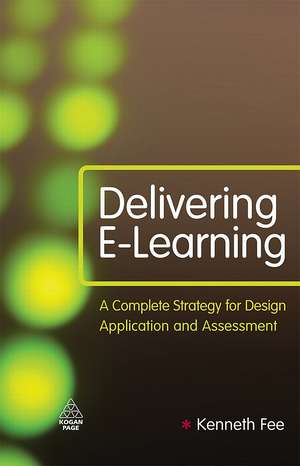
Delivering E–Learning – A Complete Strategy for Design Application and Assessment
Autor Kenneth Feeen Limba Engleză Hardback – 2 apr 2009
Preț: 261.89 lei
Puncte Express: 393
Carte disponibilă
Livrare economică 30 octombrie-13 noiembrie
Livrare express 15-21 octombrie pentru 39.02 lei
Livrare prin curier în România Termenul estimat este afișat lângă disponibilitate.
Transport gratuit de la 400.00 lei Plată online sau ramburs, în funcție de opțiunile comenzii.
Retur gratuit în 14 zile Comandă securizată și suport în română.
Specificații
ISBN-13: 9780749453978
ISBN-10: 0749453974
Pagini: 192
Dimensiuni: 156 x 234 x 17 mm
Greutate: 0.49 kg
Editura: Kogan Page
ISBN-10: 0749453974
Pagini: 192
Dimensiuni: 156 x 234 x 17 mm
Greutate: 0.49 kg
Editura: Kogan Page
V-ar putea interesa
-
 Leadership CoachingFor Coaching AssociationPreț: 323.83 lei
 -
 Cracking the PM InterviewGayle Laakmann McdowellPreț: 227.02 lei
 -
 The Alliance: Managing Talent in the Networked AgeBen CasnochaPreț: 167.97 lei
 -
 Everyone Needs a MentorDavid Clutterbuck-37%Preț: 274.09 lei438.27 lei
Cuprins
Introduction: Learning in the digital age
Katie, Devinder and Sam; Natives and immigrants; Technophiles and technophobes; Learning through the ages; Training and learning; About this book; Introducing the Virtual Round Table; How to use this book
1. Understanding e-learning
Common misconceptions; When research doesn’t help; A working definition; The three components of e-learning; A different approach; The five models of e-learning; E-learning 2.0 and learning 2.0; Summary of key points
2. Advocacy of e-learning
Different thinking; Empowering learners; Expectations and engagement; Benefits of e-learning; E-learning and learning styles; Criteria for choosing an e-learning approach; Influencing people; The paradigm shift; The Impact Matrix; Organization development strategies; Taking the lead; When e-learning is not appropriate; Summary of key points
3. E-learning strategy: development
What ‘strategy’ is not; What I mean by ‘strategy’; Why you need an e-learning strategy; Where to start; Strategic alignment; Project planning; Strategic questions in e-learning; The essential elements of an e-learning strategy statement; Vendor distractions and diversions; Quality-assuring e-learning; Questions to ask yourself; Summary of key points
4. E-learning strategy: suppliers and resources
ICT meets HR; The e-learning industry; Vendors; E-learning standards and specifications; What the technology does; Virtual learning environments; Authoring tools; E-assessment; Specialist software; Wikis, blogs, forums and podcasts; Other useful concepts; E-learning suppliers: identifying, classifying, selecting and managing them; Twenty things to be wary of with vendors; Working to a budget; Summary of key points
5. E-learning strategy: learning design issues
Strategic design; Why design matters; Design for the learner; Design for purpose; The five general principles; Looking at the different models; The route map; Designing live e-learning; Designing self-managed learning; Designing electronic performance support; Micro-design; Summary of key points
6. E-learning strategy: measurement and results
Making a business case; Five different approaches; Kirkpatrick’s four levels; Return on investment; Return on expectation; Six Sigma; Total value-add; Is e-learning different?; An evaluation checklist; Summary of key points
7. Learning more about e-learning
Personal experience; Self-development; A source of further learning; General reference; Learning in the digital age; Understanding e-learning; Advocacy of e-learning; E-learning strategy: development; E-learning strategy: suppliers and resources; E-learning strategy: learning design issues; E-learning strategy: measurement and results; E-learning in the future; Blogs; My earlier writing; Summary of key points
Epilogue: E-learning in the future
Some conclusions; Looking to the future; The exact science of hindsight; What we can do; Some predictions; Beyond the predictable; Summary of all the key points in this book
Katie, Devinder and Sam; Natives and immigrants; Technophiles and technophobes; Learning through the ages; Training and learning; About this book; Introducing the Virtual Round Table; How to use this book
1. Understanding e-learning
Common misconceptions; When research doesn’t help; A working definition; The three components of e-learning; A different approach; The five models of e-learning; E-learning 2.0 and learning 2.0; Summary of key points
2. Advocacy of e-learning
Different thinking; Empowering learners; Expectations and engagement; Benefits of e-learning; E-learning and learning styles; Criteria for choosing an e-learning approach; Influencing people; The paradigm shift; The Impact Matrix; Organization development strategies; Taking the lead; When e-learning is not appropriate; Summary of key points
3. E-learning strategy: development
What ‘strategy’ is not; What I mean by ‘strategy’; Why you need an e-learning strategy; Where to start; Strategic alignment; Project planning; Strategic questions in e-learning; The essential elements of an e-learning strategy statement; Vendor distractions and diversions; Quality-assuring e-learning; Questions to ask yourself; Summary of key points
4. E-learning strategy: suppliers and resources
ICT meets HR; The e-learning industry; Vendors; E-learning standards and specifications; What the technology does; Virtual learning environments; Authoring tools; E-assessment; Specialist software; Wikis, blogs, forums and podcasts; Other useful concepts; E-learning suppliers: identifying, classifying, selecting and managing them; Twenty things to be wary of with vendors; Working to a budget; Summary of key points
5. E-learning strategy: learning design issues
Strategic design; Why design matters; Design for the learner; Design for purpose; The five general principles; Looking at the different models; The route map; Designing live e-learning; Designing self-managed learning; Designing electronic performance support; Micro-design; Summary of key points
6. E-learning strategy: measurement and results
Making a business case; Five different approaches; Kirkpatrick’s four levels; Return on investment; Return on expectation; Six Sigma; Total value-add; Is e-learning different?; An evaluation checklist; Summary of key points
7. Learning more about e-learning
Personal experience; Self-development; A source of further learning; General reference; Learning in the digital age; Understanding e-learning; Advocacy of e-learning; E-learning strategy: development; E-learning strategy: suppliers and resources; E-learning strategy: learning design issues; E-learning strategy: measurement and results; E-learning in the future; Blogs; My earlier writing; Summary of key points
Epilogue: E-learning in the future
Some conclusions; Looking to the future; The exact science of hindsight; What we can do; Some predictions; Beyond the predictable; Summary of all the key points in this book
Descriere
The current way most people look at e-learning is flawed, and this means they are missing its full potential. The book describes a new and better way of understanding e-learning. The author looks at objections to e-learning and poor past practice before presenting a new approach.