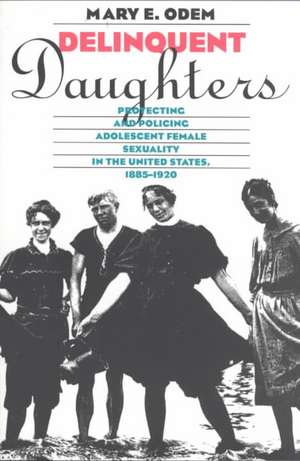
Delinquent Daughters
Autor Mary E. Odemen Limba Engleză Paperback – dec 1995
Preț: 309.35 lei
Puncte Express: 464
Carte tipărită la comandă
Livrare economică 07-21 decembrie
Livrare prin curier în România Termenul estimat este afișat lângă disponibilitate.
Transport gratuit de la 400.00 lei Plată online sau ramburs, în funcție de opțiunile comenzii.
Retur gratuit în 14 zile Comandă securizată și suport în română.
Specificații
ISBN-13: 9780807845288
ISBN-10: 0807845280
Pagini: 288
Dimensiuni: 156 x 234 x 18 mm
Greutate: 0.47 kg
Ediția:2nd edition
Editura: The University of North Carolina Press
ISBN-10: 0807845280
Pagini: 288
Dimensiuni: 156 x 234 x 18 mm
Greutate: 0.47 kg
Ediția:2nd edition
Editura: The University of North Carolina Press
V-ar putea interesa
-
 -5%Preț: 324.91 lei342.01 lei
 -
 Preț: 351.06 lei
 -
 PervJesse Bering-25%Preț: 63.20 lei84.79 lei
 -
 Backdrop: The Politics and Personalities Behind Sexual Orientation ResearchGayle E. Pitman Ph. D.Preț: 111.40 lei
 -
 The G Spot: And Other Discoveries about Human SexualityBeverly WhipplePreț: 108.54 lei
 -
 Female Ejaculation & the G-SpotDeborah SundahlPreț: 141.92 lei
 -
 The Witch and the ClownAnn Belford UlanovPreț: 194.55 lei
 -
 Dancing in the FlamesElinor DicksonPreț: 155.24 lei
 -
 Preț: 59.75 lei
 -
 The Psychology of Gender, Second EditionAlice H. EaglyPreț: 328.29 lei
Descriere
Exploring the gender, class and racial tensions that fueled campaigns to control female sexuality in late 19th- and early 20th-century America, Odem traces two distinct stages of moral reform. She also adresses the paradoxical consequences of reform by demonstrating that the protective measures advocated by middle-class women often resulted in coercive and discriminatory policies toward working-class girls.
Notă biografică
Mary E. Odem (left) is an associate professor of history and women's studies at Emory University. She is the author of numerous publications on the subjects of women, gender, immigration, and ethnicity in U.S. history. Elaine Lacy (right) is professor of history and assistant to the executive vice chancellor at the University of South Carolina, Aiken. She has published numerous articles on Latino immigration to the United States and on Mexican cultural politics.