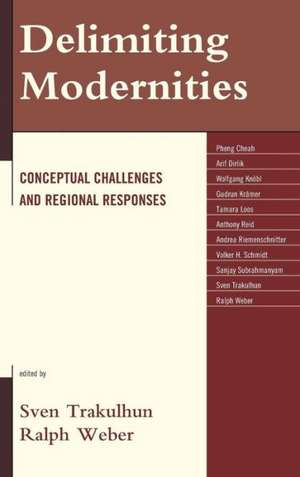
Delimiting Modernities: Conceptual Challenges and Regional Responses
Editat de Sven Trakulhun, Ralph Weber Contribuţii de Pheng Cheah, Arif Dirlik, Wolfgang Knöbl, Gudrun Krämer, Tamara Loos, Anthony Reid, Andrea Riemenschnitter, Volker H. Schmidt, Sanjay Subrahmanyamen Limba Engleză Hardback – 12 feb 2015
Preț: 626.93 lei
Preț vechi: 947.40 lei
-34%
Puncte Express: 940
Preț estimativ în valută:
110.95€ • 129.67$ • 96.33£
110.95€ • 129.67$ • 96.33£
Carte tipărită la comandă
Livrare economică 20 februarie-06 martie
Preluare comenzi: 021 569.72.76
Specificații
ISBN-13: 9780739199480
ISBN-10: 073919948X
Pagini: 296
Ilustrații: 3 BW Illustrations, 6 Tables
Dimensiuni: 158 x 237 x 30 mm
Greutate: 0.57 kg
Editura: Bloomsbury Publishing
Colecția Lexington Books
Locul publicării:New York, United States
ISBN-10: 073919948X
Pagini: 296
Ilustrații: 3 BW Illustrations, 6 Tables
Dimensiuni: 158 x 237 x 30 mm
Greutate: 0.57 kg
Editura: Bloomsbury Publishing
Colecția Lexington Books
Locul publicării:New York, United States
V-ar putea interesa
-
 New Thinking for the New MillenniumEdward de BonoPreț: 131.56 lei
 -
 -23%Preț: 443.42 lei576.21 lei
 -
 Preț: 382.46 lei
 -
 Harry Potter and International RelationsDaniel H. Nexon-23%Preț: 264.80 lei342.51 lei
 -
 Preț: 434.86 lei
 -
 Preț: 485.59 lei
 -
 Preț: 240.36 lei
 -
 Giroux ReaderHenry A. Giroux-21%Preț: 280.96 lei353.80 lei
 -
 Preț: 172.66 lei
 -
 Geography of TimeRobert LevinePreț: 199.58 lei
Cuprins
Part I. Globalization and the Rethinking of Modernity
Chapter 1: 'Of Other Worlds to Come,' Pheng Cheah
Chapter 2: What is 'Modernities' a Plural of? - A Rhetorical Analysis of Some Recent Uses, Ralph Weber
Chapter 3: Varieties of Modernity? Conceptual Prerequisites and Empirical Observations, Volker H. Schmidt
Chapter 4: The Origins of the Social Sciences and the Problem of Conceptualizing 'Modernity'/'Modernities,' Wolfgang Knöbl
Part II. Sites of Revision, Ways of Revisioning
Chapter 5: Waiting for the Simorgh: Comparisons, Connections, and the 'Early Modern,' Sanjay Subrahmanyam
Chapter 6: Early Modernity as Cosmopolis: Some Suggestions from Southeast Asia, Anthony Reid
Chapter 7: Revisioning Modernity: Modernity in Eurasian Perspectives, Arif Dirlik
Chapter 8: New Historicism and Chinese Modernity: Multiple Mythologies Revisited, Andrea Riemenschnitter
Chapter 9: Making Modern Muslims: Islamic Reform, Hasan al-Banna, and the Egyptian Muslim Brotherhood, Gudrun Krämer
Chapter 10: Dilemmas of Development: Dr. Krisana Kraisintu's Praxis in Asia and Africa, Tamara Loos
Chapter 1: 'Of Other Worlds to Come,' Pheng Cheah
Chapter 2: What is 'Modernities' a Plural of? - A Rhetorical Analysis of Some Recent Uses, Ralph Weber
Chapter 3: Varieties of Modernity? Conceptual Prerequisites and Empirical Observations, Volker H. Schmidt
Chapter 4: The Origins of the Social Sciences and the Problem of Conceptualizing 'Modernity'/'Modernities,' Wolfgang Knöbl
Part II. Sites of Revision, Ways of Revisioning
Chapter 5: Waiting for the Simorgh: Comparisons, Connections, and the 'Early Modern,' Sanjay Subrahmanyam
Chapter 6: Early Modernity as Cosmopolis: Some Suggestions from Southeast Asia, Anthony Reid
Chapter 7: Revisioning Modernity: Modernity in Eurasian Perspectives, Arif Dirlik
Chapter 8: New Historicism and Chinese Modernity: Multiple Mythologies Revisited, Andrea Riemenschnitter
Chapter 9: Making Modern Muslims: Islamic Reform, Hasan al-Banna, and the Egyptian Muslim Brotherhood, Gudrun Krämer
Chapter 10: Dilemmas of Development: Dr. Krisana Kraisintu's Praxis in Asia and Africa, Tamara Loos
Recenzii
In the current global conjuncture, claims on modernity are proliferating, and we witness increasingly contested debates about early and multiple modernities, and about visions of development outside the frame of Euro-American epistemologies. In this anthology, a group of distinguished scholars offers a wealth of insights and critical perspectives, aiming both at assessing the meaning of these interventions, and to reconfigure the notion of "modernity" for our times.
In this interdisciplinary and international collection of essays, delimiting modernities becomes a twofold project: on the one hand, consolidating as well as complicating the use of a pluralized notion of modernity; on the other hand, further provincializing the Eurocentric conceptual history of modernity in ways that reflect ongoing global assymmetries of power. The result is a far-reaching exploration of a timely subject by some of the best scholars in the field
In this interdisciplinary and international collection of essays, delimiting modernities becomes a twofold project: on the one hand, consolidating as well as complicating the use of a pluralized notion of modernity; on the other hand, further provincializing the Eurocentric conceptual history of modernity in ways that reflect ongoing global assymmetries of power. The result is a far-reaching exploration of a timely subject by some of the best scholars in the field