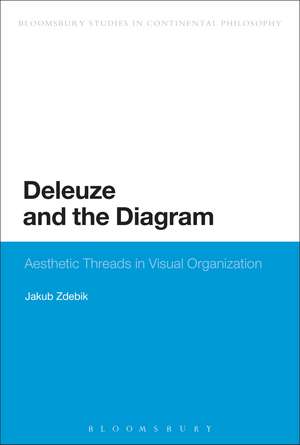
Deleuze and the Diagram: Aesthetic Threads in Visual Organization: Bloomsbury Studies in Continental Philosophy
Autor Dr Jakub Zdebiken Limba Engleză Paperback – 16 ian 2014
Publicată în cadrul prestigioasei serii Bloomsbury Studies in Continental Philosophy, lucrarea Deleuze and the Diagram aduce o perspectivă proaspătă asupra ontologiei deleuziene, propunând o sinteză a conceptului de „diagramă” prin intermediul esteticii vizuale. Considerăm că noutatea acestui volum rezidă în transformarea unor termeni aparent metaforici — harta, schița, desenul — în instrumente riguroase de analiză filozofică. Dr Jakub Zdebik reușește să demonstreze cum filozofia lui Deleuze funcționează asemenea unei picturi care migrează de la figurație la abstracție, oferind cititorului un cadru teoretic pentru a gândi filozofia prin artă.
Structura cărții este una progresivă, pornind de la definirea diagramei și explorarea constrângerilor sistemelor vizuale, până la studii de caz aplicate pe lucrările lui Paul Klee și Francis Bacon. Apreciem în mod deosebit capitolul al treilea, unde autorul complică înțelegerea diagramei prin compararea ei cu schema kantiană, oferind astfel o ancorare solidă în istoria filozofiei continentale. Această abordare continuă preocupările autorului din Deleuze and the Map-Image, unde acesta explora conceptul de hartă în contextul noilor media, însă aici focalizarea se mută spre mecanismele profunde ale organizării estetice.
Acoperă aceeași arie tematică precum Tintoretto's Difference de Kamini Vellodi, însă Deleuze and the Diagram are o abordare mai interdisciplinară, punând în dialog teoria artei nu doar cu istoria picturii, ci și cu viziunile teoretice ale lui Foucault sau Simondon. În timp ce volumul Francis Bacon scris de Gilles Deleuze însuși se concentrează pe deformarea cărnii și izolarea figurii, Dr Jakub Zdebik folosește aceste repere pentru a extrage o metodologie critică aplicabilă întregii culturi vizuale contemporane. Textul este dens, academic, dar extrem de bine structurat, fiind esențial pentru înțelegerea modului în care elementele vizuale iluminează scrierile filozofice complexe.
Din seria Bloomsbury Studies in Continental Philosophy
- 24%
 Preț: 834.95 lei
 - 14%
 Preț: 848.88 lei
 - 33%
 Preț: 772.32 lei
 -
 Preț: 276.49 lei
 - 16%
 Preț: 278.87 lei
 - 33%
 Preț: 835.40 lei
 - 23%
 Preț: 258.96 lei
 - 25%
 Preț: 276.58 lei
 - 30%
 Preț: 848.98 lei
 - 27%
 Preț: 194.26 lei
 - 33%
 Preț: 836.43 lei
 - 24%
 Preț: 835.04 lei
 - 16%
 Preț: 278.37 lei
 - 33%
 Preț: 836.26 lei
 - 25%
 Preț: 920.07 lei
 - 33%
 Preț: 784.86 lei
 -
 Preț: 282.22 lei
 - 16%
 Preț: 276.77 lei
 - 16%
 Preț: 277.68 lei
 -
 Preț: 277.20 lei
 - 16%
 Preț: 255.43 lei
 - 33%
 Preț: 772.24 lei
 - 33%
 Preț: 772.52 lei
 - 26%
 Preț: 193.48 lei
 - 16%
 Preț: 277.08 lei
 - 14%
 Preț: 959.92 lei
 - 14%
 Preț: 962.83 lei
 - 24%
 Preț: 835.00 lei
 - 16%
 Preț: 281.68 lei
 - 16%
 Preț: 282.10 lei
 - 24%
 Preț: 850.43 lei
 - 33%
 Preț: 771.89 lei
 -
 Preț: 276.19 lei
 - 25%
 Preț: 278.18 lei
 - 25%
 Preț: 278.37 lei
 - 24%
 Preț: 963.28 lei
 - 33%
 Preț: 835.84 lei
 - 33%
 Preț: 772.24 lei
Preț: 256.84 lei
Carte tipărită la comandă
Livrare economică 17 noiembrie-01 decembrie
Specificații
ISBN-10: 1472526198
Pagini: 256
Dimensiuni: 154 x 232 x 16 mm
Greutate: 0.36 kg
Editura: Bloomsbury Publishing
Colecția Bloomsbury Academic
Seria Bloomsbury Studies in Continental Philosophy
Locul publicării:London, United Kingdom
V-ar putea interesa
-
 Kierkegaard: A Very Short IntroductionPatrick Gardiner-20%Preț: 56.69 lei71.01 lei
 -
 Russell: A Very Short IntroductionA. C. Grayling-20%Preț: 56.15 lei70.17 lei
 -
 -20%Preț: 349.81 lei434.84 lei
 -
 Needs, Values, Truth: Essays in the Philosophy of ValueDavid Wiggins-28%Preț: 368.18 lei511.64 lei
 -
 Stanley Cavell: Philosophy's Recounting of the OrdinaryStephen Mulhall-28%Preț: 426.18 lei594.52 lei
 -
 -37%Preț: 460.97 lei734.78 lei
 -
 -28%Preț: 484.95 lei677.82 lei
 -
 -29%Preț: 477.51 lei668.03 lei
 -
 The Worlds of Possibility: Modal Realism and the Semantics of Modal LogicCharles S. Chihara-28%Preț: 427.14 lei595.55 lei
 -
 Rules, Reasons, and NormsPhilip Pettit-19%Preț: 379.30 lei466.53 lei
 -
 Papers on Time and TenseArthur N. Prior-28%Preț: 424.84 lei593.72 lei
 -
 Oxford Studies in Early Modern Philosophy Volume VDaniel Garber-13%Preț: 251.55 lei288.64 lei
 -
 The Post-Romantic PredicamentPaul De Man-25%Preț: 597.92 lei794.29 lei
 -
 Deleuze and EthicsNathan Jun-17%Preț: 207.10 lei248.03 lei
 -
 The Deleuze Dictionary Revised EditionAdrian Parr-16%Preț: 210.32 lei249.15 lei
 -
 Times of Crisis: What the Financial Crisis Revealed and How to Reinvent our Lives and FutureProfessor Michel Serres-45%Preț: 174.11 lei314.10 lei
 -
 Nature, History, State: 1933-1934Martin Heidegger-48%Preț: 119.14 lei228.46 lei
 -
 Theology After DeleuzeDr Kristien Justaert-15%Preț: 236.65 lei276.99 lei
 -
 Principles of Non-PhilosophyProfessor Francois Laruelle-47%Preț: 269.99 lei507.73 lei
 -
 Rhythmanalysis: Space, Time and Everyday LifeHenri Lefebvre-21%Preț: 156.85 lei199.34 lei
 -
 Being and EventAlain Badiou-18%Preț: 173.64 lei212.25 lei
 -
 Interrogating the RealDr Rex Butler-20%Preț: 147.40 lei184.12 lei
 -
 The Bloomsbury Companion to LeibnizBrandon C. Look-20%Preț: 274.55 lei342.57 lei
 -
 Key WritingsProfessor Keith Ansell Pearson-23%Preț: 187.41 lei244.22 lei
 -
 Origins of Analytical PhilosophyMichael Dummett-22%Preț: 137.58 lei176.76 lei
 -
 The Bloomsbury Companion to SpinozaProfessor Wiep van Bunge-19%Preț: 277.02 lei343.90 lei
 -
 Deleuze and Futurism: A Manifesto for NonsenseHelen Palmer-16%Preț: 195.12 lei233.14 lei
 -
 Eclipse of ReasonMax Horkheimer-22%Preț: 141.43 lei180.44 lei
De ce să citești această carte
Recomandăm această carte cercetătorilor și studenților la filozofie sau istoria artei care doresc să descifreze conceptele abstracte ale lui Deleuze prin exemple vizuale concrete. Cititorul câștigă o metodă nouă de interpretare a culturii vizuale, învățând să vadă „diagrama” din spatele picturilor lui Klee sau Bacon. Este un instrument teoretic prețios care face legătura între estetica clasică și gândirea contemporană.
Descriere
Deleuze conceptualized his theory as a form of painting, saying that, like art, it needed to shift from figuration to abstraction. This book focuses on the visual devices in Deleuze's work and uses the concept of the diagram to describe the relationship between philosophy and art and to formulate a way to think about philosophy through art.
Cuprins
and System as Vegetation: Diagram and Visual Organization \ 2. Black Line White
Surface \ 3. Gilles Deleuze's Diagram (Complicated by a Comparison to Immanuel
Kant's Schema) \ 4. The Extraordinary Contraction \ 5. Skin, Aesthetics,
Incarnation: Deleuze's Diagram of Francis Bacon-An Epilogue \ Notes \ Bibliography \ Index
Recenzii
'Finally, a book has arrived that brilliantly delineates how the diagram indirectly reveals the untraceable, yet mappable, philosophical system of Deleuze and Guattari. Zdebik delicately explains the diagram's dynamism, productive constraints, and its abstract and material dimensions.Drawing on a philosophical lineage stretching from Kant to Heidegger, Foucault and Simondon, as well as examples from natural history, architecture, and contemporary art, the diagram's hybridity and, ultimately, its carnality for Deleuze in his study of Francis Bacon, is masterfully displayed. This is a bold work of transdisciplinary scope that rightfully places the diagrammatic at the core of Deleuzean philosophy.'
'Zdebik's book fills handsomely a glaring gap in the literature on diagrammatic thinking in general and the role the diagram plays in Gilles Deleuze's ontology and aesthetics. It is thoughtful, well written, informative and will be of immense interest to those who want to understand the recent prominence of diagrammatic thinking and the way in which it rivals semiotic thinking. It will also show Deleuze scholars how exactly the diagram-a concept at the center of Deleuze's work-was meant to work.'