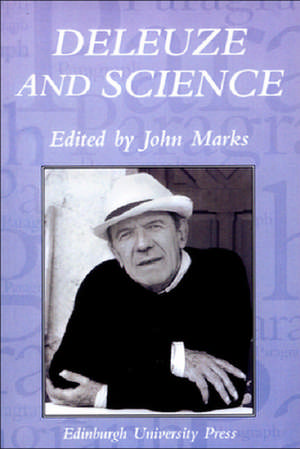
Deleuze and Science: Paragraph: A Journal of Modern Critical Theory, cartea 29
Editat de John Marksen Limba Engleză Paperback – iul 2006
În peisajul academic contemporan, studiul filozofiei continentale tinde tot mai mult spre o reconciliere cu rigoarea științelor exacte, iar volumul Deleuze and Science se plasează exact în centrul acestei intersecții disciplinare. Reținem din acest volum, apărut sub egida prestigioasei serii Paragraph: A Journal of Modern Critical Theory, o încercare sistematică de a răspunde provocării lansate de Bergson: necesitatea unei metafizici adaptate științei moderne. Descoperim aici o analiză profundă a modului în care Gilles Deleuze și Felix Guattari au integrat descoperirile din fizică, biologie și tehnologia informației în operele lor de maturitate, precum A Thousand Plateaus. Structura volumului urmărește modul în care concepte precum emergența, dinamica non-liniară și teoria complexității nu sunt simple metafore, ci fundamente ale unui materialism expresiv. Găsim în această carte argumente solide conform cărora ontologia realistă a lui Deleuze este intrinsec legată de o 'știință intensivă' care studiază procesele divergente din spatele lumii vizibile. Comparabil cu Intensive Science and Virtual Philosophy de Professor Manuel DeLanda în rigurozitate, dar actualizat pentru contextul noilor cercetări în nanotehnologie și termodinamică, acest titlu oferă o perspectivă tehnică asupra coordonatelor 'imaginii gândirii'. Spre deosebire de lucrările anterioare ale lui John Marks, cum ar fi From Vision to Action, care se concentrau pe latura practică a antreprenoriatului social, acest volum coordonat de el demonstrează o erudiție teoretică remarcabilă, ancorând filozofia deleuziană în revoluțiile științifice postbelice.
Preț: 226.52 lei
Preț vechi: 274.92 lei
-18%
Carte disponibilă
Livrare economică 16-30 noiembrie
Specificații
ISBN-10: 0748625585
Pagini: 192
Dimensiuni: 159 x 237 x 13 mm
Greutate: 0.27 kg
Editura: EDINBURGH UNIVERSITY PRESS
Seria Paragraph: A Journal of Modern Critical Theory
V-ar putea interesa
-
 Preț: 99.60 lei
 -
 Hume's Morality: Feeling and FabricationRachel Cohon-10%Preț: 372.04 lei413.16 lei
 -
 -27%Preț: 774.94 lei1061.56 lei
 -
 Gilles Deleuze: Vitalism and MultiplicityJohn MarksPreț: 240.30 lei
 -
 Dictionary of TlingitKeri EdwardsPreț: 177.67 lei
 -
 Studies in Early Indian ThoughtDorothea Jane StephenPreț: 468.78 lei
 -
 God and NatureG. K. StoutPreț: 312.03 lei
 -
 Mind and MatterG. F. StoutPreț: 490.02 lei
 -
 The Modern Dance of DeathPeyton RousPreț: 283.97 lei
 -
 The Protocols of the Learned Elders of ZionVictor E. MarsdenPreț: 112.38 lei
 -
 Beyond Madness 45°NJohn MarksPreț: 123.98 lei
 -
 Scam on the CoveJohn MarksPreț: 142.61 lei
 -
 Rail Against InjusticeJohn MarksPreț: 153.19 lei
 -
 Preț: 64.67 lei
 -
 Grenzen und GrenzüberschreitungenWolfram Hogrebe-9%Preț: 1463.98 lei1608.77 lei
 -
 Nietzsche - Radikalaufklärer oder radikaler Gegenaufklärer?Renate Reschke-13%Preț: 730.76 lei839.95 lei
 -
 "Alle Persönlichkeit ruht auf einem dunkeln Grunde"Thomas Buchheim-9%Preț: 809.37 lei889.41 lei
 -
 Nietzsche und FreudReinhard Gasser-23%Preț: 2475.82 lei3215.35 lei
 -
 Metaphysik und KritikSabine Doyé-23%Preț: 1282.48 lei1665.57 lei
 -
 Grounding the Nietzsche Rhetoric of EarthAdrian Del Caro-23%Preț: 1826.98 lei2372.70 lei
 -
 Kants Übergangskonzeption im Opus postumumDina Emundts-23%Preț: 881.50 lei1144.80 lei
 -
 Preț: 365.76 lei
 -
 Philosophia perennisWilhelm Schmidt-Biggemann-18%Preț: 2107.14 lei2569.67 lei
 -
 Hermann Cohen's Critical IdealismReinier W. Munk-18%Preț: 1230.65 lei1500.79 lei
De ce să citești această carte
Această colecție de eseuri este esențială pentru studenții și cercetătorii care doresc să înțeleagă fundamentul științific al filozofiei lui Deleuze. Cititorul câștigă o claritate conceptuală asupra distincției dintre virtual și actual, trecând dincolo de interpretările pur literare către o ontologie bazată pe fizica și matematica modernă. Este o resursă academică ce demonstrează cum filozofia poate ancora teoretic progresele din nanotehnologie și dinamica sistemelor complexe.
Despre autor
John Marks este un autor și producător cu o carieră diversă, fiind cunoscut în mediul jurnalistic ca fost șef de birou pentru U.S. News and World Report în Berlin și producător pentru emisiunea 60 Minutes. Cu un master în arte obținut la Iowa Writers' Workshop, Marks a demonstrat o versatilitate remarcabilă, publicând de la ficțiune satirică precum Fangland, până la ghiduri de antreprenoriat social. În calitate de editor pentru Deleuze and Science, el își folosește experiența de sinteză pentru a coordona o analiză critică riguroasă asupra legăturii dintre filozofia franceză contemporană și științele exacte.