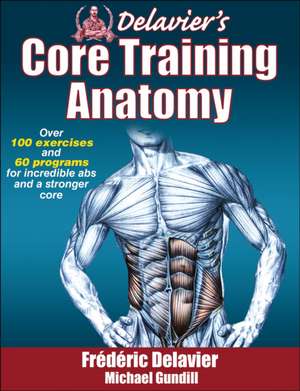
Delavier's Core Training Anatomy
Autor Frederic Delavier, Michael Gundillen Limba Engleză Paperback – 10 oct 2011
Observăm în ultimii ani o schimbare de paradigmă în fitness: accentul s-a mutat de la simpla estetică a mușchilor superficiali către dezvoltarea „core-ului” – acel nucleu central care susține postura, echilibrul și forța funcțională. Delavier's Core Training Anatomy răspunde acestei tendințe, oferind o perspectivă cvasi-medicală asupra modului în care ne putem fortifica trunchiul. Putem afirma că volumul nu este doar un manual de exerciții, ci un atlas vizual spectaculos, grație celor 460 de ilustrații realizate de Frederic Delavier. Remarcăm precizia cu care sunt descrise cele peste 100 de exerciții, unde cititorul poate vedea, la propriu, cum interacționează mușchii cu articulațiile și structura osoasă. Această abordare analitică este semnătura autorului, regăsită și în lucrări precum The Strength Training Anatomy Workout 03 sau Delavier's Mixed Martial Arts Anatomy. Dacă în volumele anterioare Frederic Delavier se concentra pe masa musculară generală sau pe sporturi de contact, aici focalizarea este chirurgicală pe stabilitatea coloanei și eficiența mișcării. Complementar lui Core Strength Training de la editura DK: unde acela se concentrează pe instrucțiuni pas cu pas pentru începători, Delavier's Core Training Anatomy explorează profunzimea anatomică și biomecanica mișcării, fiind ideal pentru cei care vor să înțeleagă de ce o anumită variație de exercițiu recrutează fibrele musculare diferit. Structura cărții permite o navigare rapidă între programele de reducere a grăsimii abdominale și rutinele specifice pentru 20 de sporturi, de la ciclism la golf, oferind un echilibru rar între rigoarea științifică și aplicabilitatea practică imediată.
Preț: 169.25 lei
Carte disponibilă
Livrare economică 16-30 noiembrie
Livrare express 30 octombrie-05 noiembrie pentru 59.37 lei
Specificații
ISBN-10: 1450413994
Pagini: 144
Ilustrații: 362 photos
Dimensiuni: 197 x 258 x 12 mm
Greutate: 0.61 kg
Ediția:New
Editura: HUMAN KINETICS
V-ar putea interesa
-
 Men's Sexual Health: Fitness for Satisfying SexBarry W. McCarthy-5%Preț: 201.22 lei211.81 lei
 -
 Swimming AnatomyIan A McLeodPreț: 159.96 lei
 -
 Preț: 124.97 lei
 -
 Gymnastic Kinesiology. a Manual of the Mechanism of Gymnastic MovementsWilliam SkarstromPreț: 174.23 lei
 -
 The Strength Training Anatomy WorkoutFrederic Delavier-5%Preț: 174.51 lei183.69 lei
 -
 Delavier's Stretching AnatomyFrederic DelavierPreț: 168.07 lei
 -
 The Strength Training Anatomy Workout 2Frédéric DelavierPreț: 196.57 lei
 -
 Preț: 163.38 lei
 -
 The New Rules of Lifting for WomenLou SchulerPreț: 120.95 lei
 -
 101 Workouts for WomenMuscle & Fitness HersPreț: 106.50 lei
De ce să citești această carte
Recomandăm această carte oricui dorește să treacă dincolo de simplele abdomene făcute mecanic. Veți câștiga o înțelegere profundă a propriei anatomii, învățând cum să vă protejați zona lombară și cum să vă îmbunătățiți performanța sportivă prin stabilitate. Este un instrument esențial atât pentru sportivii de performanță, cât și pentru persoanele care suferă de disconfort lombar și caută soluții bazate pe biomecanică corectă.
Despre autor
Frederic Delavier este un autor și ilustrator recunoscut la nivel mondial, ale cărui lucrări de anatomie sportivă s-au vândut în peste 2 milioane de exemplare. Expertiza sa provine dintr-o combinație rară de studii academice: a studiat morfologia la prestigioasa École des Beaux-Arts din Paris și a urmat cursuri de disecție la Facultatea de Medicină timp de trei ani. Fost campion al Franței la powerlifting și editor-șef al revistei PowerMag, Delavier colaborează constant cu publicații de renume precum Men's Health. Talentul său artistic excepțional îi permite să transforme concepte complexe de biomecanică în imagini clare și educative.
Descriere
"Delavier's Core Training Anatomy" is your guide for increasing core strength, stability, flexibility, and tone.
Whether you're just beginning your routine or looking to enhance an existing conditioning program, "Delavier's Core" "Training Anatomy "presents the most effective exercises and workouts for the results you want. It's all here, and all in the stunning detail that only Frederic Delavier can provide.
With 460 full-color photos and illustrations, you'll go inside over 100 exercises and 60 programs to see how muscles interact with surrounding joints and skeletal structures. You'll learn how variations, progressions, and sequencing can affect muscle recruitment, the underlying structures, and ultimately the results.
"Delavier's Core Training Anatomy "includes proven programming for sculpting your abs, reducing fat, improving cardiovascular health, and relieving low back discomfort. Targeted routines are presented for optimal training and performance in more than 20 sports, including running, cycling, basketball, soccer, and golf.
The former editor in chief of "PowerMag" in France, author and illustrator Frederic Delavier is a journalist for "Le Monde du" "Muscle" and a contributor to" Men's Health Germany" and several other strength publications. His previous publications, "Strength Training Anatomy" and "Women's Strength Training Anatomy," have sold more than 2 million copies.
Notă biografică
The former editor in chief of the French magazine PowerMag, Delavier is currently a journalist for the French magazine Le Monde du Muscle and a contributor to several other muscle publications, including Men's Health Germany. He is the author of the best-selling Strength Training Anatomy, Women's Strength Training Anatomy, The Strength Training Anatomy Workout, and Delavier's Stretching Anatomy.
Delavier won the French powerlifting title in 1988 and makes annual presentations on the sport applications of biomechanics at conferences in Switzerland. His teaching efforts have earned him the Grand Prix de Techniques et de Pédagogie Sportive. Delavier lives in Paris, France.
Michael Gundill has written 13 books on strength training, sport nutrition, and health including co-authoring The Strength Training Anatomy Workout. His books have been translated into multiple languages, and he has written over 500 articles for bodybuilding and fitness magazines worldwide, including Iron Man and Dirty Dieting. In 1998 he won the Article of the Year Award at the Fourth Academy of Bodybuilding Fitness & Sports Awards in California.
Gundill started weightlifting in 1983 in order to improve his rowing performance. Most of his training years were spent completing specific lifting programs in his home. As he gained muscle and refined his program, he began to learn more about physiology, anatomy, and biomechanics and started studying those subjects in medical journals. Since 1995 he has been writing about his discoveries in various bodybuilding and fitness magazines all over the world.
Cuprins
20 Steps to Creating the Perfect Core Workout Program
1. Set your goals
2. How many workouts should you do each week?
3. On which days of the week should you exercise?
4. Should you exercise once or twice per day?
5. What time of day should you exercise?
6. How many sets should you do?
7. Be flexible and adaptable
8. How many exercises should you do for each muscle?
9. When should you change exercises?
10. How many repetitions should you do per set?
11. How quickly should you perform repetitions?
12. Adjust range of motion in the exercises
13. How long should a workout last?
14. How much rest time should you take between sets?
15. Determine the most appropriate weight for each exercise
16. When should you increase the weight?
17. Determine rest time between exercises
18. Learn to choose exercises that work for you
19. Know when to change your workout program
20. Taking a vacation?
Keep a Workout Notebook
Making Progress
PART 2
Increase the Visibility of Your Abs
Exercising Your Abs for a Smaller Waist
Intensity First!
Diet as a Way to Slim Your Waist
Diet Plus Workout Synergy
Improving the Effectiveness of Your Diet
Role of Supplements
BCAAs for Losing Belly Fat
Calcium: The Anti-Belly Fat Mineral
PART 3
Basic Exercises to Sculpt Your Abs
Anatomical Considerations
Beware of Fake Abdominal Exercises!
If You Have an Inguinal, Femoral, or Abdominal Hernia
Rectus Abdominis Exercises
Crunch
Lying Leg Raise
Seated Leg Raise
Oblique Exercises
Apollo's Belt
Twisting Crunch
Side Crunch
Stability Exercises
Static Stability Exercise, Back Against a Wall
Plank
Breathing Exercises to Improve Athletic Performance
Lying Rib Cage Expansion With a Weight
Diaphragm Contraction
Stretching the Abdominal Muscles
On a Stability Ball
Stretching the Hip Flexors
Tilting of the Pelvis
Abdominal-Lumbar Balance
Lunge
Stretches for the Low Back
Preventing Low Back Pain
Relaxation Stretch on a Stability Ball
Hanging From a Pull-Up Bar
PART 4
Advanced Exercises and Techniques
Three Difficulties of Ab Work
How to Isolate Upper Abdominal Work From Lower Abdominal Work
Why Are the Lower Abs So Hard to Develop?
1. It is difficult to recruit that part of the muscle
2. Lower abs lack strength
3. It is difficult to isolate the lower part
4. Lower abs are not robust
5. Some exercises are inappropriate
Three Zones of Attack for Total Development
Relative Importance of Each Zone
Getting a Head Start on Recovery
Exercises for the Upper Abdominal Muscles
Double Crunch
Sit-Up
Exercises for the Lower Abdominal Muscles
Pelvic Tilts on the Pull-Up Bar
Leg Lift
Hanging Leg Raise
Exercises for the Obliques
Hanging Leg Raise to the Side
Lying Twist
PART 5
Ab and Core Exercises Using Machines and Accessories
Purpose of Home Equipment
Professional Machines
Exercises for the Upper Abdominal Muscles
Crunch Machines
Swiss Ball Crunch
Rocking Machine Crunch
Standing Cable Crunch
Exercises for the Lower Abdominal Muscles
Ab Coaster
Exercises for the Obliques
Cable Twist (or Using a Machine)
Side Bend
PART 6
Workout Programs for Abdominal and Core Muscles
Six-Pack Programs
Beginning Programs
Advanced Programs
Very Advanced Programs
At-Home Programs Using Accessories
Programs Using Equipment in a Gym
Programs to Reduce Belly Fat
Programs to Reduce Love Handles
Programs to Highlight Apollo's Belt
Programs for Well-Being
Programs for Cardiovascular Health
Programs to Relax Your Back Before Sleep
Programs to Help Protect Your Lumbar Spine
Programs to Help With Bloating and Other Digestive Problems
Sport-Specific Core Programs
Phase 1: Basic Muscle Conditioning Programs for Beginners
Phase 2: Working Toward Circuit Training
Phase 3: Workouts to Improve Overall Physical Qualities
Phase 4: Working Toward More Specific Training