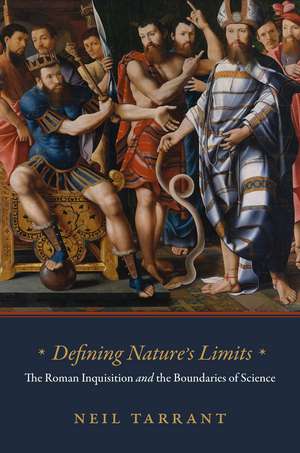
Defining Nature's Limits: The Roman Inquisition and the Boundaries of Science
Autor Neil Tarranten Limba Engleză Hardback – 18 noi 2022
Observăm în Defining Nature's Limits o analiză riguroasă a mecanismelor prin care autoritatea ecleziastică a trasat granițele între știință, magie și erezie. Structurat în două părți principale, volumul urmărește mai întâi „Fundațiile Medievale”, explorând modul în care Ordinul Dominican a construit conceptul de magie ortodoxă, pentru ca apoi să examineze „Reforma Mendicantă și Inchiziția Magiei”. Autorul Neil Tarrant propune o metodologie revizionistă, argumentând că cenzura nu a fost un fenomen brusc al Contrareformei, ci o continuitate de cinci secole de obiective instituționale care au început mult înainte de 1542.
Remarcăm modul în care cuprinsul reflectă o progresie logică: de la originile medievale ale supravegherii magiei învățate, prin criza autorității papale, până la consolidarea Inchiziției Romane după Conciliul de la Trent. Spre deosebire de alte lucrări care se concentrează strict pe persecuția religioasă, Neil Tarrant demonstrează cum delegitimarea anumitor practici magice a modelat, în mod indirect, dezvoltarea științei moderne timpurii. Cartea acoperă aceeași arie tematică precum The Roman Inquisition de Thomas F Mayer, dar cu o abordare mult mai axată pe evoluția conceptelor de filozofie naturală și pe distincția dintre superstiție și cunoaștere validată.
Apreciem profunzimea cu care este tratată tranziția de la pedepsirea ereziei protestante la investigarea practicienilor de magie „ilicită”. De asemenea, lucrarea intră în dialog cu Church, Censorship and Culture in Early Modern Italy de Gigliola Fragnito, oferind însă o perspectivă mai tehnică asupra modului în care tomismul a influențat criteriile de cenzură aplicate științelor naturii. Rezultatul este o istorie instituțională și intelectuală care explică de ce anumite forme de cunoaștere au fost marginalizate pentru a face loc metodei științifice emergente.
Preț: 338.13 lei
Carte disponibilă
Livrare economică 09-23 noiembrie
Livrare express 24-30 octombrie pentru 42.94 lei
Specificații
ISBN-10: 0226819426
Pagini: 288
Dimensiuni: 152 x 229 x 28 mm
Greutate: 0.56 kg
Ediția:First Edition
Editura: University of Chicago Press
Colecția University of Chicago Press
De ce să citești această carte
Recomandăm această carte cercetătorilor și studenților interesați de istoria ideilor și a instituțiilor ecleziastice. Cititorul va obține o înțelegere clară a modului în care Inchiziția Romană nu a vizat doar dogma religioasă, ci a jucat un rol activ în definirea limitelor științei. Este un instrument esențial pentru a înțelege rădăcinile medievale ale cenzurii moderne și evoluția filozofiei naturale în contextul presiunilor confesionale.
Despre autor
Neil Tarrant este un istoric specializat în perioada modernă timpurie, cu un interes academic profund pentru intersecția dintre religie, magie și istoria științei. Cercetările sale se concentrează pe mecanismele instituționale ale Bisericii Catolice, în special pe rolul Ordinului Dominican și al Inchiziției în modelarea peisajului intelectual european. Prin lucrarea de față, publicată de University of Chicago Press, Tarrant se stabilește ca o voce importantă în reinterpretarea continuității practicilor de cenzură din Evul Mediu până în epoca post-Tridentină.
Descriere scurtă
Neil Tarrant challenges conventional thinking by looking at the longer history of censorship, considering a five-hundred-year continuity of goals and methods stretching from the late eleventh century to well into the sixteenth.
Unlike earlier studies, Defining Nature’s Limits engages the history of both learned and popular magic. Tarrant explains how the church developed a program that sought to codify what was proper belief through confession, inquisition, and punishment and prosecuted what they considered superstition or heresy that stretched beyond the boundaries of religion. These efforts were continued by the Roman Inquisition, established in 1542. Although it was designed primarily to combat Protestantism, from the outset the new institution investigated both practitioners of “illicit” magic and inquiries into natural philosophy, delegitimizing certain practices and thus shaping the development of early modern science. Describing the dynamics of censorship that continued well into the post-Reformation era, Defining Nature's Limits is revisionist history that will interest scholars of the history science, the history of magic, and the history of the church alike.
Notă biografică
Cuprins
I. Medieval Foundations
1. The Origins of the Inquisition of Magic
2. The Dominican Order and the Construction of Orthodox Magic
3. The Inquisition of Learned Magic in the Fourteenth Century
II. Mendicant Reform and the Inquisition of Magic
4. The Crisis of Papal Authority and Observant Reform, 1378–1500
5. The Pursuit of Superstition in an Age of Reform, 1500–1517
6. The Reformation: Trent and the Establishment of the Roman Inquisition, 1517–49
7. Between Trent and the Roman Inquisition, 1549–64
Conclusion: The Ambiguities of Censorship in Post-Tridentine Italy
Acknowledgments
Notes
Bibliography
Index