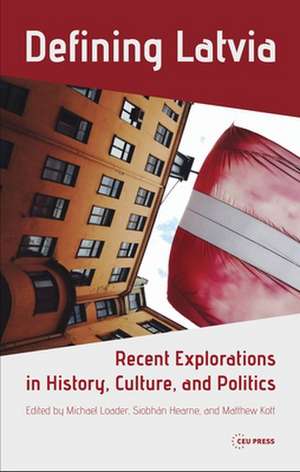
Defining Latvia: Recent Explorations in History, Culture, and Politics
Editat de Michael Loader, Siobhán Hearneen Limba Engleză Hardback – 15 apr 2022
The volume moves beyond an exclusively political context to incorporate a variety of social and cultural perspectives, ranging from the experiences of Latvian mapmakers in the Russian Empire, to the participation of Latvians in the Wehrmacht and Red Army during World War II, Latvian national communism, and the development of extremist politics following Latvia’s accession to the European Union. Other chapters address developing trends in the fields of history and political science, including the history of antisemitism, memory, language politics, photography, and political extremism.
Based on the book’s temporal span from the nineteenth century to the present, the authors and editors of Defining Latvia understand the construction of Latvian identity as a continuous and interconnected process across significant political and ideological ruptures.
Preț: 701.64 lei
Preț vechi: 771.04 lei
-9%
Puncte Express: 1052
Carte disponibilă
Livrare economică 09-23 noiembrie
Livrare prin curier în România Termenul estimat este afișat lângă disponibilitate.
Transport gratuit pentru acest produs Plată online sau ramburs, în funcție de opțiunile comenzii.
Retur gratuit în 14 zile Comandă securizată și suport în română.
Specificații
ISBN-13: 9789633864456
ISBN-10: 9633864453
Pagini: 270
Dimensiuni: 152 x 229 x 21 mm
Greutate: 0.66 kg
Ediția:1
Editura: Amsterdam University Press
Colecția Central European University Press
Locul publicării:Oxford, United Kingdom
ISBN-10: 9633864453
Pagini: 270
Dimensiuni: 152 x 229 x 21 mm
Greutate: 0.66 kg
Ediția:1
Editura: Amsterdam University Press
Colecția Central European University Press
Locul publicării:Oxford, United Kingdom
Public țintă
AcademicNotă biografică
Matthew Kott is a historian of twentieth century Latvia, with a focus on political ideologies and their consequences. He is a researcher at Uppsala University and is currently editor-in-chief of the Journal of Baltic Studies.
Ivars Ijabs is a Latvian political scientist and politician. He is a lecturer and professor at the University of Latvia and holds a PhD in political science. In May 2019, representing political alliance Development/For!, he was elected as a Member of the European Parliament.
Michael Loader is a political historian of the Soviet Communist Party, nationality politics, and Soviet Latvia. He is currently a Leverhulme Early Career Fellow at the University of Glasgow and Assistant Editor of the Journal of Baltic Studies.
Siobhán Hearne is a historian of gender and sexuality in the Russian Empire and Soviet Union. She is currently a Leverhulme Early Career Fellow at Durham University in the UK.
Ivars Ijabs is a Latvian political scientist and politician. He is a lecturer and professor at the University of Latvia and holds a PhD in political science. In May 2019, representing political alliance Development/For!, he was elected as a Member of the European Parliament.
Michael Loader is a political historian of the Soviet Communist Party, nationality politics, and Soviet Latvia. He is currently a Leverhulme Early Career Fellow at the University of Glasgow and Assistant Editor of the Journal of Baltic Studies.
Siobhán Hearne is a historian of gender and sexuality in the Russian Empire and Soviet Union. She is currently a Leverhulme Early Career Fellow at Durham University in the UK.
Cuprins
List of Figures, Acknowledgements, Foreword, Introduction, Latvia and Latvian Identity in Historical Perspective, 1 Mapping Latwija, Mat?ss Sili?š and Latvian Cartographic Publishing in the 1890s, 2 The Sokolowski Affair, 3 More than a Means to an End, 4 “My Home and My Family Are Now Our Regiment”, 5 The Economic Program of the Latvian National Communists – Myth or Reality?, 6 Latvia Goes Rogue, 7 Latvian Photography of the 1960s between Art and Censorship, 8 Onwards and Upwards!, 9 Gaming the System, Glossary of Archives, About the Contributors, Index
Descriere
Brings together the latest research from leading political scientists, historians, and area studies specialists across Europe and North America to examine Latvia's turbulent transition over just over a century from imperial periphery to nation-state, then Soviet republic, and finally to independent republic following the Soviet Union's collapse.