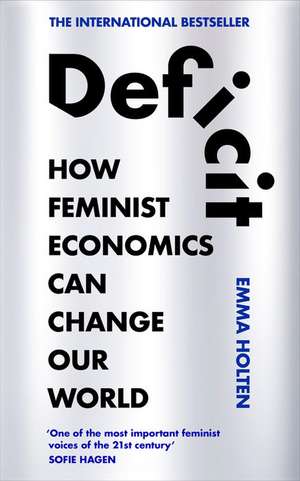
Deficit
Autor Emma Holten Traducere de Sherilyn Nicolette Hellbergen Limba Engleză Paperback – 6 mar 2025
Această monografie de teorie feministă și critică economică pornește de la un incident statistic frapant: în 2020, rapoartele oficiale daneze etichetau femeile drept un „deficit” net pentru societate, argumentând că acestea consumă mai multe resurse publice decât contribuie prin taxe. Emma Holten demontează această premisă, oferind o analiză riguroasă a modului în care indicatorii de bogăție au fost construiți istoric pentru a exclude sistematic contribuția feminină. Descoperim aici o incursiune documentată care începe cu Iluminismul și ajunge la politicile fiscale contemporane, demonstrând că actualul cadru de evaluare a valorii este fundamental viciat deoarece nu cuantifică munca de îngrijire și sectorul public. Stilul este unul precis și argumentat, evitând retorica goală în favoarea unei deconstrucții a modelelor matematice care dictează deciziile politice. Volumul, câștigător al premiului Politiken 2024, nu este doar o critică a capitalismului, ci o propunere de recalibrare a priorităților sociale. Considerăm că abordarea lui Holten completează perspectiva oferită de Coming Up Short de Robert Reich. În timp ce Reich se concentrează pe inegalitatea generată de puterea corporațiilor și a lobby-ului politic în America, Deficit adaugă o dimensiune structurală de gen, explicând de ce chiar și în statele cu o protecție socială avansată, precum cele scandinave, sistemul economic eșuează să recunoască activitățile care susțin, de fapt, viața socială. Este o lectură esențială pentru înțelegerea mecanismelor invizibile care definesc valoarea în secolul XXI.
Preț: 122.27 lei
Cartea se retipărește
Specificații
ISBN-10: 0753561476
Pagini: 336
Dimensiuni: 136 x 214 x 28 mm
Greutate: 0.34 kg
Editura: Penguin Random House UK
V-ar putea interesa
-
 Clever Girl Finance, 2nd EditionBola SokunbiPreț: 137.83 lei
 -
 What's Keeping You Broke?The Simple SumPreț: 124.73 lei
 -
 Preț: 111.22 lei
 -
 Mad about MoneyMaddy Alexander-GroutPreț: 105.27 lei
 -
 10 Things I Love about MoneyMat MegensPreț: 121.21 lei
 -
 Personal Finance For Dummies, UK EditionEric TysonPreț: 157.72 lei
 -
 The Money ManualAbigail FosterPreț: 121.89 lei
 -
 Can You Run the Economy?Joe MayesPreț: 123.77 lei
 -
 Year of the RatHarry ShukmanPreț: 106.72 lei
 -
 KaputWolfgang MunchauPreț: 79.03 lei
 -
 Book of MoneyMonzoPreț: 85.58 lei
 -
 The Modern Money ManifestoCharlotte JessopPreț: 119.24 lei
 -
 Who Needs More Cuts?Barry KushnerPreț: 71.44 lei
 -
 With the Law on Our SideLady HalePreț: 191.77 lei
 -
 Fighter!Harry A Hill-12%Preț: 80.94 lei91.76 lei
 -
 The Pharaoh's PitchIvan Yong-12%Preț: 81.84 lei92.64 lei
 -
 Another WayDave WhortonPreț: 189.16 lei
De ce să citești această carte
Recomandăm această carte oricui este interesat de economie politică și sociologie. Cititorul va înțelege cum s-au format prejudecățile din spatele indicatorilor economici actuali și de ce munca domestică sau de îngrijire rămâne invizibilă în PIB. Emma Holten oferă argumentele necesare pentru a regândi valoarea dincolo de cifrele brute, într-un volum premiat care îmbină rigoarea academică cu o perspectivă umanistă urgentă.
Notă biografică
Descriere
*AN INTERNATIONAL BESTSELLER* WINNER OF THE POLITIKEN LITERATURE PRIZE 2024 'Brilliantly rewrites the history of economic thought to place 'her story' at its heart. A must-read' - Kate Raworth, author of DOUGHNUT ECONOMICS 'One of the most important feminist voices of the 21st century . . . The book about capitalism we didn't know we needed' - Sofie Hagen In 2020, the prominent Danish feminist Emma Holten read an article stating that women were a net 'deficit' to society. Women took more than they gave, 'draining' the public purse by giving birth and taking parental leave. They contributed less than their fair share in taxes, because they often worked part-time to look after other people at home, or held low-paid jobs in the public sector. Denmark would be richer if women's lives looked more like men's, the economic experts concluded. A similar story is told around the globe. How did we get here? In Deficit, Emma Holten traces how economic thinkers - from the Enlightenment onwards - created a value framework that overlooked and neglected 'women's work' and acts of care. She reveals how the economic models that drive political decisions today are just as flawed, giving us unparalleled monetary wealth, but causing deep social harms that are hurting us all. If we cannot properly value the things that matter, how can we build a better future?