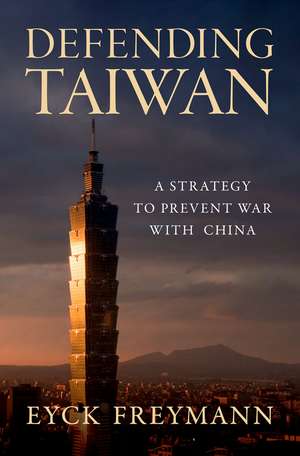
Defending Taiwan: A Strategy to Prevent War with China
Autor Eyck Freymannen Limba Engleză Hardback – 15 iul 2026
Preț: 180.18 lei
Preț vechi: 205.95 lei
-13%
Puncte Express: 270
Carte disponibilă
Livrare economică 19-24 noiembrie
Livrare express 31 octombrie-06 noiembrie pentru 68.46 lei
Livrare prin curier în România Termenul estimat este afișat lângă disponibilitate.
Transport gratuit de la 400.00 lei Plată online sau ramburs, în funcție de opțiunile comenzii.
Retur gratuit în 14 zile Comandă securizată și suport în română.
Specificații
ISBN-13: 9780197823842
ISBN-10: 019782384X
Pagini: 432
Dimensiuni: 165 x 236 x 30 mm
Greutate: 0.75 kg
Editura: Oxford University Press
Colecția OUP USA
Locul publicării:New York, United States
ISBN-10: 019782384X
Pagini: 432
Dimensiuni: 165 x 236 x 30 mm
Greutate: 0.75 kg
Editura: Oxford University Press
Colecția OUP USA
Locul publicării:New York, United States
Recenzii
In Defending Taiwan, Eyck Freymann offers an innovative, multidimensional strategy integrating military, political, economic, and technological tools to enhance deterrence and defeat China if war occurs. This is an essential book for policy practitioners and scholars seeking innovative and feasible ways to protect Taiwan's democracy and secure America's interests in the Indo-Pacific.
The future of Taiwan may decide the shape of global geopolitics for the next hundred years and beyond, and yet academic scholarship has been slow to catch up. Eyck Freymann is at the forefront of an emerging group of scholar-strategists turning their minds to this problem—and doing so with great skill. In Defending Taiwan, he shows expertly how military approaches alone will not suffice and lays out a four-pillar concept of deterrence to help guide policy thinking.
A magnificent intellectual achievement. Eyck Freymann has crafted one of those rare scholarly works that offers readers both a deep well of knowledge and a thrilling read. As tensions with the Peoples Republic of China mount, American government officials and military officers will want to keep copies of this book spring-loaded for emergencies. I was particularly struck by the remarkable clarity, realism, and actionability of the military analysis. The conflict scenarios read like the scripts of tier one war games, and the strategy discussions will make you feel like you have a seat in the White House Situation Room. I didnt want to put it down!
Within his time in power, Xi Jinping is determined to assert control over Taiwan if he can possibly find a viable opportunity. The stakes could scarcely be higher: PRC subjugation of the capitalist democracy would devastate global supply chains, trigger economic shocks, hamstring U.S. alliances, and threaten nuclear proliferation. Atop a consummate analysis of these critical dynamics, Freymann offers innovative recommendations regarding a credible U.S. threat to engage in avalanche decoupling—a battery of preplanned economic separation measures—to deter PRC aggression.
Defending Taiwan compellingly argues that peace in the Taiwan Strait depends not only on military deterrence but on an integrated strategy combining diplomacy, economics, and technology. Clear-eyed and pragmatic about Taiwans defense needs, this book offers a valuable path toward sustainable peace. A must-read for understanding contemporary strategic challenges.
Freymann skillfully dismantles trendy theories for how to deter Beijing. There is no one magic bullet—but we may yet save Taiwan and the rest of the free world if we marshal our political, military, geostrategic, and economic advantages in the ways Freymann prescribes. Freymanns knowledge of history imbues the book with a refreshingly broad and authoritative scope. I hope it is widely—and urgently—read.
If weve learned anything over the last century, it is that we should always take statements by authoritarian leaders at face value. Thus, it is not a matter of whether China will move to subdue Taiwan, but when and how. In Defending Taiwan, Eyck Freymann offers a comprehensive tutorial on every aspect of this most complex of potential geopolitical cycle-ending crises as well as a compelling approach to how to deter it.
Eyck Freymann has written a seminal, timely, and readable book on how to deter war with China. Based on my discussions with senior officials and experts in Beijing, Taipei, and Washington, I can confirm his four-pillar framework addresses the strategic realities we face: military deterrence alone will fail without unprecedented allied coordination across economic, technological, and diplomatic domains. This is precisely the kind of challenge that Japan—positioned at the forefront and at the strategic heart of the First Island Chain—must take the lead in addressing. It is an essential read for anyone committed to preserving peace.
Taiwan is the most dangerous flashpoint in the world and Eyck Freymanns book is the most comprehensive analysis of what can be done about it. It is the first account that integrates economic analysis with national defense to address, as he puts it, how to restructure the global economy if the worlds manufacturing superpower goes rogue.
..."Defending Taiwan" represents a useful contribution to the national conversation about how to deal with the most significant strategic challenge of our time.
The future of Taiwan may decide the shape of global geopolitics for the next hundred years and beyond, and yet academic scholarship has been slow to catch up. Eyck Freymann is at the forefront of an emerging group of scholar-strategists turning their minds to this problem—and doing so with great skill. In Defending Taiwan, he shows expertly how military approaches alone will not suffice and lays out a four-pillar concept of deterrence to help guide policy thinking.
A magnificent intellectual achievement. Eyck Freymann has crafted one of those rare scholarly works that offers readers both a deep well of knowledge and a thrilling read. As tensions with the Peoples Republic of China mount, American government officials and military officers will want to keep copies of this book spring-loaded for emergencies. I was particularly struck by the remarkable clarity, realism, and actionability of the military analysis. The conflict scenarios read like the scripts of tier one war games, and the strategy discussions will make you feel like you have a seat in the White House Situation Room. I didnt want to put it down!
Within his time in power, Xi Jinping is determined to assert control over Taiwan if he can possibly find a viable opportunity. The stakes could scarcely be higher: PRC subjugation of the capitalist democracy would devastate global supply chains, trigger economic shocks, hamstring U.S. alliances, and threaten nuclear proliferation. Atop a consummate analysis of these critical dynamics, Freymann offers innovative recommendations regarding a credible U.S. threat to engage in avalanche decoupling—a battery of preplanned economic separation measures—to deter PRC aggression.
Defending Taiwan compellingly argues that peace in the Taiwan Strait depends not only on military deterrence but on an integrated strategy combining diplomacy, economics, and technology. Clear-eyed and pragmatic about Taiwans defense needs, this book offers a valuable path toward sustainable peace. A must-read for understanding contemporary strategic challenges.
Freymann skillfully dismantles trendy theories for how to deter Beijing. There is no one magic bullet—but we may yet save Taiwan and the rest of the free world if we marshal our political, military, geostrategic, and economic advantages in the ways Freymann prescribes. Freymanns knowledge of history imbues the book with a refreshingly broad and authoritative scope. I hope it is widely—and urgently—read.
If weve learned anything over the last century, it is that we should always take statements by authoritarian leaders at face value. Thus, it is not a matter of whether China will move to subdue Taiwan, but when and how. In Defending Taiwan, Eyck Freymann offers a comprehensive tutorial on every aspect of this most complex of potential geopolitical cycle-ending crises as well as a compelling approach to how to deter it.
Eyck Freymann has written a seminal, timely, and readable book on how to deter war with China. Based on my discussions with senior officials and experts in Beijing, Taipei, and Washington, I can confirm his four-pillar framework addresses the strategic realities we face: military deterrence alone will fail without unprecedented allied coordination across economic, technological, and diplomatic domains. This is precisely the kind of challenge that Japan—positioned at the forefront and at the strategic heart of the First Island Chain—must take the lead in addressing. It is an essential read for anyone committed to preserving peace.
Taiwan is the most dangerous flashpoint in the world and Eyck Freymanns book is the most comprehensive analysis of what can be done about it. It is the first account that integrates economic analysis with national defense to address, as he puts it, how to restructure the global economy if the worlds manufacturing superpower goes rogue.
..."Defending Taiwan" represents a useful contribution to the national conversation about how to deal with the most significant strategic challenge of our time.
Notă biografică
Eyck Freymann is a Hoover Fellow at Stanford University and a Non-Resident Research Fellow at the U.S. Naval War College's China Maritime Studies Institute. He is the author of The Arsenal of Democracy: Technology, Industry, and Deterrence in an Age of Hard Choices (Hoover, 2025) and One Belt One Road: Chinese Power Meets the World (Harvard, 2021). His writings have also appeared in The Wall Street Journal, Foreign Affairs, The Economist, War on the Rocks, The China Quarterly, The Atlantic, and other venues. He previously held fellowships at Harvard and Columbia and he holds four degrees in history and China Studies from Oxford, Cambridge, and Harvard.