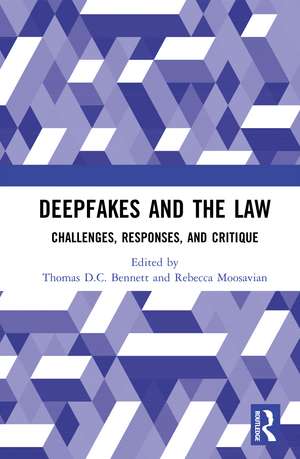
Deepfakes and the Law: Challenges, Responses, and Critique
Editat de Thomas D.C. Bennett, Rebecca Moosavianen Limba Engleză Hardback – sep 2026
Deepfake technology has moved with disorienting speed from fringe curiosity to a global social, political, and legal problem. Once the preserve of Hollywood studios, the ability to fabricate hyper‑realistic images, audio, and video is now available to anyone with a smartphone. Its most prevalent and devastating use remains the creation of non‑consensual sexually explicit content targeting women. Yet deepfakes also fuel political disinformation, destabilise democratic processes, enable fraud and identity theft, and contribute to a broader post‑truth climate in which the authenticity of all digital evidence becomes contestable. In this landscape, one of the most urgent tasks is simply to begin the right conversations about how law and society should respond. Across three sections, various international scholars examine how synthetic media challenges foundational assumptions about privacy, image rights, evidential truth, and democratic integrity. These essays explore deepfakes’ profound impact on the individual dignity of both the living and the dead, their capacity to generate epistemic uncertainty, and the structural difficulties they pose for courts, regulators, and lawmakers. Bringing together theoretical, doctrinal, and comparative insights, the book illuminates a fragmented regulatory landscape and articulates both the pressing need for more coherent, principled governance of synthetic media, and some of the difficulties that will necessarily be encountered by those designing regulatory measures.
This is a timely and vital volume for scholars, jurists, and legislators concerned with the future of truth, autonomy, and accountability in an increasingly synthetic world.
Preț: 1351.39 lei
Preț vechi: 1648.04 lei
-18% Nou
Puncte Express: 2027
Carte tipărită la comandă
Livrare economică 04-18 decembrie
Livrare prin curier în România Termenul estimat este afișat lângă disponibilitate.
Transport gratuit pentru acest produs Plată online sau ramburs, în funcție de opțiunile comenzii.
Retur gratuit în 14 zile Comandă securizată și suport în română.
Specificații
ISBN-13: 9781032964539
ISBN-10: 1032964537
Pagini: 368
Dimensiuni: 156 x 234 mm
Greutate: 0.7 kg
Ediția:1
Editura: Taylor & Francis
Colecția Routledge
Locul publicării:Oxford, United Kingdom
ISBN-10: 1032964537
Pagini: 368
Dimensiuni: 156 x 234 mm
Greutate: 0.7 kg
Ediția:1
Editura: Taylor & Francis
Colecția Routledge
Locul publicării:Oxford, United Kingdom
Public țintă
PostgraduateCuprins
Introduction Part One: Deepfakes, Imagery, and Privacy 1. Triangulating Deepfakes as a Privacy Problem 2. Saving ‘Souls’? How Misuse of Private Information Could Protect Targets of Intrusive Deepfakes 3. Deepfake Pornography: Legal and Human Rights Responses 4. The Need for Constitutional Protection of Personal Identifiers in the Age of Deepfakes 5. Taking Down Deepfakes Through Copyright Law: These are not the droits you are looking for Part Two: Deepfakes, Disinformation and Truth 6. The Impact of Deepfakes on Trust in User-Generated Evidence 7.Regulating Deepfake Harms: Lessons from False Advertising Law 8. Deepfakes, Democracy, and Disinformation: Neo-Republican Unfreedom 9. Deepfakes and Democratic Vulnerabilities: Safeguarding Electoral Integrity in India Part Three: Deepfakes and Death 10. The Challenges of Digital Immortality and Deepfakes 11. Voice Cloning of the Deceased: Data Protection and the Challenge of Deepfakes
Notă biografică
Thomas D.C. Bennett is Senior Lecturer in Law at the City Law School, City St George’s, University of London. He is an expert in media law and writes principally in the areas of judicial methodology, privacy doctrine and theory, and defamation. His work has been published widely and internationally. He is the co-founder and co-host of The Media Law Podcast and has co-edited two previous collections published by Routledge.
Rebecca Moosavian is Associate Professor in Law at the School of Law, University of Leeds. She researches across IP, media law, legal theory, and human rights. She has published articles on the right to privacy (Art 8 ECHR), the right to free expression (Art 10 ECHR), misuse of private information, copyright, and defamation law. Her recent works have focused on the legal regulation of the individual’s image, particularly in the digital age. Rebecca is co-director of the Centre for Law & Social Justice at the School of Law, and has served as a member of the Socio-Legal Studies Association board of trustees (2019–2025) and jurisprudence stream convenor for the Society of Legal Scholars (2015–2018). She has is also deputy co-director of the SLAPPs Research Group, an independent international network of over 50 academics across 15 countries which is committed to advancing balanced, evidence-based research on strategic litigation against public participation (SLAPPs) and anti-SLAPP reform.
Rebecca Moosavian is Associate Professor in Law at the School of Law, University of Leeds. She researches across IP, media law, legal theory, and human rights. She has published articles on the right to privacy (Art 8 ECHR), the right to free expression (Art 10 ECHR), misuse of private information, copyright, and defamation law. Her recent works have focused on the legal regulation of the individual’s image, particularly in the digital age. Rebecca is co-director of the Centre for Law & Social Justice at the School of Law, and has served as a member of the Socio-Legal Studies Association board of trustees (2019–2025) and jurisprudence stream convenor for the Society of Legal Scholars (2015–2018). She has is also deputy co-director of the SLAPPs Research Group, an independent international network of over 50 academics across 15 countries which is committed to advancing balanced, evidence-based research on strategic litigation against public participation (SLAPPs) and anti-SLAPP reform.
Descriere
This collection offers the first sustained, multidisciplinary legal analysis of deepfakes and their far‑reaching consequences.