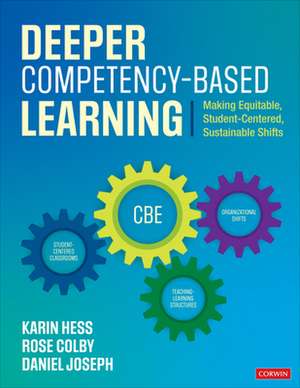
Deeper Competency-Based Learning
Autor Karin J Hess, Rose L Colby, Daniel A Josephen Limba Engleză Paperback – 11 iun 2020
Găsim în Deeper Competency-Based Learning un manual de implementare care depășește discuția teoretică despre educație, concentrându-se pe mecanismele concrete prin care o școală poate trece de la modelul tradițional la cel bazat pe competențe. Notăm cu interes capitolul dedicat schimbărilor organizaționale, unde autorii Karin J Hess, Rose L Colby și Daniel A Joseph demonstrează că reforma pedagogică nu poate avea succes fără o recalibrare a politicilor de leadership și a culturii profesionale din interiorul instituției. Structura volumului este una progresivă, pornind de la fundamentarea conceptului de echitate în educație și ajungând la aspecte tehnice de finețe, precum evaluarea bazată pe dovezi (Body of Evidence). Această abordare permite educatorilor să vizualizeze nu doar destinația, ci și pașii intermediari necesari pentru a permite elevilor să progreseze în ritm propriu. Acoperă aceeași arie tematică precum Over-Tested and Under-Prepared de Bob Sornson, dar cu o abordare mult mai axată pe structuri administrative și politici de sistem, spre deosebire de accentul pe experiența de învățare individuală din textul lui Sornson. Descoperim aici un ghid care nu evită dificultățile practice, dedicând secțiuni ample modului în care se pot stabili obiective riguroase fără a sacrifica flexibilitatea. Față de Scheduling for Personalized Competency-Based Education, care se concentrează strict pe logistica programului școlar, această lucrare oferă un cadru holistic, integrând pedagogia cu managementul educațional. Tonul este precis și pragmatic, fiind o resursă valoroasă pentru districtele școlare care caută o metodologie coerentă pentru a maximiza timpul și locul învățării în beneficiul tuturor elevilor.
Preț: 314.87 lei
Carte disponibilă
Livrare economică 14-28 noiembrie
Specificații
ISBN-10: 1544397062
Pagini: 248
Dimensiuni: 216 x 277 x 13 mm
Greutate: 0.68 kg
Ediția:1
Editura: SAGE Publications
Locul publicării:Thousand Oaks, United States
De ce să citești această carte
Recomandăm această carte liderilor școlari și cadrelor didactice care doresc să implementeze un sistem de învățământ echitabil și personalizat. Cititorul câștigă o strategie clară pentru a înlocui notarea tradițională cu evaluarea bazată pe competențe, obținând instrumente practice pentru a gestiona schimbarea culturii profesionale. Este un ghid esențial pentru a transforma școala dintr-un mecanism de „parcurgere a materiei” într-un mediu centrat pe stăpânirea reală a cunoștințelor.
Despre autor
Karin J Hess este o autoritate recunoscută la nivel internațional în domeniul evaluării și al învățării profunde, fiind creatoarea matricei Hess Cognitive Rigor Matrix. Rose L Colby este consultant în designul sistemelor de învățământ bazate pe competențe, oferind asistență școlilor în procesul de tranziție către modele personalizate. Daniel A Joseph completează echipa cu expertiza sa în strategii de instruire și leadership educațional. Împreună, autorii combină cercetarea academică cu decenii de experiență practică în reforma curriculumului și a politicilor educaționale.
Recenzii
"Deeper Competency-Based Learning takes the current 'caterpillar' state of education, where we are beginning to recognize that individualized, personalized learning is key in student success, and provides the wings—the tools and guidance necessary to transform the caterpillar into the butterfly. This book is not a 'quick fix' for a classroom problem. It is a transformation of education—the transformation that is critical to meeting students where they are, guiding them through the learning challenges of both academic and interpersonal/intrapersonal skills, and then confidently preparing students for what lies ahead."
"Finally, a primer on competency-based education that understands that every school is unique in the same way that every student will take personalized pathways as he or she learns! The authors provide a comprehensive guide for districts and schools to use in plotting their journey to competency education. One thing that makes this book so valuable and unique is that it is rooted in effective practices identified in John Hattie’s Visible Learning research. This is a book that you can trust to help you chart your course."
"Hess, Colby, and Joseph’s new book, Deeper Competency-Based Learning, is nothing less than extraordinary, timely, and necessary as the nation questions the validity of traditional educational systems and their impact on student achievement and potential. Business and industry must respond to ever-changing advances in technology and information if they are to remain competitive; however, the nation’s traditional education system has remained stagnant until now. This book reveals a teaching and learning instructional model known as competency-based education (CBE), which predominantly focuses on students mastering competencies through performance-based tasks, projects, and collection of evidence of learning. Students' learning is made visible to them and the power of a CBE system becomes exponential for optimizing student potential. This book is enlightening, proactive, and much-needed for student learners in the 21st century. Kudos to all educators who empower students to learn through competency-based educational systems."
“It is clear to me that this new book will be a major step forward for US educators seeking to transform their systems of teaching and learning to one that provides equitable and practical access for every student. As the authors point out in the introduction, 'the work of transforming to competency-based education is complex, requiring major shifts away from the conventional organizational structures of schools and away from many less-effective teaching and learning structures towards student-centered classrooms.' This approach is just right: Competency-based education requires major changes organizationally, however, these shifts must be grounded in transformed experiences of the learner and also of the teacher in the classroom first, and each additional change must support that experience through new structures and reformed culture."
"I recommend this book for anyone looking to begin or continue your work around competency-based education in your district. This is an easy to read, comprehensive guide to implementation with resources, examples, and several entry points."
Cuprins
Foreword
Acknowledgments
About the Authors
Introduction
Chapter 1: The WHAT, the WHY, and the HOW of CBE
1.1 A Historical Look at the WHAT and WHY of Competency-Based Education
1.2 Considering the HOW that Connects With Your School’s WHY
1.3 Start by Examining the Traditional Education Framework
1.4 Shifts in Moving From Traditional Education to CBE
1.5 Getting Started on Your CBE Journey
Chapter 2: Making Organizational Shifts
2.1 Organizational Shift 1: Policy
2.2 Organizational Shift 2: Leadership
2.3 Organizational Shift 3: Professional Culture
2.4 Organizational Shift 4: Professional Learning
2.5 Developing CBE Assessment Policies and Practices
Chapter 3: Making Shifts in Teaching and Learning Structures
3.1 Establishing Rigorous Goals for Learning: Competencies
3.2 A Range of Performance Assessment Types
3.3 Evidence-Based Grading in CBE Systems
3.4 Evidence-Based Grading and the Body of Evidence (BOE)
3.5 CBE Development and Validation Tools and Processes
Chapter 4: Making the Shift to Student-Centered Classrooms
4.1 Changing Mindsets: Roles, Responsibilities, and Classroom Culture
4.2 Integrating Personalized Core Instruction With Competencies of Deeper Learning
4.3 Applying Instructional Practices to CBE Learning Cycles
4.4 Promoting Intrinsic Motivation and Engagement Through Assessments and Timely Feedback
Appendix A: CBE Tools 1–12
Appendix B: Hess Cognitive Rigor Matrices #1–#5D
Appendix C: Recommended Resources to Support CBE Implementation
Glossary
Bibliography
Index
Journal Entries
Notă biografică
Descriere
Employ the WHAT (deeper academic and personalized learning), the WHY (equity), and the HOW (learner-centered approaches) of Competency-Based Education, maximizing the time, place, and pace of student learning. Make the shift to CBE using best practices from the authors’ CBE implementation experiences across states, districts, and schools.
- Build the foundation with organizational shifts - policy, leadership, culture, and professional learning
- Shift teaching-learning structures—rigorous learning, performance assessment, and evidence-based grading and reporting
- Dive into student-centered classrooms—personalized instruction and shifting mindsets for teacher-student roles, responsibilities, and classroom culture