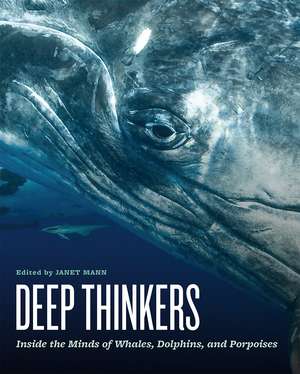
Deep Thinkers: Inside the Minds of Whales, Dolphins, and Porpoises
Editat de Janet Mannen Limba Engleză Hardback – 11 oct 2017
Descoperim în Deep Thinkers un volum de o eleganță aparte, prezentat într-un format hardback robust, tipărit pe hârtie de calitate superioară, capabilă să pună în valoare cele peste 150 de planșe color spectaculoase. Editura University of Chicago Press ne oferă o lucrare care, deși se adresează unui public academic și profesionist, reușește să captiveze orice pasionat de natură prin claritatea vizuală și rigoarea informației.
Observăm cum Janet Mann reușește să coordoneze o echipă de experți mondiali pentru a demonta mitul conform căruia dimensiunea creierului este singurul indicator al inteligenței. Ne-a atras atenția în mod special capitolul dedicat cogniției, unde suntem invitați să părăsim perspectiva noastră antropocentrică, bazată pe văz, pentru a înțelege lumea prin sunete și ecolocație, așa cum o fac delfinii și balenele. Ca și Whales and Dolphins de Philippa Brakes, acest volum pune accent pe complexitatea socială și conservare, dar se diferențiază printr-o analiză mult mai profundă a neuroanatomiei și a modului în care s-au format culturile marine.
Structura progresivă a cărții ne poartă de la istoria cercetării cetaceelor până la mecanismele subtile de comunicare și transmitere culturală. Deși interesele anterioare ale editorului, reflectate în Creating Compassionate Foster Care, par să aparțină unei sfere diferite, regăsim și aici aceeași preocupare pentru conexiune, empatie și înțelegerea unor forme de inteligență care nu pot fi exprimate prin limbaj uman. Este o incursiune fascinantă în mințile celor mai enigmatice creaturi ale oceanului, tratată cu o rigoare științifică dublată de o estetică rară.
Preț: 310.86 lei
Carte disponibilă
Livrare economică 07-21 noiembrie
Livrare express 24-30 octombrie pentru 54.46 lei
Specificații
ISBN-10: 022638747X
Pagini: 192
Ilustrații: 150 color plates
Dimensiuni: 203 x 254 x 20 mm
Greutate: 0.91 kg
Ediția:1
Editura: University of Chicago Press
Colecția University of Chicago Press
De ce să citești această carte
Pentru cititorul care dorește să depășească nivelul documentarelor comerciale, această carte oferă o bază științifică solidă despre inteligența non-umană. Câștigați acces la cele mai noi descoperiri despre cultura și comunicarea cetaceelor, prezentate într-un format vizual de excepție. Este o resursă esențială pentru a înțelege cum evoluează mintea într-un mediu radical diferit de cel terestru.
Despre autor
Janet Mann este un biolog renumit, specializat în studiul cetaceelor, și profesor la Universitatea Georgetown. Recunoscută la nivel mondial pentru cercetările sale de lungă durată asupra delfinilor din Shark Bay, Australia, ea a contribuit fundamental la înțelegerea comportamentului social și a transmiterii culturale la mamiferele marine. În Deep Thinkers, ea își folosește expertiza pentru a reuni cele mai importante voci din domeniu, oferind o perspectivă integrată asupra cogniției animale. Activitatea sa academică este completată de o viziune plină de compasiune asupra interacțiunilor sociale, temă care transpare și în lucrările sale dedicate psihologiei dezvoltării.
Descriere scurtă
Diving into our current understanding of and dynamic research on dolphin and whale cognition, communication, and culture, Deep Thinkers reveals how incredibly sophisticated these mammals are—and how much we can learn about other animal minds by studying cetacean behavior. Through a combination of fascinating text and more than 150 beautiful and informative illustrations, chapters compare the intelligence markers of cetaceans with those of birds, bats, and primates, asking how we might properly define intelligence in nonhumans. As all-encompassing and profound as the seas in which these deep cetacean cultures have evolved, Deep Thinkers is an awesome and inspiring journey into the fathoms—a reminder of what we gain through their close study, and of what we lose when the great minds of the sea disappear.
Notă biografică
Cuprins
Janet Mann
CHAPTER 1
BENEATH THE SURFACE
Janet Mann & Andrew Read
How and why do we study cetaceans? This chapter looks at the history of human association with cetaceans from whaling to research and monitoring in the wild and in captivity and the challenges ahead.
CHAPTER 2
THE CETACEAN BRAIN
Camilla Butti & Patrick Hof
By studying mammals’ brains and comparing those of odontocetes and mysticetes scientists demonstrate that, in terms of intelligence, size isn’t everything. This chapter considers the relationship between brain and body mass and how scientists determine what it means to have a big brain.
CHAPTER 3
COGNITION
Heidi E. Harley
Humans make sense of their surroundings primarily by sight, a perspective that can skew understanding of cetacean cognition. This chapter adopts the cetacean perception of their aquatic world—using multiple senses, including sound and echolocation.
CHAPTER 4
CETACEAN COMMUNICATION
Laela Sayigh & Vincent Janik
How do cetaceans communicate through water? Studies of whale song and dolphin whistles demonstrate the types of communication and consider call function, social recognition, and communication networks.
CHAPTER 5
QUINTESSENTIALLY SOCIAL CETACEANS
Janet Mann
Social bonds bind cetaceans throughout their lifetimes. Long-term studies have been crucial in revealing remarkably complex communities in which relationships are based on affiliation, aggression, kinship, communal care, protection, mating strategies, and extended networks.
CHAPTER 6
DEEP CULTURE
Hal Whitehead & Luke Rendell
We may assume culture to be a uniquely human condition, but cetaceans display considerable cultural diversity. This chapter assesses behavior, communication, social dynamics, migration, cooperative hunting, and learned foraging techniques.
CHAPTER 7
CETACEAN TOOL USE
Eric Patterson & Janet Mann
Like primates and birds, cetaceans use tools for different tasks and different reasons: sticks, shells, and sponges become tools for attraction, display, and foraging purposes.
CHAPTER 8
US & THEM
Andrew Read
From our first encounters with whales as game to attempts to save species from extinction, this chapter looks at how humans and cetaceans coexist. Hunting, fishing, pollution, and sonic disturbance are among the threats whales and dolphins face from human activity.
GLOSSARY
RESOURCES & NOTES ON CONTRIBUTORS
INDEX & ACKNOWLEDGMENTS