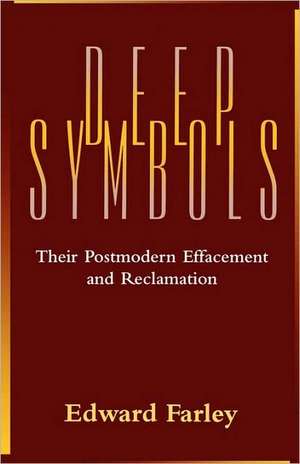
Deep Symbols: Their Postmodern Effacement and Reclamation
Autor Edward Farleyen Limba Engleză Paperback – oct 1996
Two introductory chapters spell out the character and prospect of deep symbols in postmodern society. Then follow five chapters, each of which considers a particular deep symbol: tradition, obligation (duty), reality, law, and hope. A concluding chapter shows the structural entanglement of these symbols with each other and their relation to the sacred and the interhuman.
From the opening chapter- "Words of power, that is, deep and enduring symbols that shape the values of a society and guide the life of faith, morality, and action are subject to powerful forces of discreditation and even disenchantment. If this is so, we must find ways to recover their power or live without them."
Edward Farley is Professor of Theology at Vanderbilt University and the author of many books, including Good and Evil: Interpreting a Human Condition.
Preț: 196.71 lei
Preț vechi: 267.83 lei
-27%
Puncte Express: 295
Carte tipărită la comandă
Livrare economică 28 noiembrie-12 decembrie
Livrare prin curier în România Termenul estimat este afișat lângă disponibilitate.
Transport gratuit de la 400.00 lei Plată online sau ramburs, în funcție de opțiunile comenzii.
Retur gratuit în 14 zile Comandă securizată și suport în română.
Specificații
ISBN-13: 9781563381850
ISBN-10: 1563381850
Pagini: 158
Dimensiuni: 138 x 216 x 11 mm
Greutate: 0.19 kg
Ediția:New.
Editura: Bloomsbury Publishing
Colecția Trinity Press International
Locul publicării:New York, United States
ISBN-10: 1563381850
Pagini: 158
Dimensiuni: 138 x 216 x 11 mm
Greutate: 0.19 kg
Ediția:New.
Editura: Bloomsbury Publishing
Colecția Trinity Press International
Locul publicării:New York, United States
V-ar putea interesa
-
 The Book of ForgivingArchbishop Desmond TutuPreț: 71.60 lei
 -
 Christ ActuallyJames CarrollPreț: 140.37 lei
 -
 -31%Preț: 931.61 lei1355.01 lei
 -
 -12%Preț: 339.25 lei384.40 lei
 -
 -27%Preț: 859.23 lei1175.77 lei
 -
 Cyril of Alexandria's Trinitarian Theology of ScriptureMatthew R. Crawford-31%Preț: 979.66 lei1424.83 lei
 -
 -31%Preț: 1026.52 lei1494.02 lei
 -
 Lost ChurchAlan BillingsPreț: 98.60 lei
 -
 Simply Good NewsTom WrightPreț: 86.79 lei
 -
 Where on Earth is Heaven?Paula GooderPreț: 41.59 lei
 -
 What Do We Mean by 'God'?Keith WardPreț: 60.27 lei
 -
 The SPCK Dictionary of Theology and HermeneuticsAnthony ThiseltonPreț: 464.80 lei
 -
 Challenge of Jesus (Revised)WrightPreț: 112.49 lei
 -
 Totally Forgiving GodR T Kendall Ministries Inc.Preț: 93.10 lei
 -
 From Fear to LoveHarry WillsonPreț: 89.73 lei
 -
 Discourse on Free WillDesiderius Erasmus-25%Preț: 141.44 lei188.23 lei
Recenzii
"Edward Farley...applies his phenomenological expertise to several of what he terms 'deep symbols.' His strength is uncovering this persistent presence, at least the residues, of deep symbols... the chapter on reality is especially strong, where Farley deftly analyzes reasons for the loss of a sense of reality in secular and religious life and yet shows the way in which reference to the real is manifested in a postmodern context... This is a concise work, full of insight and wisdom, that communicates to a broad audience. The argument appeals to contemporary experience and is not laced with jargon." -- Dan R. Stiver, Southern Baptist Theological Seminary, reviewing for Anglican Theological Review
"This book will help preachers and other leaders in the religious community (and beyond) diagnose fundamental shifts that are taking place in our ethos. All seminary students known to me would profit from reading Farley's discussion of law." --Ronald J. Allen, Christian Theological Seminary, writing in ENCOUNTER, Summer 1997
"Helpfully aimed at a broad audience, which should include students of religion as well as leaders and laity in communities of faith, Deep Symbols is a wise and insightful work." --Martha J. Reineke, University of Northern Iowa, reviewing for Journal of the American Academy of Religion
"...an engaging critique of the demise of deep symbols...This book offers stimulating reading for all who consider such a task a central imperative of our time." --Lexington Theological Quarterly
"[Deep Symbols is] very learned and scholarly...calmly and clearly written. Because [it is] very rich, [it does] not invite speedy reading, but each sentence, paragraph, and chapter is laid out with perfect clarity...the enduring value...lies in the deep, passionate compassion that imbues each page." --Wendy Farley, Emory University, reviewing for Religious Studies Review, April 1998
"Farley takes central symbols (tradition, obligation, reality, law, and hope) and demonstrates their present atrophy and the prospect of their recovery. His approach is realistic and yet hopeful. A provocative theological/cultural analysis written in a style that is both absorbing and accessible."
"...thought-provoking book...Used in course preparation and seminar discussions, Farley's book can invite instructors and students to reflect self-critically on the words they use." -- Gilbert Ostdiek, O.F.M., Catholic Theological Union, reviewing for Teaching Theology and Religion
"This excellent book directly addresses our social condition and cultural flux and comes to grips with what must be done to remedy them." -- John C. haughey, S.J., Loyola University, reviewing for Theological Studies
"He deals with five...symbols: tradition, reality, obligation (duty), law and hope. He asks two questions of each: 'What is the effect of postmodernity on the symbol? Can an atrophied symbol be re-thought and re-enchanted?' He concludes with reflections on how these 'words of power' are interrelated." --Theology Digest
"None...who read this book with understanding will ever step into a pulpit, or offer pastoral counsel, or teach a Sunday School class with the same perspective again. There will be new attentiveness to god-words born of the theological vision and understanding that is offered here. This book is and will be a challenge to the church." -- Ronald Olson, Luther Seminary, reviewing for Word and World
"This book will help preachers and other leaders in the religious community (and beyond) diagnose fundamental shifts that are taking place in our ethos. All seminary students known to me would profit from reading Farley's discussion of law." --Ronald J. Allen, Christian Theological Seminary, writing in ENCOUNTER, Summer 1997
"Helpfully aimed at a broad audience, which should include students of religion as well as leaders and laity in communities of faith, Deep Symbols is a wise and insightful work." --Martha J. Reineke, University of Northern Iowa, reviewing for Journal of the American Academy of Religion
"...an engaging critique of the demise of deep symbols...This book offers stimulating reading for all who consider such a task a central imperative of our time." --Lexington Theological Quarterly
"[Deep Symbols is] very learned and scholarly...calmly and clearly written. Because [it is] very rich, [it does] not invite speedy reading, but each sentence, paragraph, and chapter is laid out with perfect clarity...the enduring value...lies in the deep, passionate compassion that imbues each page." --Wendy Farley, Emory University, reviewing for Religious Studies Review, April 1998
"Farley takes central symbols (tradition, obligation, reality, law, and hope) and demonstrates their present atrophy and the prospect of their recovery. His approach is realistic and yet hopeful. A provocative theological/cultural analysis written in a style that is both absorbing and accessible."
"...thought-provoking book...Used in course preparation and seminar discussions, Farley's book can invite instructors and students to reflect self-critically on the words they use." -- Gilbert Ostdiek, O.F.M., Catholic Theological Union, reviewing for Teaching Theology and Religion
"This excellent book directly addresses our social condition and cultural flux and comes to grips with what must be done to remedy them." -- John C. haughey, S.J., Loyola University, reviewing for Theological Studies
"He deals with five...symbols: tradition, reality, obligation (duty), law and hope. He asks two questions of each: 'What is the effect of postmodernity on the symbol? Can an atrophied symbol be re-thought and re-enchanted?' He concludes with reflections on how these 'words of power' are interrelated." --Theology Digest
"None...who read this book with understanding will ever step into a pulpit, or offer pastoral counsel, or teach a Sunday School class with the same perspective again. There will be new attentiveness to god-words born of the theological vision and understanding that is offered here. This book is and will be a challenge to the church." -- Ronald Olson, Luther Seminary, reviewing for Word and World