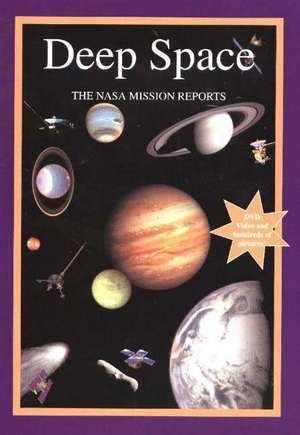
Deep Space: The NASA Mission Reports
Editat de Robert Godwinen Limba Engleză Paperback – 2 iul 2023
Preț: 124.73 lei
Preț vechi: 137.32 lei
-9%
Puncte Express: 187
Carte indisponibilă temporar
Doresc să fiu notificat când acest titlu va fi disponibil:
Se trimite...
Specificații
ISBN-13: 9781894959155
ISBN-10: 1894959159
Pagini: 432
Ilustrații: colour photos
Dimensiuni: 255 x 175 x 25 mm
Greutate: 0.79 kg
Editura: APOGEE BOOKS
Colecția Apogee Books (US)
ISBN-10: 1894959159
Pagini: 432
Ilustrații: colour photos
Dimensiuni: 255 x 175 x 25 mm
Greutate: 0.79 kg
Editura: APOGEE BOOKS
Colecția Apogee Books (US)
Recenzii
"...it will bring hours of pleasure to planetary mission enthusiasts or historians of space exploration." -- Professor Fred Taylor, BBC Sky At Night Magazine, July 2005.
"Highly recommended." -- J.Z. Kiss of Miama University, in Choice, September 2005.
"Any space buff will enjoy this collection of reports..." -- Astronomy, September 2005.
"Highly recommended." -- J.Z. Kiss of Miama University, in Choice, September 2005.
"Any space buff will enjoy this collection of reports..." -- Astronomy, September 2005.
Cuprins
Pioneer Missions; Voyager Missions; Galileo Mission; Jupiter Millennium Mission; Cassini-Huygens Mission; Deep Space I Mission; Stardust Mission; Future Deep Space Missions.
Descriere
Descriere de la o altă ediție sau format:
For as long as mankind has possessed a sense of wonder, astronomy has been practised in one form or another. It can be thought of as having graduated to the status of a true science at the point in history when it became forever separated from astrology. Clearly they were not of the same mould; astronomy was hard to do; astrology was merely hard to swallow. The next significant change came in the early 20th century. Men and women of science felt it was no longer sufficient to simply catalogue the visual characteristics of the stars and other heavenly bodies; the desire to understand their physical makeup, behaviour and creation gave us the study of astrophysics. As the name suggests, this is the physics of astronomical bodies and the space they inhabit. During the second half of the 20th century interest turned also to the other eight planets of our solar system, spawning several new disciplines relating to Planetology, the formation of the solar system, and the possibility of past or present extraterrestrial life. Every decade of the last century brought ever more numerous and fascinating discoveries. It was not until 1930 that Pluto, the ninth planet, was discovered. Only as late as 1978 was it discovered that Pluto possessed a moon. And now, in late 2005, NASA's Hubble Space Telescope has given astronomers evidence that Pluto may have not one, but three moons. In recent decades much interest has also been given to the far reaches of the universe -- far stars; other galaxies, some old, some still forming; and even the earliest detectable galaxies of the universe, at the very limits of our ability to probe. Each field of space study requires its own special tools and its own expertise. The many programs that come loosely under the headings of astronomy and space exploration are as varied and rewarding as the fascinating discoveries that they have made. To the uninformed, the exploration of deep space may seem esoteric and unexciting, but in truth the wonder and the beauty of deep space outshine almost anything that Earth and man can offer. The time when people can go and explore deep space in person is still well into the future. Until then, we shall continue to do as we have done for the past 40 years, sending unmanned spacecraft and satellites as our proxies and ambassadors to the universe. This book examines deep space exploration missions, past, present and future, and their results.
For as long as mankind has possessed a sense of wonder, astronomy has been practised in one form or another. It can be thought of as having graduated to the status of a true science at the point in history when it became forever separated from astrology. Clearly they were not of the same mould; astronomy was hard to do; astrology was merely hard to swallow. The next significant change came in the early 20th century. Men and women of science felt it was no longer sufficient to simply catalogue the visual characteristics of the stars and other heavenly bodies; the desire to understand their physical makeup, behaviour and creation gave us the study of astrophysics. As the name suggests, this is the physics of astronomical bodies and the space they inhabit. During the second half of the 20th century interest turned also to the other eight planets of our solar system, spawning several new disciplines relating to Planetology, the formation of the solar system, and the possibility of past or present extraterrestrial life. Every decade of the last century brought ever more numerous and fascinating discoveries. It was not until 1930 that Pluto, the ninth planet, was discovered. Only as late as 1978 was it discovered that Pluto possessed a moon. And now, in late 2005, NASA's Hubble Space Telescope has given astronomers evidence that Pluto may have not one, but three moons. In recent decades much interest has also been given to the far reaches of the universe -- far stars; other galaxies, some old, some still forming; and even the earliest detectable galaxies of the universe, at the very limits of our ability to probe. Each field of space study requires its own special tools and its own expertise. The many programs that come loosely under the headings of astronomy and space exploration are as varied and rewarding as the fascinating discoveries that they have made. To the uninformed, the exploration of deep space may seem esoteric and unexciting, but in truth the wonder and the beauty of deep space outshine almost anything that Earth and man can offer. The time when people can go and explore deep space in person is still well into the future. Until then, we shall continue to do as we have done for the past 40 years, sending unmanned spacecraft and satellites as our proxies and ambassadors to the universe. This book examines deep space exploration missions, past, present and future, and their results.