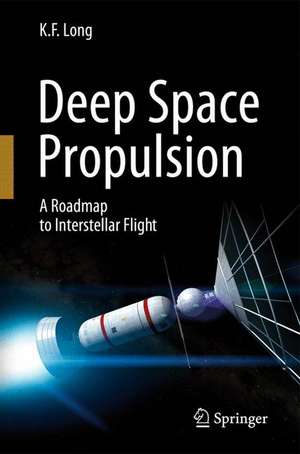
Deep Space Propulsion
Autor K. F. Longen Limba Engleză Paperback – 24 noi 2011
ECOSISTEMUL propulsiei spațiale prezentat în această lucrare se fundamentează pe modele fizice riguroase, explorând tehnologii de la motoare ionice și nucleare până la pânze fotonice și concepte avansate de fuziune. Reținem abordarea pragmatică a autorului K. F. Long, care depășește bariera teoretică pentru a analiza fezabilitatea tehnică a sondelor robotizate destinate explorării sistemelor stelare vecine. Subliniem faptul că, spre deosebire de lucrările de popularizare, acest volum publicat de Springer tratează propulsia ca pe o disciplină de inginerie aplicată, unde limitările vitezei luminii și densitatea energetică a combustibililor dictează arhitectura misiunilor viitoare.
Structura volumului reflectă o progresie logică, pornind de la istoria aviației și a rachetelor convenționale spre provocările unice ale spațiului profund. Ne-a atras atenția modul în care capitolele dedicate propulsiei nucleare prin puls extern și ramjet-ului interstelar sunt echilibrate de analize privind designul sistemelor aerospațiale și costurile economice ale unor astfel de proiecte monumentale. Ca și Paul Gilster în Centauri Dreams, autorul distilează experiență reală în principii acționabile, oferind o perspectivă tehnică asupra modului în care am putea atinge Alpha Centauri într-un interval de timp rezonabil. Totuși, Deep Space Propulsion se diferențiază prin includerea exercițiilor practice la finalul capitolelor, transformând textul dintr-o simplă lectură într-un instrument de studiu activ. Este o resursă care separă riguros mecanica cerească de ficțiunea speculativă, ancorând viitorul astronauticii în legile fundamentale ale fizicii.
Preț: 326.05 lei
Carte disponibilă
Livrare economică 11-25 noiembrie
Specificații
ISBN-10: 1461406064
Pagini: 392
Ilustrații: XXI, 367 p. 73 illus., 22 illus. in color.
Dimensiuni: 155 x 235 x 22 mm
Greutate: 0.59 kg
Ediția:2012
Editura: Springer
Locul publicării:New York, NY, United States
V-ar putea interesa
-
 The Future of HumanityMichio Kaku-31%Preț: 64.89 lei93.48 lei
 -
 -16%Preț: 170.70 lei202.18 lei
 -
 Astrophysics for Supervillains 2 The Great Alien HuntDr Matthew Bothwell-19%Preț: 45.72 lei56.53 lei
 -
 The Next Decade of Discovery in Solar and Space PhysicsCommittee on a Decadal Survey for Solar and Space Physics 2024-2033-14%Preț: 592.76 lei689.25 lei
 -
 Pale Blue DotCarl SaganPreț: 122.75 lei
 -
 Preț: 115.03 lei
 -
 Preț: 189.60 lei
 -
 Space Race 2.0Brad Bergan-22%Preț: 171.53 lei219.45 lei
 -
 -5%Preț: 75.34 lei79.65 leiRecomandat
 -
 -28%Preț: 66.92 lei92.44 lei
 -
 Space ExplorationCarolyn Collins PetersenPreț: 71.57 lei
 -
 Here and BeyondHal LaCroix-26%Preț: 79.86 lei107.39 lei
 -
 Interplanetary RobotsRod PylePreț: 106.92 lei
 -
 The Case for SpaceRobert ZubrinPreț: 135.21 lei
 -
 Moving to MarsEduard AltarribaPreț: 81.41 lei
 -
 Preț: 124.00 lei
 -
 -19%Preț: 99.40 lei122.53 lei
 -
 The Ross 248 ProjectLes JohnsonPreț: 104.21 lei
 -
 Journey to The PlanetsGiancarlo Genta-18%Preț: 1448.15 lei1766.03 lei
 -
 Space Propulsion and Spaceship DesignFarid Gamgami-15%Preț: 679.99 lei799.98 lei
Public țintă
Popular/generalDe ce să citești această carte
Această carte este esențială pentru inginerii aerospațiali, studenții la fizică și antreprenorii din industria spațială care doresc să înțeleagă realitatea tehnică a călătoriilor interstelare. Veți câștiga o viziune clară asupra limitărilor tehnologice actuale și a soluțiilor de propulsie care pot transforma explorarea robotizată a altor sisteme stelare dintr-un vis teoretic într-un proiect de inginerie viabil în deceniile următoare.
Despre autor
K. F. Long este un cercetător și expert în astronautică, recunoscut pentru contribuțiile sale în domeniul propulsiei avansate. În Deep Space Propulsion, el își folosește expertiza tehnică pentru a sintetiza decenii de progrese în astrofizică și inginerie spațială. Autorul este implicat activ în comunitatea științifică ce explorează viitorul zborului interstelar, fiind un promotor al distincției necesare între posibilitățile oferite de fizica teoretică și soluțiile practice aplicabile misiunilor robotizate, oferind astfel o bază solidă pentru generația următoare de exploratori ai spațiului profund.
Descriere scurtă
In order to reach the nearest stars, we must first develop a propulsion technology that would take our robotic probes there in a reasonable time. Such propulsion technology has radically different requirements from conventional chemical rockets, because of the enormous distances that must be crossed. Surprisingly, many propulsion schemes for interstellar travel have been suggested and await only practical engineering solutions and the political will to make them a reality. This is a result of the tremendous advances in astrophysics that have been made in recent decades and the perseverance and imagination of tenacious theoretical physicists. This book explores these different propulsion schemes – all based on current physics – and the challenges they present to physicists, engineers, and space exploration entrepreneurs.
This book will be helpful to anyone who really wants to understand the principles behind and likely future course of interstellar travel and who wants to recognizes the distinctions between pure fantasy (such as Star Trek’s ‘warp drive’) and methods that are grounded in real physics and offer practical technological solutions for exploring the stars in the decades to come.
Cuprins
Recenzii
“This is a readable, insightful and personal history of interstellar travel thinking with a focus on propulsion … . each chapter has an ‘introduction’ providing a short overview of the chapter while the ‘practice exercises’ at the end are to stimulate discussion. … The theoretical background presented here by Long deserves to be read and the bibliography deserves to be considered as a starting point for anyone interested in these topics. The colour illustrations are very helpful.” (Anders Hansson, The Aeronautical Journal, November, 2014)
“Kelvin has taken the reader from the basic, simple principles of reaction propulsion … and on to the exotic world of deep-space journeys. … The most valuable aspect of this book is that it never bucks difficult issues … . If there is one book from which to gather all essential aspects of deep-space propulsion and stellar transportation systems this is it. It is both required reading and an essential reference … . useful for the layreader and the professional.” (Spaceflight, Vol. 54 (7), July, 2012)
Notă biografică
Textul de pe ultima copertă
In this book, Kelvin F. Long takes us on all the possible journeys - the mission targets, the technologies we might use to power such journeys, and what scientific knowledge we are seeking to obtain upon arriving there.
Despite the problems of today it is important that we take a long-term view for the future of our species. In fact, the only way to assure a future is to start planning for it now and then progress incrementally. Today, society is not in a position to launch the types of missions outlined in this book, mainly due to a lack of political motivations to try and the economic cost for launching it. But if we start to develop these technologies today, then it is likely that one of them will come to technological maturity at some point in the coming centuries and will power our species to the stars. Our commitment today to achieve near-term goals will ensure a tomorrow for the generations ahead.