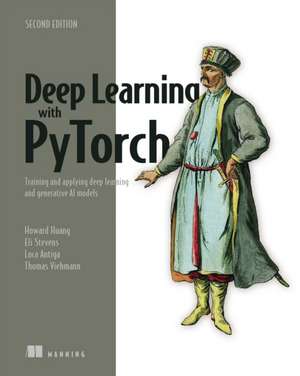
Deep Learning with PyTorch, Second Edition
Autor Howard Huangen Limba Engleză Hardback – apr 2026
Autorul principal al acestei ediții, Howard Huang, aduce o perspectivă tehnică rară, fiind implicat direct în dezvoltarea nucleului bibliotecii PyTorch, cu un focus specific pe antrenarea distribuită. Această expertiză se traduce într-un text riguros, ancorat în realitățile ecosistemului actual de inteligență artificială. Observăm cum structura cărții facilitează tranziția de la instrumente clasice de procesare a datelor, precum NumPy, către fluxuri complexe de învățare profundă, fără a sacrifica detaliile despre accelerarea hardware sau diferențierea automată. În Deep Learning with Pytorch, Second Edition, găsim o actualizare esențială a fundamentelor, extinsă acum către frontierele inteligenței artificiale generative. Ca și Ian Pointer în Programming Pytorch for Deep Learning, autorii distilează experiența reală în principii acționabile, însă această ediție merge mai departe, explorând arhitecturile Transformer și modelele de difuzie. Un element distinctiv este abordarea incrementală: pe parcursul capitolelor, dezvoltăm un clasificator de imagini medicale la scară reală, proces ce ne permite să înțelegem nu doar sintaxa, ci și arhitectura conductelor de date (DL pipelines) și monitorizarea antrenării. Textul pune un accent deosebit pe optimizare și deployment, oferind soluții practice pentru fine-tuning și augmentarea datelor. Ritmul este dens, orientat către inginerul care dorește să stăpânească API-urile flexibile ale PyTorch pentru a construi sisteme robuste. Prin integrarea noilor funcționalități din versiunile recente ale framework-ului, lucrarea devine un manual tehnic indispensabil pentru implementarea rețelelor neuronale moderne, de la CNN-uri clasice la cele mai noi modele de limbaj.
Preț: 335.78 lei
Preț vechi: 419.72 lei
-20%
Carte disponibilă
Livrare economică 17-31 octombrie
Livrare express 06-10 octombrie pentru 76.05 lei
Specificații
ISBN-10: 1633438856
Pagini: 544
Dimensiuni: 186 x 235 x 39 mm
Greutate: 0.73 kg
Ediția:2. Auflage
Editura: Manning Publications
De ce să citești această carte
Această carte este esențială pentru programatorii Python care doresc să treacă de la teorie la producție în domeniul învățării profunde. Scrisă de experți care dezvoltă activ framework-ul, oferă cunoștințe practice despre Transformers și modele generative. Cititorul câștigă abilitatea de a construi, antrena și optimiza rețele neuronale complexe, beneficiind de exemple aplicate pe scenarii reale, precum procesarea imaginilor medicale.
Descriere
Notă biografică
Descriere scurtă
PyTorch core developer Howard Huang updates the bestselling original Deep Learning with PyTorch with new insights into the transformers architecture and generative AI models.
Instantly familiar to anyone who knows PyData tools like NumPy, PyTorch simplifies deep learning without sacrificing advanced features. In this book you’ll learn how to create your own neural network and deep learning systems and take full advantage of PyTorch’s built-in tools for automatic differentiation, hardware acceleration, distributed training, and more. You’ll discover how easy PyTorch makes it to build your entire DL pipeline, including using the PyTorch Tensor API, loading data in Python, monitoring training, and visualizing results. Each new technique you learn is put into action with practical code examples in each chapter, culminating into you building your own convolution neural networks, transformers, and even a real-world medical image classifier.
In Deep Learning with PyTorch, Second Edition you’ll find:
• Deep learning fundamentals reinforced with hands-on projects
• Mastering PyTorch's flexible APIs for neural network development
• Implementing CNNs, transformers, and diffusion models
• Optimizing models for training and deployment
• Generative AI models to create images and text
About the technology
The powerful PyTorch library makes deep learning simple—without sacrificing the features you need to create efficient neural networks, LLMs, and other ML models. Pythonic by design, it’s instantly familiar to users of NumPy, Scikit-learn, and other ML frameworks. This thoroughly-revised second edition covers the latest PyTorch innovations, including how to create and refine generative AI models.
About the book
Deep Learning with PyTorch, Second Edition shows you how to build neural network models using the latest version of PyTorch. Clear explanations and practical projects help you master the fundamentals and explore advanced architectures including transformers and LLMs. Along the way you’ll learn techniques for training using augmented data, improving model architecture, and fine tuning.
What's inside
• PyTorch APIs for neural network development
• LLMs, transformers, and diffusion models
• Model training and deployment
About the reader
For Python programmers with a background in machine learning.
About the author
Howard Huang is a software engineer and developer on the PyTorch library focusing on large scale, distributed training. Eli Stevens, Luca Antiga, and Thomas Viehmann authored the first edition of Deep Learning with PyTorch.
Table of Contents
Part 1
1 Introducing deep learning and the PyTorch library
2 Pretrained networks
3 It starts with a tensor
4 Real-world data representation using tensors
5 The mechanics of learning
6 Using a neural network to fit the data
7 Telling birds from airplanes: Learning from images
8 Using convolutions to generalize
Part 2
9 How transformers work
10 Diffusion models for images
11 Using PyTorch to fight cancer
12 Combining data sources into a unified dataset
13 Training a classification model to detect suspected tumors
14 Improving training with metrics and augmentation
15 Using segmentation to find suspected nodules
16 Training models on multiple GPU
17 Deploying to production