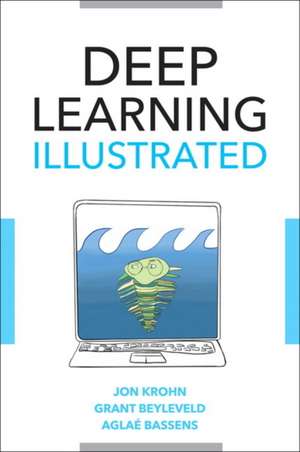
Deep Learning Illustrated: Addison-Wesley Data & Analytics Series
Autor Aglae Bassens, Grant Beyleveld, Jon Krohnen Limba Engleză Paperback – 17 dec 2019
Prin parcurgerea acestui volum, cititorul va reuși să implementeze modele funcționale de rețele neuronale profunde folosind cele mai relevante biblioteci actuale: TensorFlow (cu API-ul Keras), PyTorch și Coach. Observăm că Deep Learning Illustrated reușește să demistifice un domeniu adesea arid, transformând abstractizările matematice în soluții software concrete pentru viziune artificială, procesarea limbajului natural sau generarea de conținut vizual prin algoritmi. Cititorul care a aplicat ideile din Deep Learning de Andrew Glassner va găsi aici o continuare naturală, care face trecerea de la înțelegerea vizuală la execuția efectivă în Python. Considerăm că punctul forte al lucrării este echilibrul dintre teorie și pragmatism: conceptele biologice ale vederii sau structura limbajului sunt imediat cuplate cu exemple de cod și caiete de lucru Jupyter, facilitând o progresie rapidă. Structura cărții este organizată intuitiv, pornind de la fundamentul istoric și terminologic în Partea I, explorând apoi în detaliu aplicații specifice. Capitolele dedicate 'Machine Art' și 'Game-Playing Machines' sunt deosebit de relevante pentru cei interesați de rețele generative și învățare prin recompensă (Reinforcement Learning). Spre deosebire de Python Deep Learning de Ivan Vasilev, care menține un ton tehnic tradițional, volumul de față prioritizează intuiția vizuală și accesibilitatea, fără a sacrifica rigoarea necesară pentru a construi sisteme AI capabile să rezolve probleme din lumea reală.

Preț: 328.25 lei
Preț vechi: 410.31 lei
-20%
Carte disponibilă
Livrare economică 06-20 noiembrie
Livrare express 22-28 octombrie pentru 46.41 lei
Specificații
ISBN-10: 0135116694
Pagini: 416
Dimensiuni: 179 x 231 x 22 mm
Greutate: 0.77 kg
Editura: Pearson Education (US)
Colecția Addison-Wesley Data & Analytics Series
Seria Addison-Wesley Data & Analytics Series
V-ar putea interesa
-
 Learning Deep LearningMagnus Ekman-20%Preț: 414.01 lei517.52 lei
 -
 Deep LearningIan Goodfellow-21%Preț: 684.46 lei865.01 lei
 -
 Introduction to Deep LearningEugene Charniak-20%Preț: 244.30 lei305.37 lei
 -
 Understanding Deep LearningSimon J. D. Prince-20%Preț: 636.22 lei795.27 lei
 -
 Deep LearningJohn D. Kelleher-20%Preț: 89.01 lei111.27 lei
 -
 Skunk WorksLeo JanosPreț: 130.23 lei
 -
 AI SuperpowersKai-Fu LeePreț: 93.40 lei
 -
 -39%Preț: 394.79 lei646.62 lei
 -
 Grokking Deep LearningAndrew W Trask-20%Preț: 288.36 lei360.45 lei
 -
 Deep Learning with PyTorchEli Stevens-20%Preț: 293.41 lei366.76 lei
 -
 Deep Learning for Vision SystemsMohamed Elgendy-20%Preț: 348.66 lei435.83 lei
 -
 Math and Architectures of Deep LearningKrishnendu Chaudhury-20%Preț: 410.21 lei512.76 lei
 -
 Deep Learning with Python, Second EditionFrancois Chollet-20%Preț: 358.75 lei448.44 lei
 -
 Inside Deep Learning: Math, Algorithms, ModelsEdward Raff-20%Preț: 398.09 lei497.61 lei
 -
 Deep Learning: A Visual ApproachAndrew Glassner-35%Preț: 504.69 lei777.34 lei
 -
 -36%Preț: 299.83 lei465.21 lei
 -
 -20%Preț: 249.08 lei311.36 lei
 -
 Deep Learning Crash CourseGiovanni Volpe-35%Preț: 290.84 lei445.88 lei
 -
 Practical Deep Learning, 2nd Edition: A Python-Based IntroductionRonald T. Kneusel-35%Preț: 333.73 lei515.68 lei
 -
 Practical Deep Learning with PyTorchDeepak Gowda-20%Preț: 225.42 lei281.77 lei
De ce să citești această carte
Recomandăm această carte profesioniștilor și studenților care doresc să treacă pragul de la curiozitate la execuție în domeniul inteligenței artificiale. Câștigul imediat este capacitatea de a construi și antrena modele de Deep Learning fără a fi blocați în formalism matematic excesiv. Este resursa ideală pentru cei care învață cel mai bine prin exemple vizuale și practică directă în cod Python.
Despre autor
Echipa de autori este formată din trei instructori și practicieni de calibru mondial. Jon Krohn este un expert recunoscut în data science, cu o capacitate remarcabilă de a explica subiecte complexe. Grant Beyleveld aduce expertiza sa tehnică în aplicarea algoritmilor, în timp ce Aglae Bassens contribuie la componenta vizuală unică a cărții, facilitând înțelegerea intuitivă prin ilustrații care susțin procesul de învățare în cadrul seriei Addison-Wesley Data & Analytics.
Descriere scurtă
Cuprins
Tables xxvii
Examples xxix
Foreword xxxiii
Preface xxxv
Acknowledgments xxxix
About the Authors xli
Part I: Introducing Deep Learning 1
Chapter 1: Biological and Machine Vision 3
Biological Vision 3
Machine Vision 8
TensorFlow Playground 17
Quick, Draw! 19
Summary 19
Chapter 2: Human and Machine Language 21
Deep Learning for Natural Language
Processing 21
Computational Representations of Language 25
Elements of Natural Human Language 33
Google Duplex 35
Summary 37
Chapter 3: Machine Art 39
A Boozy All-Nighter 39
Arithmetic on Fake Human Faces 41
Style Transfer: Converting Photos into Monet (and Vice Versa) 44
Make Your Own Sketches Photorealistic 45
Creating Photorealistic Images from Text 45
Image Processing Using Deep Learning 46
Summary 48
Chapter 4: Game-Playing Machines 49
Deep Learning, AI, and Other Beasts 49
Three Categories of Machine Learning Problems 53
Deep Reinforcement Learning 56
Video Games 57
Board Games 59
Manipulation of Objects 67
Popular Deep Reinforcement Learning Environments 68
Three Categories of AI 71
Summary 72
Part II: Essential Theory Illustrated 73
Chapter 5: The (Code) Cart Ahead of the (Theory)
Horse 75
Prerequisites 75
Installation 76
A Shallow Network in Keras 76
Summary 84
Chapter 6: Artificial Neurons Detecting Hot Dogs 85
Biological Neuroanatomy 101 85
The Perceptron 86
Modern Neurons and Activation Functions 91
Choosing a Neuron 96
Summary 96
Key Concepts 97
Chapter 7: Artificial Neural Networks 99
The Input Layer 99
Dense Layers 99
A Hot Dog-Detecting Dense Network 101
The Softmax Layer of a Fast Food-Classifying Network 106
Revisiting Our Shallow Network 108
Summary 110
Key Concepts 110
Chapter 8: Training Deep Networks 111
Cost Functions 111
Optimization: Learning to Minimize Cost 115
Backpropagation 124
Tuning Hidden-Layer Count and Neuron
Count 125
An Intermediate Net in Keras 127
Summary 129
Key Concepts 130
Chapter 9: Improving Deep Networks 131
Weight Initialization 131
Unstable Gradients 137
Model Generalization (Avoiding Overfitting) 140
Fancy Optimizers 145
A Deep Neural Network in
Keras 147
Regression 149
TensorBoard 152
Summary 154
Key Concepts 155
Part III: Interactive Applications of Deep Learning 157
Chapter 10: Machine Vision 159
Convolutional Neural Networks 159
Pooling Layers 169
LeNet-5 in Keras 171
AlexNet and VGGNet in Keras 176
Residual Networks 179
Applications of Machine Vision 182
Summary 193
Key Concepts 193
Chapter 11: Natural Language Processing 195
Preprocessing Natural Language Data 195
Creating Word Embeddings with word2vec 206
The Area under the ROC Curve 217
Natural Language Classification with Familiar Networks 222
Networks Designed for Sequential Data 240
Non-sequential Architectures: The Keras Functional API 251
Summary 256
Key Concepts 257
Chapter 12: Generative Adversarial Networks 259
Essential GAN Theory 259
The Quick, Draw! Dataset 263
The Discriminator Network 266
The Generator Network 269
The Adversarial Network 272
GAN Training 275
Summary 281
Key Concepts 282
Chapter 13: Deep Reinforcement Learning 283
Essential Theory of Reinforcement Learning 283
Essential Theory of Deep Q-Learning Networks 290
Defining a DQN Agent 293
Interacting with an OpenAI Gym Environment 300
Hyperparameter Optimization with SLM Lab 303
Agents Beyond DQN 306
Summary 308
Key Concepts 309
Part IV: You and AI 311
Chapter 14: Moving Forward with Your Own Deep Learning Projects 313
Ideas for Deep Learning Projects 313
Resources for Further Projects 317
The Modeling Process, Including Hyperparameter Tuning 318
Deep Learning Libraries 321
Software 2.0 324
Approaching Artificial General Intelligence 326
Summary 328
Part V: Appendices 331
Appendix A: Formal Neural Network Notation 333
Appendix B: Backpropagation 335
Appendix C: PyTorch 339
PyTorch Features 339
PyTorch in Practice 341
Index 345