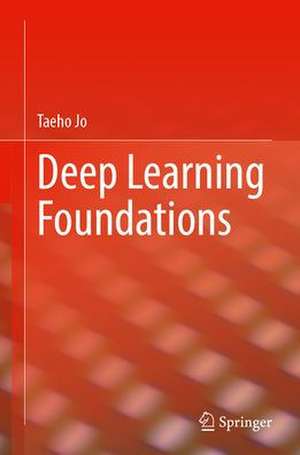
Deep Learning Foundations
Autor Taeho Joen Limba Engleză Hardback – 26 iul 2023
Preț: 1049.36 lei
Preț vechi: 1279.71 lei
-18%
Puncte Express: 1574
Carte tipărită la comandă
Livrare economică 27 noiembrie-11 decembrie
Livrare prin curier în România Termenul estimat este afișat lângă disponibilitate.
Transport gratuit pentru acest produs Plată online sau ramburs, în funcție de opțiunile comenzii.
Retur gratuit în 14 zile Comandă securizată și suport în română.
Specificații
ISBN-13: 9783031328787
ISBN-10: 3031328787
Pagini: 448
Ilustrații: XX, 426 p.
Dimensiuni: 160 x 241 x 30 mm
Greutate: 0.78 kg
Ediția:1st ed. 2023
Editura: Springer
Locul publicării:Cham, Switzerland
ISBN-10: 3031328787
Pagini: 448
Ilustrații: XX, 426 p.
Dimensiuni: 160 x 241 x 30 mm
Greutate: 0.78 kg
Ediția:1st ed. 2023
Editura: Springer
Locul publicării:Cham, Switzerland
Cuprins
Introduction.- Part I. Foundation.- Supervised Learning.- Unsupervised Learning.- Ensemble Learning.- Part II. Deep Machine Learning.- Deep K Nearest Neighbor.- Deep Probabilistic Learning.- Deep Decision Tree.- Deep SVM.- Part III. Deep Neural Networks.- Multiple Layer Perceptron.- Recurrent Networks.- Restricted Boltzmann Machine.- Convolutionary Neural Networks.- Part IV. Textual Deep Learning.- Index Expansion.- Text Summarization.- Textual Deep Operations.- Convolutionary Text Classifier.- Conclusion.
Notă biografică
Dr. Taeho Jo The author of this book, Taeho Jo, is the founder of the publishing company, Alpha AI Publication, to which the copyright of this book belongs to, and a professor in KENTECH (Korea Institute of Energy Technology). His specialty is artificial intelligence; he got a Bachelor from Korea University, a Master from POSTECH (Pohang University of Science and Technology), and a PhD from University of Ottawa. He has careers in both industrial organizations, Samsung SDS, ETRI (Electronic and Telecommunication Research Institute), and KISTI (Korea Institute of Science and Technology Information) and academic organizations, Inha University, Hongik University, and KENTECH as a professor. He has published more than 260 research papers and 30 books with almost solo-author, awarded three times in Marquis Who's Who in the World, and granted the noble title, Duke, from United Kingdom in 2018. The author of this book, Taeho Jo, has a very strong vision for the future as a pioneer of artificial intelligence; he recently established the international organization, UAIN (United Artificial Intelligence Nation) for propagating AI techniques globally.
Textul de pe ultima copertă
This book provides a conceptual understanding of deep learning algorithms. The book consists of the four parts: foundations, deep machine learning, deep neural networks, and textual deep learning. The first part provides traditional supervised learning, traditional unsupervised learning, and ensemble learning, as the preparation for studying deep learning algorithms. The second part deals with modification of existing machine learning algorithms into deep learning algorithms. The book’s third part deals with deep neural networks, such as Multiple Perceptron, Recurrent Networks, Restricted Boltzmann Machine, and Convolutionary Neural Networks. The last part provides deep learning techniques that are specialized for text mining tasks. The book is relevant for researchers, academics, students, and professionals in machine learning.
- Provides a conceptual understanding of deep learning algorithms;
- Presents ways of modifying existing machine learning algorithms into deep learning algorithms for further analysis;
- Details how deep learning can solve problems such as classification, regression, and clustering.
Descriere
Descriere de la o altă ediție sau format:
The book consists of the four parts: foundations, deep machine learning, deep neural networks, and textual deep learning. The first part provides traditional supervised learning, traditional unsupervised learning, and ensemble learning, as the preparation for studying deep learning algorithms.
The book consists of the four parts: foundations, deep machine learning, deep neural networks, and textual deep learning. The first part provides traditional supervised learning, traditional unsupervised learning, and ensemble learning, as the preparation for studying deep learning algorithms.