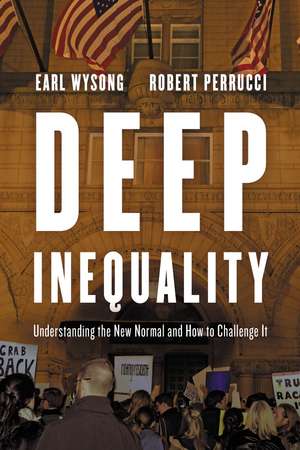
Deep Inequality: Understanding the New Normal and How to Challenge It
Autor Earl Wysong, Robert Perruccien Limba Engleză Hardback – 17 noi 2017
Preț: 287.37 lei
Preț vechi: 381.45 lei
-25%
Puncte Express: 431
Carte tipărită la comandă
Livrare economică 27 noiembrie-11 decembrie
Livrare prin curier în România Termenul estimat este afișat lângă disponibilitate.
Transport gratuit de la 400.00 lei Plată online sau ramburs, în funcție de opțiunile comenzii.
Retur gratuit în 14 zile Comandă securizată și suport în română.
Specificații
ISBN-13: 9781442266452
ISBN-10: 1442266457
Pagini: 224
Ilustrații: 4 b/w illustrations; 5 tables
Dimensiuni: 159 x 236 x 22 mm
Greutate: 0.45 kg
Editura: Bloomsbury Publishing
Colecția Rowman & Littlefield
Locul publicării:New York, United States
ISBN-10: 1442266457
Pagini: 224
Ilustrații: 4 b/w illustrations; 5 tables
Dimensiuni: 159 x 236 x 22 mm
Greutate: 0.45 kg
Editura: Bloomsbury Publishing
Colecția Rowman & Littlefield
Locul publicării:New York, United States
Descriere
Forbes reports that the richest 1 percent of the world's population owns nearly half the world's wealth, and the gap between the richest and poorest of the world only continues to increase. Deep Inequality looks behind these stark statistics to understand not only wealth inequality but also rising disparities in other elements of life-from education to the media. The authors argue that inequality has become so pervasive that it is the new normal. When we do recognize troubling inequality, we look at individual or small-scale problems without understanding the broader structural issues that shape the economy, the global political system, and more. Only by understanding the structural forces at play can we recognize the deep divisions in our society and work for meaningful change. Deep Inequality explains the changing landscape of inequality to help readers see society in a new way.
Cuprins
Chapter 1: When Worlds Collide: The New Normal Meets Structural Realities
Chapter 2: Income and Wealth Inequality: The New Class Structure
Chapter 3: The New Economy: National and Global Dimensions
Chapter 4: The New Workplace: Employers, Employment, Workers
Chapter 5: New Normal Politics: Money, Class, and Power
Chapter 6: New Normal Education: Public Schools and Colleges
Chapter 7: The Information and Culture Industries: Pacification and Resistance
Chapter 8: The Future of Inequality: Polarization, Gridlock, and Global Warming
Chapter 2: Income and Wealth Inequality: The New Class Structure
Chapter 3: The New Economy: National and Global Dimensions
Chapter 4: The New Workplace: Employers, Employment, Workers
Chapter 5: New Normal Politics: Money, Class, and Power
Chapter 6: New Normal Education: Public Schools and Colleges
Chapter 7: The Information and Culture Industries: Pacification and Resistance
Chapter 8: The Future of Inequality: Polarization, Gridlock, and Global Warming
Recenzii
Writing for students new to the study of stratification and mobility, sociologists Wysong (Indiana Univ. Kokomo) and Perrucci (Purdue) take issue not only with conservative and neoliberal policies and ideas but also with those of mainstream liberals. Their primer features clear and succinct conceptualization, references to current events, and data on economic trends. The authors interpret current grassroots social movements striving for greater racial, social, economic, and political equality on the heels of the short-lived "Occupy Wall Street uprising" as indicative of "today's inequality wars." They fear that growing inequality, even in the face of populist Trumpism, is being normalized with a narrative that excuses the immense gap between a minority doing well and a disempowered majority experiencing stagnating wages, declining status and security, and historically low chances for their children's success. As for globalization; the insecurities of a gig economy, declining unionization, robotics and a diminution of well-paying blue-collar jobs, contraction of public services, and political campaigns funded by an ultra-wealthy "superclass," the new normal says "get used to it." This descriptive, theoretically friendly examination of class structure in late capitalism offers a good introduction.... Summing Up: Recommended. General, public, and undergraduate libraries.
Increasing inequality, precarious work arrangements, stagnant wages, and cutbacks in government spending-in the mainstream public sphere, these and other troubling features of the contemporary American landscape are commonly described as the "new normal." Challenging this legitimating ideology, Earl Wysong and Robert Perrucci convincingly argue that the grim realities we are expected to accept as given are in fact the contingent and reversible outcomes of decisions made by networks of wealthy and well-placed corporate and political power holders. In developing their analysis of today's inequalities, the authors take us on a richly detailed and multifaceted tour, with many interesting stops along the way: the contemporary class structure, globalization, the gig economy, the corrupting role of money in politics, the class-based education system, the corporate media, political polarization and gridlock, climate change, and much more. An important, innovative, and well-written book.
A provocative critique of the "new normal," the seductive narrative of the 1% that treats deep inequality and injustice as not only normal but natural. The authors are political economists who show through careful structural and cultural analysis, as well as lively interviews with workers and students, that the "new normal" is propaganda, a social Darwinism disguising and justifying our capitalist system, and now tweeted out by President Trump. Their book makes a persuasive case against the "new normal," empowering the reader to find truth beyond the fake news of our corporate rulers.
The key struggle of our time is the struggle over what's seen as natural, what's seen as inevitable, and what's seen as possible. If you are at risk of forgetting this, please rush out and read Deep Inequality at once. It makes the compelling case that the game is up if we ever forget that our institutions are . our institutions.
Wysong and Perrucci present a much-needed narrative analysis that counteracts the neoliberal narrative of structural inequalities that has been created by wealthy elites and disseminated through the mass media. The authors examine the current conditions of wealth inequality, globalization, political polarization, and other structural realities that have dire consequences for most Americans. In an era of fake news, alternative facts, and other Trumpisms, Deep Inequality shows us how to resist the "new normal" storyline.
Wysong and Perrucci's Deep Inequality is very readable, and contributes to the contemporary discussion of economic inequalities and the ideologies used to justify them. It will be suitable, in whole or in part, as a supplementary text for undergraduate and postgraduate courses in social stratification. It is also accessible to the general educated reader seeking a critical view of contemporary economic inequalities. Deep Inequality provides a solidly sociological view of the current status and ideology of inequality in contemporary America.
Increasing inequality, precarious work arrangements, stagnant wages, and cutbacks in government spending-in the mainstream public sphere, these and other troubling features of the contemporary American landscape are commonly described as the "new normal." Challenging this legitimating ideology, Earl Wysong and Robert Perrucci convincingly argue that the grim realities we are expected to accept as given are in fact the contingent and reversible outcomes of decisions made by networks of wealthy and well-placed corporate and political power holders. In developing their analysis of today's inequalities, the authors take us on a richly detailed and multifaceted tour, with many interesting stops along the way: the contemporary class structure, globalization, the gig economy, the corrupting role of money in politics, the class-based education system, the corporate media, political polarization and gridlock, climate change, and much more. An important, innovative, and well-written book.
A provocative critique of the "new normal," the seductive narrative of the 1% that treats deep inequality and injustice as not only normal but natural. The authors are political economists who show through careful structural and cultural analysis, as well as lively interviews with workers and students, that the "new normal" is propaganda, a social Darwinism disguising and justifying our capitalist system, and now tweeted out by President Trump. Their book makes a persuasive case against the "new normal," empowering the reader to find truth beyond the fake news of our corporate rulers.
The key struggle of our time is the struggle over what's seen as natural, what's seen as inevitable, and what's seen as possible. If you are at risk of forgetting this, please rush out and read Deep Inequality at once. It makes the compelling case that the game is up if we ever forget that our institutions are . our institutions.
Wysong and Perrucci present a much-needed narrative analysis that counteracts the neoliberal narrative of structural inequalities that has been created by wealthy elites and disseminated through the mass media. The authors examine the current conditions of wealth inequality, globalization, political polarization, and other structural realities that have dire consequences for most Americans. In an era of fake news, alternative facts, and other Trumpisms, Deep Inequality shows us how to resist the "new normal" storyline.
Wysong and Perrucci's Deep Inequality is very readable, and contributes to the contemporary discussion of economic inequalities and the ideologies used to justify them. It will be suitable, in whole or in part, as a supplementary text for undergraduate and postgraduate courses in social stratification. It is also accessible to the general educated reader seeking a critical view of contemporary economic inequalities. Deep Inequality provides a solidly sociological view of the current status and ideology of inequality in contemporary America.
Notă biografică
Earl Wysong is professor of sociology at Indiana University Kokomo. He is a past president of the Indiana Academy of the Social Sciences and author of High Risk and High Stakes.