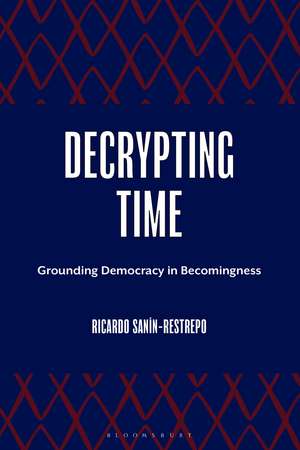
Decrypting Time: Grounding Democracy in Becomingness: Decrypting Power and Coloniality: Philosophical Perspectives from and through the Global South
Autor Ricardo Sanín-Restrepoen Limba Engleză Hardback – 2 apr 2027
Ricardo Sanín-Restrepo radically reframes our understanding of reality and time to expose the ontological basis for true democracy and legitimate power, proposing that time is not a single line but a rupture articulated across two irreducible dimensions. The first-Meillassoux's hyper-chaos-is the radical, unbridled contingency where no law, trajectory, or final state is necessary, creating a world that is 'rational' precisely because it lacks any fixed necessity to be the way it is. The second is the emergence of meaning and irreversible succession when and if hyper-chaos acts. Since being is radically contingent, no meaning can be given in advance; it therefore arises as a collective, conflictual labor. By connecting these two dimensions through the theory of encryption of power, the book forges a new political ontology that grounds democracy in the unqualified power of becomingness.
This book, rather than being about a philosophy of temporality, is about the radical power of time to create without necessity, the rationality of unreason, and the worlds that emerge when meaning arises without ground. It concerns how such emergences shape the orders and distributions of the sensible of the world, while holding fast to our central proof: being is contingent. And it explores a radical democracy that serves as the political horizon where no identity or order can be imposed as necessary.





Preț: 560.58 lei
Preț vechi: 828.55 lei
-32% Precomandă
Puncte Express: 841
Carte nepublicată încă
Livrare prin curier în România Precomanda se expediază când titlul devine disponibil.
Transport gratuit pentru acest produs Plată online sau ramburs, în funcție de opțiunile comenzii.
Retur gratuit în 14 zile Comandă securizată și suport în română.
Doresc să fiu notificat când acest titlu va fi disponibil:
Se trimite...
Specificații
ISBN-13: 9798216485698
Pagini: 226
Ilustrații: 1 table
Dimensiuni: 152 x 229 x 12 mm
Greutate: 0.31 kg
Editura: Bloomsbury Publishing
Colecția Bloomsbury Academic
Seria Decrypting Power and Coloniality: Philosophical Perspectives from and through the Global South
Locul publicării:New York, United States
Pagini: 226
Ilustrații: 1 table
Dimensiuni: 152 x 229 x 12 mm
Greutate: 0.31 kg
Editura: Bloomsbury Publishing
Colecția Bloomsbury Academic
Seria Decrypting Power and Coloniality: Philosophical Perspectives from and through the Global South
Locul publicării:New York, United States
Cuprins
Introduction
1. The Historical and Anthropological Proofs
2. The First Ontological Path
3. Meillassoux's Philosophical Breakthrough
4. The Ontological Core: Becomingness as a Modality of Hyper-Chaos
5. Time Absolute and Meaning in Time
Conclusion: The Political Ontology of Becomingness
Notes
Bibliography
Index
1. The Historical and Anthropological Proofs
2. The First Ontological Path
3. Meillassoux's Philosophical Breakthrough
4. The Ontological Core: Becomingness as a Modality of Hyper-Chaos
5. Time Absolute and Meaning in Time
Conclusion: The Political Ontology of Becomingness
Notes
Bibliography
Index
Recenzii
In an exemplary instance of serendipity, I realized I had for years been circling around the elusive mechanics of contemporary domination without possessing the exact concept-rather as Molière's Monsieur Jourdain spoke prose without knowing it. Ricardo Sanín-Restrepo's work provides that precise, indispensable tool. In Decrypting Time, he brilliantly exposes the ultimate structures of the encryption of power. A vital, gripping intervention for late democracy.
A genuine and serious philosophical contribution to the literature on political ontology and radical democratic theory. Its ambition is clear, its originality recognisable, and its interdisciplinary range impressive. This work has the potential to make a distinctive and lasting contribution to its field.
A genuine and serious philosophical contribution to the literature on political ontology and radical democratic theory. Its ambition is clear, its originality recognisable, and its interdisciplinary range impressive. This work has the potential to make a distinctive and lasting contribution to its field.