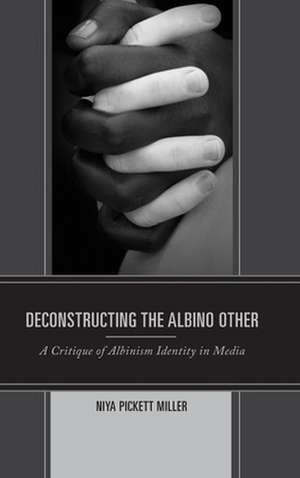
Deconstructing the Albino Other: A Critique of Albinism Identity in Media
Autor Niya Pickett Milleren Limba Engleză Hardback – 3 noi 2020
Preț: 523.22 lei
Preț vechi: 814.73 lei
-36%
Puncte Express: 785
Carte tipărită la comandă
Livrare economică 23 noiembrie-07 decembrie
Livrare prin curier în România Termenul estimat este afișat lângă disponibilitate.
Transport gratuit pentru acest produs Plată online sau ramburs, în funcție de opțiunile comenzii.
Retur gratuit în 14 zile Comandă securizată și suport în română.
Specificații
ISBN-13: 9781793630872
ISBN-10: 1793630879
Pagini: 134
Ilustrații: 3 b/w photos;
Dimensiuni: 161 x 229 x 15 mm
Greutate: 0.36 kg
Editura: Bloomsbury Publishing
Colecția Lexington Books
Locul publicării:New York, United States
ISBN-10: 1793630879
Pagini: 134
Ilustrații: 3 b/w photos;
Dimensiuni: 161 x 229 x 15 mm
Greutate: 0.36 kg
Editura: Bloomsbury Publishing
Colecția Lexington Books
Locul publicării:New York, United States
Cuprins
Preface: Why This Book Matters
Chapter 1: Introduction
Chapter 2: The (Evil) Albino Trope
Chapter 3: (Re)constituting Albinic Identity
Chapter 4: "Other" White Storytellers: Emancipating Albinism Identity through Personal Narratives
Chapter 5: Conclusion
References
About the Author
Chapter 1: Introduction
Chapter 2: The (Evil) Albino Trope
Chapter 3: (Re)constituting Albinic Identity
Chapter 4: "Other" White Storytellers: Emancipating Albinism Identity through Personal Narratives
Chapter 5: Conclusion
References
About the Author
Recenzii
An important contribution on multiple disciplinary fronts, Niya Pickett Miller presents a compelling look at the intersections of rhetoric, race, and identity through an understudied context, albinism. Miller's book sheds light on albinism not as a medical condition, rather as a rhetorical construct. The author weaves an education of albinism into a critical read of popular media texts, providing insight on the ways in which racial identity and albinism become conflated. Miller exposes popular media's portrayal of albinism as a trope inappropriately deployed for humor or fear, providing all readers a reminder of the consequences of albinism when mediated in this way.
Starting with her personal connections to albinism, Niya Pickett Miller quickly turns this study into a compellingly critical look at whiteness, blackness, and all of the ways that society "races" individuals. Through her critical readings of various media texts, the author explores how race is often visualized. Because of its visual markings, albinism is often interpreted as a lack of race, making the seemingly random social construction of race apparent. Miller not only provides the reader with an important look at an unexplored approach to race, but does so through texts that are widely recognized.
Starting with her personal connections to albinism, Niya Pickett Miller quickly turns this study into a compellingly critical look at whiteness, blackness, and all of the ways that society "races" individuals. Through her critical readings of various media texts, the author explores how race is often visualized. Because of its visual markings, albinism is often interpreted as a lack of race, making the seemingly random social construction of race apparent. Miller not only provides the reader with an important look at an unexplored approach to race, but does so through texts that are widely recognized.