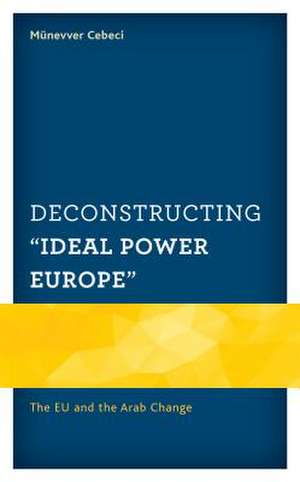
Deconstructing "Ideal Power Europe": Europe and the World
Autor Münevver Cebecien Limba Engleză Hardback – 31 dec 2018


Preț: 549.28 lei
Preț vechi: 815.22 lei
-33%
Puncte Express: 824
Carte tipărită la comandă
Livrare economică 22 octombrie-05 noiembrie
Livrare prin curier în România Termenul estimat este afișat lângă disponibilitate.
Transport gratuit pentru acest produs Plată online sau ramburs, în funcție de opțiunile comenzii.
Retur gratuit în 14 zile Comandă securizată și suport în română.
Specificații
ISBN-13: 9781498539036
ISBN-10: 1498539033
Pagini: 156
Dimensiuni: 157 x 235 x 13 mm
Greutate: 0.4 kg
Editura: Lexington Books
Colecția Europe and the World
Seria Europe and the World
Locul publicării:New York, United States
ISBN-10: 1498539033
Pagini: 156
Dimensiuni: 157 x 235 x 13 mm
Greutate: 0.4 kg
Editura: Lexington Books
Colecția Europe and the World
Seria Europe and the World
Locul publicării:New York, United States
Cuprins
1. Foreign Policy, Sovereignty, Identity and Foreign Policy Research
2. European Foreign Policy Research: An Overview
3. The "Ideal Power Europe" Metanarrative
4. European Foreign Policy on the Southern Mediterranean: Discourse, Practice, and Research
5. Displacing the 'Ideal Power Europe' Meta-Narrative: A Second Reading of European Foreign Policy Regarding Arab Change
2. European Foreign Policy Research: An Overview
3. The "Ideal Power Europe" Metanarrative
4. European Foreign Policy on the Southern Mediterranean: Discourse, Practice, and Research
5. Displacing the 'Ideal Power Europe' Meta-Narrative: A Second Reading of European Foreign Policy Regarding Arab Change
Recenzii
In this excellent and highly engaging analysis of EU discourses on the Southern Mediterranean, Cebeci masterfully unsettles the comfortable self-appraisals of many EU scholars and practitioners. A sobering must-read for anyone interested in EU foreign policy and EU-Arab relations.
At a time when the EU seems to be in search of its role and identity in general and vis-à-vis its neighbors in particular, Münevver Cebeci offers a very timely and distinct analysis of the role of discourse in EU foreign policy. By providing a detailed post-structuralist interrogation of how the EU uses discourse and the depiction of itself as post-modern, post-sovereign and normative as tools to construct and reproduce an "ideal" self and an "inferior" and "imperfect" other, she sheds a much welcome light on the de facto legitimizing practices driving the EU's supposedly hegemonic ambitions in the space beyond its territorial borders. Drawing on Foucault's governmentality approach, this insightful study is a stark and much overdue reminder to all European Studies scholars and students alike to look beneath the surface of idealized and idealizing role concepts and EU foreign policy behavior. With this enlightening book, Cebeci puts herself at the forefront of the literature addressing the linkage between EU foreign policy, identity and sovereignty."
In this book Münevver Cebeci offers a reading of current EU policy towards the Southern Mediterranean that is both critical and original. In contrast to the overwhelming majority of accounts in this field, the book provides a historically conscious account of the EU's current approach to its southern "neighborhood". Cebeci debunks a number of tacit assumptions and myths that cloud our understanding of the EU's foreign policy - its current orientation, its past record and its future prospects. As she also skilfully shows, these myths are not only perpetuated by the EU organizations itself; they are also the result of a vast scholarship, stuck in an idealized conception of the EU project.
In a world where Europe's influence is arguably more necessary than ever, Munevver Cebeci provides us with a precious counterpoint to the dominant analysis on EU foreign policy. The EU may think of itself as an "ideal power," in contrast in particular to its imperfect Arab neighbor, but such is not the secret for effectiveness in a post-colonial world. In the end, says Dr Cebeci, the EU will need to move from its narrow emphasis over security concerns and technocratic recipes to the more robust politics of democratic transformation in the region.
At a time when the EU seems to be in search of its role and identity in general and vis-à-vis its neighbors in particular, Münevver Cebeci offers a very timely and distinct analysis of the role of discourse in EU foreign policy. By providing a detailed post-structuralist interrogation of how the EU uses discourse and the depiction of itself as post-modern, post-sovereign and normative as tools to construct and reproduce an "ideal" self and an "inferior" and "imperfect" other, she sheds a much welcome light on the de facto legitimizing practices driving the EU's supposedly hegemonic ambitions in the space beyond its territorial borders. Drawing on Foucault's governmentality approach, this insightful study is a stark and much overdue reminder to all European Studies scholars and students alike to look beneath the surface of idealized and idealizing role concepts and EU foreign policy behavior. With this enlightening book, Cebeci puts herself at the forefront of the literature addressing the linkage between EU foreign policy, identity and sovereignty."
In this book Münevver Cebeci offers a reading of current EU policy towards the Southern Mediterranean that is both critical and original. In contrast to the overwhelming majority of accounts in this field, the book provides a historically conscious account of the EU's current approach to its southern "neighborhood". Cebeci debunks a number of tacit assumptions and myths that cloud our understanding of the EU's foreign policy - its current orientation, its past record and its future prospects. As she also skilfully shows, these myths are not only perpetuated by the EU organizations itself; they are also the result of a vast scholarship, stuck in an idealized conception of the EU project.
In a world where Europe's influence is arguably more necessary than ever, Munevver Cebeci provides us with a precious counterpoint to the dominant analysis on EU foreign policy. The EU may think of itself as an "ideal power," in contrast in particular to its imperfect Arab neighbor, but such is not the secret for effectiveness in a post-colonial world. In the end, says Dr Cebeci, the EU will need to move from its narrow emphasis over security concerns and technocratic recipes to the more robust politics of democratic transformation in the region.