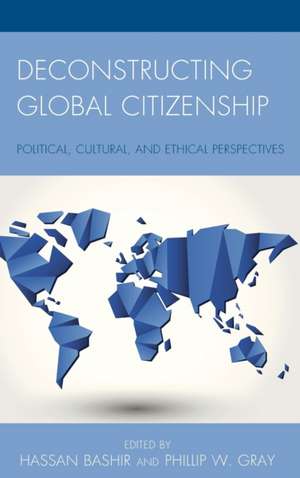
Deconstructing Global Citizenship: Political, Cultural, and Ethical Perspectives
Editat de Hassan Bashir, Phillip W. Gray Contribuţii de Ahmed Bashir, Alexandria Innes, Hamza Bin Jehangir, Tanya Kane, Bettina Koch, Christopher Lamont, Khalid Mir, Salma Mousa, Nancy Small, Rashmika Pandya, Francis Robinson, Sanee Sajjad, Sara Jordan, Robin Seelan, Yan I. Vaslavskiy, Professor Andrej Zwitteren Limba Engleză Hardback – 30 oct 2015
Preț: 676.25 lei
Preț vechi: 1021.60 lei
-34%
Puncte Express: 1014
Preț estimativ în valută:
119.68€ • 139.87$ • 103.91£
119.68€ • 139.87$ • 103.91£
Carte tipărită la comandă
Livrare economică 20 februarie-06 martie
Preluare comenzi: 021 569.72.76
Specificații
ISBN-13: 9781498502580
ISBN-10: 149850258X
Pagini: 342
Ilustrații: 2 Charts, 5 Tables
Dimensiuni: 157 x 238 x 30 mm
Greutate: 0.64 kg
Editura: Bloomsbury Publishing
Colecția Lexington Books
Locul publicării:New York, United States
ISBN-10: 149850258X
Pagini: 342
Ilustrații: 2 Charts, 5 Tables
Dimensiuni: 157 x 238 x 30 mm
Greutate: 0.64 kg
Editura: Bloomsbury Publishing
Colecția Lexington Books
Locul publicării:New York, United States
V-ar putea interesa
-
 -9%Preț: 327.39 lei358.46 lei
 -
 -18%Preț: 353.21 lei433.03 lei
 -
 -26%Preț: 338.93 lei459.17 lei
 -
 Preț: 407.09 lei
 -
 A New World OrderAnne-Marie SlaughterPreț: 282.03 lei
 -
 Globalisation In World HistoryA. G. Hopkins-32%Preț: 93.12 lei136.72 lei
 -
 -17%Preț: 92.66 lei111.09 lei
 -
 Preț: 258.11 lei
 -
 Globalization / Anti-GlobalizationDavid HeldPreț: 144.67 lei
 -
 Minor TransnationalismF LionnetPreț: 274.30 lei
 -
 Rethinking GlobalizationNick BisleyPreț: 270.00 lei
 -
 Preț: 529.48 lei
 -
 TescopolyAndrew SimmsPreț: 159.11 lei
 -
 Preț: 93.42 lei
Cuprins
Introduction: Deconstructing Global Citizenship, Hassan Bashir & Phillip W. Gray
Chapter 1: The Modern State: Citizenship, Multiculturalism and Globalization, Francis Robinson
Chapter 2: (Re) Situating the West's Cultural Others in International Relations Theory: Towards Developing Joint East-West Perspectives, Hassan Bashir & Hamza bin Jehangir
Chapter 3: The Limited Virtue of Tolerance in a Globalized World, Phillip W. Gray
Chapter 4: Civil Economy: Re-imagining an Ethical Economy and the Implications for Citizenship, Khalid Mir
Chapter 5: Citizenship in the Age of Global Surveillance: Some Observations on the Change in State-Citizen Relationship, Bettina Koch
Chapter 6: Deciding What to Do: A Universal Code of Ethics for Global Citizenship, Andrej Zwitter
Chapter 7: Citizenship, History and Culture: Derrida's Monolingualism of the Other in a Post 9/11 World, Rashmika Pandya
Chapter 8: Challenges of Religious Universality to Global Citizenship: Ethical Implications for Today, Robin Seelan
Chapter 9: Practice-Dependence, Cosmopolitanism and Conflict Avoidance, Kevin Gray
Chapter 10: Multiculturalism is Not Dead: Positive Experience of Multicultural Society Management in Russia, Yan I. Vaslavskiy
Chapter 11: Faith, Class and Citizenship in Conflict: The Christian Predicament in the Syrian and Egyptian Uprisings, Salma Mousa
Chapter 12: Human Security in a Globalized World: Reflections on Japan's Official Development Assistance Programs, Alexandria Innes & Christopher Lamont
Chapter 13: Global Imperatives versus Local Needs: Analysis of Agricultural Development and Food Security in Rural South Asia, Sanee Sajjad
Chapter 14: Non-adherence to international IP protection standards in less developed countries: The case of Pakistan, Ahmed Bashir
Chapter 15: Mobilizing Democracy in Post-Colonial Africa: The Case for Democracy in the Thought of Kwame Nkrumah, Sara Jordan
Chapter 16: Education in a Globalized World: Education City and the Recalibration of Qatari Citizens, Tanya Kane
Chapter 17: Qatar's Globalized Citizenry and the Majlis Culture: Insights from Habermas's Theory of the Development of a Public Sphere, Nancy Small
Chapter 1: The Modern State: Citizenship, Multiculturalism and Globalization, Francis Robinson
Chapter 2: (Re) Situating the West's Cultural Others in International Relations Theory: Towards Developing Joint East-West Perspectives, Hassan Bashir & Hamza bin Jehangir
Chapter 3: The Limited Virtue of Tolerance in a Globalized World, Phillip W. Gray
Chapter 4: Civil Economy: Re-imagining an Ethical Economy and the Implications for Citizenship, Khalid Mir
Chapter 5: Citizenship in the Age of Global Surveillance: Some Observations on the Change in State-Citizen Relationship, Bettina Koch
Chapter 6: Deciding What to Do: A Universal Code of Ethics for Global Citizenship, Andrej Zwitter
Chapter 7: Citizenship, History and Culture: Derrida's Monolingualism of the Other in a Post 9/11 World, Rashmika Pandya
Chapter 8: Challenges of Religious Universality to Global Citizenship: Ethical Implications for Today, Robin Seelan
Chapter 9: Practice-Dependence, Cosmopolitanism and Conflict Avoidance, Kevin Gray
Chapter 10: Multiculturalism is Not Dead: Positive Experience of Multicultural Society Management in Russia, Yan I. Vaslavskiy
Chapter 11: Faith, Class and Citizenship in Conflict: The Christian Predicament in the Syrian and Egyptian Uprisings, Salma Mousa
Chapter 12: Human Security in a Globalized World: Reflections on Japan's Official Development Assistance Programs, Alexandria Innes & Christopher Lamont
Chapter 13: Global Imperatives versus Local Needs: Analysis of Agricultural Development and Food Security in Rural South Asia, Sanee Sajjad
Chapter 14: Non-adherence to international IP protection standards in less developed countries: The case of Pakistan, Ahmed Bashir
Chapter 15: Mobilizing Democracy in Post-Colonial Africa: The Case for Democracy in the Thought of Kwame Nkrumah, Sara Jordan
Chapter 16: Education in a Globalized World: Education City and the Recalibration of Qatari Citizens, Tanya Kane
Chapter 17: Qatar's Globalized Citizenry and the Majlis Culture: Insights from Habermas's Theory of the Development of a Public Sphere, Nancy Small
Recenzii
How does one live in an increasingly deterritorialized world that is still shaped by a state-centric conception of citizenship? Taking up this profound question from the perspective of the Global South, this volume is a timely meditation on the forms and functions of citizenship in a globalized world. Drawing from many different disciplinary perspectives and covering a wide range of empirical and geographical contexts, the essays in this collection provide some important insights into mutating conceptions of citizenship, new forms of subjectivity, and shifting articulations of justice in our contemporary world.
Many commentators have grappled with the impact of the multiple processes of globalization on the content and practices of citizenship. Few however have done this as incisively and innovatively as the contributors to the volume edited by Bashir and Gray. By bringing together superbly researched accounts from a diversity of disciplinary, historical, and regional perspectives, the collection provides a wealth of solid knowledge and sharp insights on the globalization and citizenship nexus. It is expected that the conceptual sophistication, empirical scope, and theoretical depth of the volume will make it invaluable for the teaching, explanation, and understanding of the complex and uneasy relationship between citizenship and globalization.
Many commentators have grappled with the impact of the multiple processes of globalization on the content and practices of citizenship. Few however have done this as incisively and innovatively as the contributors to the volume edited by Bashir and Gray. By bringing together superbly researched accounts from a diversity of disciplinary, historical, and regional perspectives, the collection provides a wealth of solid knowledge and sharp insights on the globalization and citizenship nexus. It is expected that the conceptual sophistication, empirical scope, and theoretical depth of the volume will make it invaluable for the teaching, explanation, and understanding of the complex and uneasy relationship between citizenship and globalization.