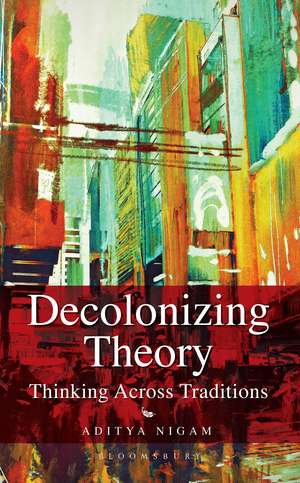
Decolonizing Theory: Thinking across Traditions
Autor Aditya Nigamen Limba Engleză Hardback – 31 iul 2020
modernity and secularism to its democracy and even capitalism, is always seen to be deficient. In other words, all it tells us is that we do not live up to the standards set by Western modernity. From this point of departure, it seeks to create a conceptual space outside (Western) modernity and capitalism, by insisting on a rethink of non-synchronous synchronicities.
The book takes three key themes around which the whole story of modernity can be unraveled, namely the question of the political, capital and historical time, and secularism for a detailed discussion. It does so by bracketing, in a sense, the autobiographical story that Western modernity gives itself. In each case, it tries to show that past forms never simply disappear, without residue, to be fully supplanted by the modern, and merely applying theory produced in one context to another is, therefore, very misleading.
Preț: 550.63 lei
Preț vechi: 819.06 lei
-33%
Carte disponibilă
Livrare economică 30 octombrie-13 noiembrie
Specificații
ISBN-10: 9388630475
Pagini: 320
Dimensiuni: 142 x 220 x 20 mm
Greutate: 0.47 kg
Editura: Bloomsbury Publishing
Colecția Bloomsbury Academic India
Locul publicării:New Delhi, India
Cuprins
Chapter 1: Theoretical Decolonization: A New Conjuncture
Chapter 2: Modernity and Coloniality: Beyond Kaviraj's Revisionist Theory
Chapter 3: Marxism and Non-Western Thought: Apropos a Debate on Slavoj Zizek
Chapter 4: Theorizing the Political: Mandala and the Idea of Social Polity
Chapter 5: Secularism and Subalternity: The Paramodern and the Puranic
Chapter 6: Capital and Historical Time: Synchronicity of the Non-synchronous
Chapter 7: Conclusion
Recenzii
Notă biografică
Aditya Nigam is Professor at the Centre for the Study of Developing Societies, Delhi. His main areas of interest are political philosophy and social theory.
His recent work has been concerned with the decolonization of social and political theory. He has earlier worked on ideological and discursive formations and their relationship to the emergence and constitution of political subjectivities. The engagement with discursive formations has led to the need for greater attentiveness to the actual thought-worlds and imaginations of social agents and the need to step outside theoretical frames provided by standard theory, derived primarily from Western experience.
In particular, Nigam is interested in theorizing the contemporary experience of politics, populism and democracy in the non-West - treating the non-West as the ground for 'doing theory', rather than a field for application or testing of standard frameworks derived from the Western experience.
A parallel and related part of Nigam's work has been concerned with interrogating the received 'philosophical history' of capital, once again from the vantage point of the experiences of India and the non-West.
Aditya Nigam has also been associated with a group of South Asian scholars from Sri Lanka, Pakistan, and India, working around the idea of the 'post-national condition'.
He also works with the CSDS's Indian Languages Programme and is on the editorial board of its Hindi journal Pratiman. He comments regularly on contemporary political issues on the blog, kafila.online
He is the author of The Insurrection of Little Selves: The Crisis of Secular Nationalism in India (2006), Power and Contestation: India Since 1989, with Nivedita Menon (2007), After Utopia: Modernity and Socialism and the Postcolony (2010), and Desire Named Development (2011).