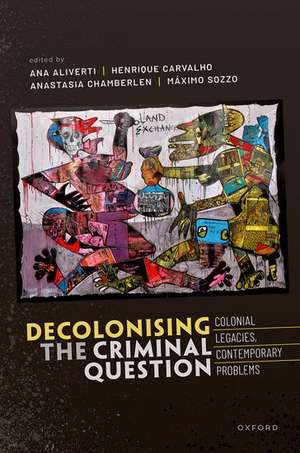
Decolonizing the Criminal Question: Colonial Legacies, Contemporary Problems
Editat de Ana Aliverti, Henrique Carvalho, Anastasia Chamberlen, Máximo Sozzoen Limba Engleză Hardback – 8 iun 2023
Preț: 796.78 lei
Preț vechi: 1171.86 lei
-32%
Puncte Express: 1195
Carte disponibilă
Livrare economică 12-18 noiembrie
Livrare prin curier în România Termenul estimat este afișat lângă disponibilitate.
Transport gratuit pentru acest produs Plată online sau ramburs, în funcție de opțiunile comenzii.
Retur gratuit în 14 zile Comandă securizată și suport în română.
Specificații
ISBN-13: 9780192899002
ISBN-10: 0192899007
Pagini: 416
Dimensiuni: 163 x 241 x 26 mm
Greutate: 0.81 kg
Editura: OUP OXFORD
Colecția OUP Oxford
Locul publicării:Oxford, United Kingdom
ISBN-10: 0192899007
Pagini: 416
Dimensiuni: 163 x 241 x 26 mm
Greutate: 0.81 kg
Editura: OUP OXFORD
Colecția OUP Oxford
Locul publicării:Oxford, United Kingdom
V-ar putea interesa
-
 The Preventive Turn in Criminal LawHenrique Carvalho-31%Preț: 645.89 lei937.37 lei
 -
 Embodying Punishment: Emotions, Identities, and Lived Experiences in Women's PrisonsAnastasia Chamberlen-29%Preț: 537.43 lei752.03 lei
 -
 Policing the Borders WithinAna Aliverti-33%Preț: 710.94 lei1055.41 lei
 -
 Police Culture: Themes and ConceptsTom CockcroftPreț: 470.73 lei
 -
 Child Pornography: Law and PolicyAlisdair A. Gillespie-15%Preț: 472.57 lei555.97 lei
 -
 Penal Exceptionalism?: Nordic Prison Policy and PracticeThomas UgelvikPreț: 467.12 lei
 -
 -18%Preț: 1309.41 lei1596.85 lei
 -
 Crimmigrant NationsRobert Koulish-23%Preț: 774.95 lei1006.43 lei
 -
 Organised Crime in European BusinessesErnesto Savona-18%Preț: 1250.55 lei1525.06 lei
 -
 Domestic Violence in International ContextDiana Scharff Peterson-18%Preț: 1249.78 lei1524.13 lei
 -
 The Routledge Handbook of Technology, Crime and JusticeM. R. McGuire-18%Preț: 2087.68 lei2545.95 lei
 -
 Order and Conflict in Public SpaceMattias De Backer-18%Preț: 1249.78 lei1524.13 lei
 -
 Engaging with Ethics in International Criminological ResearchMichael Adorjan-15%Preț: 421.23 lei495.57 lei
 -
 -22%Preț: 87.90 lei113.28 lei
 -
 -26%Preț: 1668.73 lei2256.04 lei
 -
 Crime and Economics: An IntroductionKevin Albertson-15%Preț: 428.60 lei504.24 lei
 -
 -15%Preț: 450.77 lei530.31 lei
 -
 New Directions in Criminological TheorySteve HallPreț: 471.37 lei
 -
 -34%Preț: 555.56 lei837.23 lei
 -
 WJEC Level 3 Applied Certificate & Diploma Criminology: Revised EditionCarole A Henderson-19%Preț: 249.54 lei307.70 lei
 -
 Prisons, Inmates and Governance in Latin AmericaMáximo Sozzo-18%Preț: 762.89 lei930.36 lei
 -
 The Palgrave Handbook of Criminology and the Global SouthKerry CarringtonPreț: 1598.62 lei
Notă biografică
Ana Aliverti is a Professor of Law at the School of Law, University of Warwick. She holds a D.Phil. in Law (Oxford, 2012), an MSc in Criminology and Criminal Justice (Distinction, Oxford, 2008), an MA in Sociology of Law (IISL, 2005) and a BA in Law (Honours, Buenos Aires, 2002). Her research explores questions of national identity and belonging in criminal justice, and of law, sovereignty and globalisation. She has led extensive empirical work in the UK's criminal justice and immigration systems. She is the author of Crimes of Mobility (Routledge, 2013) and Policing the Borders Within (OUP, 2021). She was co-awarded the British Society of Criminology Best Book Prize for 2014, and has received the British Academy Rising Star Engagement Award (BARSEA) (2015), the Philip Leverhulme Prize in Law (2017), and the British Journal of Criminology's Radzinowicz Prize. She is co-Director of the Criminal Justice Centre at Warwick and the Associate Director of Border Criminologies.Henrique Carvalho's research interests lie in the areas of criminal law, criminalisation and punishment, and legal, social, political and cultural theory. He joined the University of Warwick in September 2015, having previously worked as a Lecturer in Law at City, University of London, a Visiting Lecturer at King's College London and a Graduate Teaching Assistant at the London School of Economics.Anastasia Chamberlen's research interests lie in the areas of theoretical criminology, the sociology of punishment and prisons, feminist theory and theoretical debates in the study of emotions, embodiment and the arts in criminal justice. Having previously worked as a lecturer in criminology at Birkbeck, University of London, she joined Warwick's Sociology Department in 2016 as Associate Professor of Sociology.Over the last 25 years Máximo Sozzo has completed research in different areas of contemporary criminology, always with a focus on Latin America and Argentina. He is now working on prisons and power, historical transformations of punishment, the mechanisms of sentencing without trial, and the travels of ideas about the criminal question across the Global North and South.