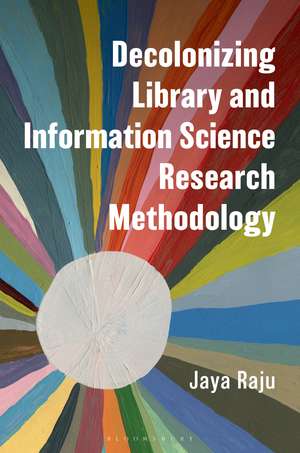
Decolonizing Library and Information Science Research Methodology: Association for Library and Information Science Education
Autor Jaya Rajuen Limba Engleză Hardback – 12 oct 2026
"Information" as conceptualized in the discipline of Library and Information Science (LIS) is not neutral. Library and information services increasingly, in the current digital information age, engage historical, cultural, social, economic, and political forces that interact with information. Such forces may use information to advance dominant epistemic agendas; hence there is a need for LIS researchers, students, practitioners, and other relevant stakeholders to critically interrogate and disrupt these forces in their curation of information for use in research, practice, theory development, policy application, etc.
This book engages decolonial perspectives in LIS research methodology for a transformative and critically reflexive approach to research that is community-based, culturally responsive and impactful for Indigenous and other historically marginalized communities. It positions decolonization as rejecting the privileging in scholarship of dominant western knowledge systems and intellectual traditions. Instead, it calls for the centering of perspectives, insights, and knowledges of Indigenous and other marginalized societies so that research may be inclusive of all knowledge systems, respectful of the researched, and of different ways of knowing embedded in the worldviews of others.


Preț: 616.08 lei
Preț vechi: 915.52 lei
-33% Precomandă
Puncte Express: 924
Carte nepublicată încă
Livrare prin curier în România Precomanda se expediază când titlul devine disponibil.
Transport gratuit pentru acest produs Plată online sau ramburs, în funcție de opțiunile comenzii.
Retur gratuit în 14 zile Comandă securizată și suport în română.
Doresc să fiu notificat când acest titlu va fi disponibil:
Se trimite...
Specificații
ISBN-13: 9781538187470
ISBN-10: 1538187477
Pagini: 280
Ilustrații: 3 bw illus
Dimensiuni: 156 x 235 mm
Editura: Bloomsbury Publishing
Colecția Bloomsbury Libraries Unlimited
Seria Association for Library and Information Science Education
Locul publicării:New York, United States
ISBN-10: 1538187477
Pagini: 280
Ilustrații: 3 bw illus
Dimensiuni: 156 x 235 mm
Editura: Bloomsbury Publishing
Colecția Bloomsbury Libraries Unlimited
Seria Association for Library and Information Science Education
Locul publicării:New York, United States
Cuprins
Dedication
Contents
Acknowledgements
Introduction
1. Library and Information Science Research Methodology: Ontology, Epistemology, Axiology and Methodology
2. Conceptual Framing: Decolonizing Library and Information Science Research Methodology
3. Research Approaches and Paradigms in Library and Information Science Research: Why the Need for an Epistemic 'Decolonial Turn'?
4. Decolonizing Research Methodology in Library and Information Science Research for Transformative Analysis of 'Lived Experiences' and 'Other Ways of Knowing'
5. Theory Intervention in Decolonizing Library and Information Science Research
6. Case Study 1: Decolonizing Library and Information Science Research Methodology - Africa
7. Case Study 2: Decolonizing Library and Information Science Research Methodology - Asia-Oceania
8. Case Study 3: Decolonizing Library and Information Science Research Methodology - North America
9. 'Braiding' Indigenous Knowledge Systems and Western Epistemologies in Library and Information Science Research Methodology: Opportunities for Co-existence and Convergence in Research
10. Decolonizing Library and Information Science Research Methodology: A Heuristic Tool in Library and Information Science Education for Socially Responsive and Impactful Research
References
Index
Contents
Acknowledgements
Introduction
1. Library and Information Science Research Methodology: Ontology, Epistemology, Axiology and Methodology
2. Conceptual Framing: Decolonizing Library and Information Science Research Methodology
3. Research Approaches and Paradigms in Library and Information Science Research: Why the Need for an Epistemic 'Decolonial Turn'?
4. Decolonizing Research Methodology in Library and Information Science Research for Transformative Analysis of 'Lived Experiences' and 'Other Ways of Knowing'
5. Theory Intervention in Decolonizing Library and Information Science Research
6. Case Study 1: Decolonizing Library and Information Science Research Methodology - Africa
7. Case Study 2: Decolonizing Library and Information Science Research Methodology - Asia-Oceania
8. Case Study 3: Decolonizing Library and Information Science Research Methodology - North America
9. 'Braiding' Indigenous Knowledge Systems and Western Epistemologies in Library and Information Science Research Methodology: Opportunities for Co-existence and Convergence in Research
10. Decolonizing Library and Information Science Research Methodology: A Heuristic Tool in Library and Information Science Education for Socially Responsive and Impactful Research
References
Index
Recenzii
Jaya Raju's Decolonizing Library and Information Science Research Methodology is a timely, intellectually rigorous, and groundbreaking contribution to Library and Information Science (LIS) scholarship. Challenging the long-standing dominance of western epistemological traditions in LIS research, the monograph advances inclusive, socially responsive, and contextually grounded methodological perspectives rooted in global south and Indigenous knowledge systems. Foregrounding decoloniality, social justice, and epistemic plurality, this seminal work reimagines the philosophical foundations of LIS research and opens innovative pathways for scholars, educators, and practitioners worldwide. It is an essential text that will significantly shape contemporary and future discourse on LIS research methodology.
Decolonizing Library and Information Science Research Methodology is a timely and significant contribution to the LIS field. It rigorously engages with the theoretical foundations and challenges the ongoing dominance of western paradigms in LIS research. Professor Raju draws on rich international case studies and diverse lived experiences of scholars engaged in decolonizing research. Her work actively promotes Indigenous and marginalized perspectives and offers practical pathways for transforming methodological approaches to conducting research in these contexts. This is essential reading for LIS scholars, educators, and practitioners seeking to rethink research in ways that are culturally inclusive and ethically grounded.
Decolonizing Library and Information Science Research Methodology invites Library and Information Science (LIS) researchers and practitioners to think more deeply about the relationships among knowledge, power, identity, and community. By framing the text through a decolonizing lens that includes voices from Indigenous, Global South, and Global North LIS scholars, Raju challenges inherited assumptions about what LIS scientific research is and expands methodological possibilities for quantitative, qualitative, and mixed-methods research in libraries, archives, museums, and galleries. Accordingly, Raju's work is an apt textbook selection for LIS archival studies and research methods classes because it embeds cultural heritage informatics into the LIS methods conversation. Additionally, the book serves as a professional primer, providing an essential roadmap for LIS scholars seeking to conduct research that honors holistic ways of knowing and being in library and community settings. Thought-provoking and timely, this volume contributes meaningfully to the continuing transformation of LIS scholarship and practice as a socioculturally inclusive, global knowledge field within the social sciences.
Jaya Raju's Decolonizing Library and Information Science Research Methodology is a landmark contribution to the field, challenging the supposed neutrality of libraries and exposing the epistemological dominance of western knowledge systems over Indigenous and marginalized communities. The author proposes a transformative approach based on "braiding" western and Indigenous epistemologies, offering a practical and community-centered methodological framework essential not only for post-colonial nations but also for European institutions tasked with re-evaluating their canons and information access structures. This is an indispensable book for the 21st-century LIS curriculum.
Decolonizing Library and Information Science Research Methodology is a timely and significant contribution to the LIS field. It rigorously engages with the theoretical foundations and challenges the ongoing dominance of western paradigms in LIS research. Professor Raju draws on rich international case studies and diverse lived experiences of scholars engaged in decolonizing research. Her work actively promotes Indigenous and marginalized perspectives and offers practical pathways for transforming methodological approaches to conducting research in these contexts. This is essential reading for LIS scholars, educators, and practitioners seeking to rethink research in ways that are culturally inclusive and ethically grounded.
Decolonizing Library and Information Science Research Methodology invites Library and Information Science (LIS) researchers and practitioners to think more deeply about the relationships among knowledge, power, identity, and community. By framing the text through a decolonizing lens that includes voices from Indigenous, Global South, and Global North LIS scholars, Raju challenges inherited assumptions about what LIS scientific research is and expands methodological possibilities for quantitative, qualitative, and mixed-methods research in libraries, archives, museums, and galleries. Accordingly, Raju's work is an apt textbook selection for LIS archival studies and research methods classes because it embeds cultural heritage informatics into the LIS methods conversation. Additionally, the book serves as a professional primer, providing an essential roadmap for LIS scholars seeking to conduct research that honors holistic ways of knowing and being in library and community settings. Thought-provoking and timely, this volume contributes meaningfully to the continuing transformation of LIS scholarship and practice as a socioculturally inclusive, global knowledge field within the social sciences.
Jaya Raju's Decolonizing Library and Information Science Research Methodology is a landmark contribution to the field, challenging the supposed neutrality of libraries and exposing the epistemological dominance of western knowledge systems over Indigenous and marginalized communities. The author proposes a transformative approach based on "braiding" western and Indigenous epistemologies, offering a practical and community-centered methodological framework essential not only for post-colonial nations but also for European institutions tasked with re-evaluating their canons and information access structures. This is an indispensable book for the 21st-century LIS curriculum.
Notă biografică
Jaya Raju is Full Professor and Head of the Department of Knowledge and Information Stewardship at the University of Cape Town in South Africa. She holds a PhD in Information Studies and has been teaching research methodology and supervising master's and PhD research for the past 29 years.