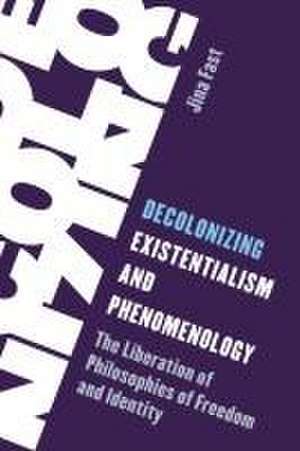
Decolonizing Existentialism and Phenomenology: The Liberation of Philosophies of Freedom and Identity: Living Existentialism
Autor Jina Fasten Limba Engleză Hardback – 15 noi 2023



Preț: 525.14 lei
Preț vechi: 790.83 lei
-34%
Puncte Express: 788
Preț estimativ în valută:
92.84€ • 108.68$ • 81.07£
92.84€ • 108.68$ • 81.07£
Carte tipărită la comandă
Livrare economică 06-20 martie
Specificații
ISBN-13: 9781538178034
ISBN-10: 1538178036
Pagini: 232
Dimensiuni: 158 x 236 x 19 mm
Greutate: 0.51 kg
Editura: Bloomsbury Publishing
Colecția Rowman & Littlefield Publishers
Seria Living Existentialism
Locul publicării:New York, United States
ISBN-10: 1538178036
Pagini: 232
Dimensiuni: 158 x 236 x 19 mm
Greutate: 0.51 kg
Editura: Bloomsbury Publishing
Colecția Rowman & Littlefield Publishers
Seria Living Existentialism
Locul publicării:New York, United States
Cuprins
Introduction: Decolonizing Existentialism and Phenomenology
Chapter 1: Roots of a Decolonial Feminist Philosophy: Beauvoir's Feminist Phenomenology and Existentialism
Chapter 2: Fanon's Phenomenological Decolonial Psychology and the Negation of Black Subjectivity
Chapter 3: Decolonizing the Paradox of Hyper-Visible Bodies, Un-visible Humanity in Wright's Native Son and Black Boy
Chapter 4: Lewis Gordon's Phenomenology of Racist Bad Faith
Chapter 5: Audre Lorde's Decolonial, Queer, Black Feminist Phenomenology
Chapter 6: Sylvia Wynter and Jamaica Kincaid: Post-Colonial Feminist Approaches to Lived Experience
Conclusion: Where do Existentialism and Phenomenology Go from Here?
Bibliography
Index
About the Author
Chapter 1: Roots of a Decolonial Feminist Philosophy: Beauvoir's Feminist Phenomenology and Existentialism
Chapter 2: Fanon's Phenomenological Decolonial Psychology and the Negation of Black Subjectivity
Chapter 3: Decolonizing the Paradox of Hyper-Visible Bodies, Un-visible Humanity in Wright's Native Son and Black Boy
Chapter 4: Lewis Gordon's Phenomenology of Racist Bad Faith
Chapter 5: Audre Lorde's Decolonial, Queer, Black Feminist Phenomenology
Chapter 6: Sylvia Wynter and Jamaica Kincaid: Post-Colonial Feminist Approaches to Lived Experience
Conclusion: Where do Existentialism and Phenomenology Go from Here?
Bibliography
Index
About the Author
Recenzii
An interesting exposition of the multiple aspects of marginalization connected to colonization using existential/phenomenological (Sartre/ Hussert) interrogation and interpretation derived from the critics Beauvoir, Wright, Wynter, Kincaid, Lewis, Lorde, and others. The book provides a comprehensive understanding of the structures of meaning, identity, and consciousness that avoid bracketing or bad faith. Fast's personal, informed, authentic stories enlighten multifaceted personal, institutional, social, and political relationships embedded in lived experiences. This approach has potentially powerful transformative appeal to a colonized audience, which recognizes its own false consciousness and bad faith fixed by its lived experiences in colonized consciousness embedded in the pre-existing place where they initially find themselves in the white world. Recommended. Upper-division undergraduates through faculty.
Lucidly written, rigorously argued with nuance, and rich with scholarly evidence, Jina Fast's Decolonizing Existentialism and Phenomenology is nothing short of an extraordinary metacritique of reason in existential phenomenological contexts. Skillfully avoiding pitfalls of epistemic apartheid and reductive reasoning, Fast not only addresses lacunae but also demonstrates, through careful reading, a wonderful synthesis through which a path is offered also for philosophy to be critically true to and beyond itself. A must read not only for anyone interested in Global Southern existential thought but also the complexity of what is needed to think across non-essentialist struggles for dignity and freedom.
Why is a philosophy-a domain of inquiry quintessentially associated with critical inquiry-so amenable to colonization and so difficult to decolonize? Jina Fast's highly readable, consistently thought-provoking text engages existentialist and phenomenological writings of Simone de Beauvoir, Frantz Fanon, Richard Wright, Audre Lorde, Lewis R. Gordon, Sylvia Wynter, and Jamaica Kincaid to clarify what it means for knowledge and consciousness to be made free.
Lucidly written, rigorously argued with nuance, and rich with scholarly evidence, Jina Fast's Decolonizing Existentialism and Phenomenology is nothing short of an extraordinary metacritique of reason in existential phenomenological contexts. Skillfully avoiding pitfalls of epistemic apartheid and reductive reasoning, Fast not only addresses lacunae but also demonstrates, through careful reading, a wonderful synthesis through which a path is offered also for philosophy to be critically true to and beyond itself. A must read not only for anyone interested in Global Southern existential thought but also the complexity of what is needed to think across non-essentialist struggles for dignity and freedom.
Why is a philosophy-a domain of inquiry quintessentially associated with critical inquiry-so amenable to colonization and so difficult to decolonize? Jina Fast's highly readable, consistently thought-provoking text engages existentialist and phenomenological writings of Simone de Beauvoir, Frantz Fanon, Richard Wright, Audre Lorde, Lewis R. Gordon, Sylvia Wynter, and Jamaica Kincaid to clarify what it means for knowledge and consciousness to be made free.