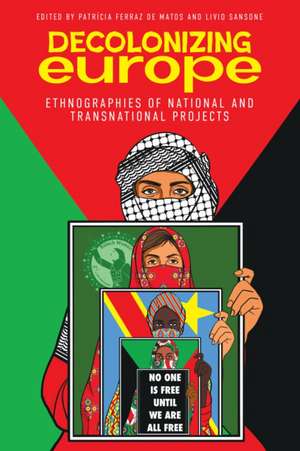
Decolonizing Europe
Editat de Patrícia Ferraz de Matos, Livio Sansoneen Limba Engleză Hardback – noi 2025
Preț: 760.27 lei
Preț vechi: 987.37 lei
-23%
Puncte Express: 1140
Carte tipărită la comandă
Livrare economică 01-15 decembrie
Livrare prin curier în România Termenul estimat este afișat lângă disponibilitate.
Transport gratuit pentru acest produs Plată online sau ramburs, în funcție de opțiunile comenzii.
Retur gratuit în 14 zile Comandă securizată și suport în română.
Specificații
ISBN-13: 9781836952480
ISBN-10: 1836952481
Pagini: 242
Dimensiuni: 157 x 235 x 18 mm
Greutate: 0.51 kg
Editura: BERGHAHN BOOKS
ISBN-10: 1836952481
Pagini: 242
Dimensiuni: 157 x 235 x 18 mm
Greutate: 0.51 kg
Editura: BERGHAHN BOOKS
Notă biografică
Patrícia Ferraz de Matos is an Integrated Researcher at the Interdisciplinary Centre for Education and Development Studies (CeiED) at Lusófona University since 2026. She was an Assistant Researcher at the Institute of Social Sciences, University of Lisbon (ULisboa) (2013-2025), and is a member of the teaching staff of the PhD Programme in Anthropology at ULisboa since 2013. She is an Associate Editor of the Anthropological Journal of European Cultures (2020-present), Coordinator of the Europeanist Network of the EASA (2020-2026), Deputy Director of Análise Social (2021-2026), and, since 2019, corresponding member in Portugal of HOAN (History of Anthropology Network, EASA). She is Fellow of the Royal Anthropological Institute of Great Britain and Ireland, elected in 2019, and since 2025 is Secretary-Elect of the Society for the Anthropology of Europe (SAE, American Anthropological Association). She is the author of The Colours of the Empire (Berghahn 2013 [Victor de Sá Prize of Contemporary History 2005]) and Anthropology, Nationalism and Colonialism (Berghahn 2023).
Descriere
This volume explores how race, colonial legacies, and structural inequality are addressed across diverse European contexts – north, central, eastern and southern – as well as in their entanglements with regions beyond Europe. It offers critical, grounded insights into the possibilities and challenges of decolonial thinking today.