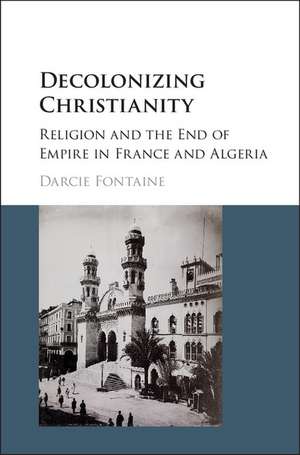
Decolonizing Christianity
Autor Darcie Fontaineen Limba Engleză Hardback – 20 iun 2016
În Decolonizing Christianity, Darcie Fontaine investighează transformarea profundă a instituțiilor creștine în contextul prăbușirii imperiilor coloniale. Notăm cu interes cum această ediție publicată de Cambridge University Press reușește să depășească narațiunea politică tradițională, integrând mărturii din arhive private algeriene despre creștinii care s-au opus colonialismului francez. Cartea debutează cu o analiză a relației dintre biserică și statul colonial, progresând rapid spre momentele de criză morală unde teologia a devenit un instrument de rezistență. Observăm că structura volumului este construită pentru a evidenția o schimbare de paradigmă: primele capitole definesc moralitatea creștină sub asediu, în timp ce ultimele secțiuni, precum „Inventing postcolonial Christianity”, detaliază modul în care aceste tensiuni locale au prefigurat reformele ecumenice globale din anii '60. Spre deosebire de lucrarea sa anterioară, Modern France and the World, unde Darcie Fontaine adopta o perspectivă de istorie globală a statului francez, aici focalizarea se mută pe dimensiunea umană și etică a decolonizării, incluzând relatări despre arestări și tortură. Comparabil cu Decolonization and the Remaking of Christianity de Elizabeth A Foster în rigurozitate, volumul de față este actualizat pentru a sublinia rolul specific al Algeriei ca laborator pentru un nou tip de angajament social. Dacă lucrarea lui Foster oferă o privire de ansamblu pe cinci continente, Decolonizing Christianity oferă o analiză chirurgicală a unui singur punct de cotitură istoric. Apreciem modul în care Darcie Fontaine demonstrează că decolonizarea nu a fost doar un proces administrativ, ci și o reconstrucție radicală a identității religioase în fața violenței și rasismului sistemic.
Preț: 597.62 lei
Preț vechi: 802.80 lei
-26%
Carte indisponibilă temporar
Specificații
ISBN-10: 1107118174
Pagini: 251
Ilustrații: 5 b/w illus.
Dimensiuni: 159 x 236 x 25 mm
Greutate: 0.52 kg
Editura: Cambridge University Press
Locul publicării:New York, United States
V-ar putea interesa
-
 Ceremony and Civility: Civic Culture in Late Medieval LondonBarbara A. Hanawalt-21%Preț: 250.45 lei315.67 lei
 -
 -17%Preț: 105.51 lei127.63 lei
 -
 Evolution of the BookFrederick G. Kilgour-28%Preț: 451.16 lei630.87 lei
 -
 Early Modern Europe: An Oxford HistoryEuan Cameron-11%Preț: 316.11 lei356.18 lei
 -
 -32%Preț: 543.99 lei800.73 lei
 -
 Preț: 322.73 lei
 -
 The Norman Kingdom of SicilyDonald MatthewPreț: 525.74 lei
 -
 Barbarian Migrations and the Roman West, 376-568Guy HalsallPreț: 320.39 lei
 -
 Reading Medieval LatinKeith SidwellPreț: 263.09 lei
 -
 The Ottoman Empire and Early Modern EuropeDaniel GoffmanPreț: 347.43 lei
 -
 Women, Family, and Gender in Islamic LawJudith E. TuckerPreț: 299.16 lei
 -
 The Byzantine LadyDonald M. NicolPreț: 206.07 lei
 -
 The Formation of Islam 1edJonathan P. BerkeyPreț: 389.06 lei
 -
 Portuguese Oceanic Expansion, 1400-1800Francisco BethencourtPreț: 376.96 lei
 -
 The Byzantine EconomyAngeliki E. LaiouPreț: 318.21 lei
 -
 The Jews of Medieval Western ChristendomRobert ChazanPreț: 334.40 lei
 -
 The Crusades, C.1071 C.1291Jean RichardPreț: 448.10 lei
 -
 Islamic HistoriographyChase RobinsonPreț: 277.60 lei
 -
 Roger II of SicilyHubert HoubenPreț: 337.74 lei
 -
 CharlemagneRosamond MckitterickPreț: 331.20 lei
 -
 German Histories in the Age of Reformations, 1400-1650Thomas A. Brady Jr.Preț: 313.18 lei
 -
 A Social History of England, 1200-1500Rosemary HorroxPreț: 441.75 lei
 -
 Medieval Africa, 1250 1800Roland OliverPreț: 386.58 lei
 -
 The Making of PolitiesJohn WattsPreț: 251.69 lei
 -
 Southeastern Europe in the Middle Ages, 500-1250Florin CurtaPreț: 434.18 lei
 -
 The Cambridge History of ChristianityMargaret M. MitchellPreț: 447.64 lei
 -
 An Economic History of EuropeKarl Gunnar PerssonPreț: 272.80 lei
 -
 Reformation EuropeUlinka RublackPreț: 232.26 lei
 -
 Medieval HeresiesChristine Caldwell AmesPreț: 274.47 lei
 -
 Preț: 501.58 lei
De ce să citești această carte
Este o resursă esențială pentru cercetătorii în istorie și teologie care doresc să înțeleagă cum s-a redefinit creștinismul în afara sferelor de putere europene. Cititorul câștigă o perspectivă unică asupra modului în care evenimentele din Algeria au forțat biserica să se confrunte cu propria complicitate în imperialism. Este o lectură fundamentală pentru înțelegerea rădăcinilor creștinismului global contemporan și a tranziției sale spre justiție socială.
Cuprins
Recenzii
'Decolonizing Christianity is a most welcome addition to histories of empire, religion, and politics. It is a must-read for historians of France and Algeria, scholars of the new imperial history, and social and intellectual historians interested in contextualizing Christianity.' Minayo Nasiali, French History
'Decolonizing Christianity is a detailed and well-researched book, which clearly succeeds in demonstrating the importance of Christianity to debates about Algerian independence on a whole host of levels. Its range is, quite simply, impressive: it moves seamlessly between Algeria, France, Vatican II and the World Council of Churches, covering Catholics and Protestants, metropole and periphery, procolonial and anti-colonial Christians. Its scholarship is equally strong: the large quantity of archival evidence is supported by twenty oral interviews, and extensive reading of the relevant anglophone and francophone historiography.' Sam Brewitt-Taylor, The Journal of Ecclesiastical History
'Darcie Fontaine's Decolonizing Christianity examines the history of Christianity in colonial Algeria, and the ramifications of decolonization on a local and global scale. It alternates between close historical details, as it narrates the lives of individual Christians living in Algeria, and broad theoretical discussion, as it shows how decolonization drove reforms of 'global Christianity' in the twentieth century. Balancing a challenging combination of minute detail and broad debate, this work paints a compelling and well-articulated portrait of decolonization and Christianity that will be of interest to a wide range of readers.' Erin Twohig, Contemporary French Civilization
'Decolonizing Christianity demonstrates the deep ties between religion and politics in France and its North African colony, as well as the reciprocal nature of theological debates across the Mediterranean. But if the book adds to a growing literature on religion and decolonisation, it makes an equally important intervention into the history of Algerian independence. Fontaine is careful not to recreate a totalising narrative of Christians' engagement in the war; in so doing, she offers a more complex and pluralistic history of Christian activism, the broader settler community, and the young Algerian state's attitude toward its religious minorities.' Terrence G. Peterson, The Journal of North African Studies
'In tracing the relationship between religion and politics across a broad timeframe while simultaneously connecting developments in Algeria to those within metropolitan France and global Christianity, Fontaine draws together geographical and chronological frames of analysis usually kept separate. This allows her to fulfil her stated objective of 'provincializing Christianity' without decontextualising it. However, the most compelling sections of the book are the ones that tell the story on the ground in Algeria. This reflects the archive-based fieldwork and oral histories Fontaine undertook in Algeria, which add much to her original and engaging study.' Clare Eldridge, Modern & Contemporary France
'The book's merits are its details and its descriptions of a wide array of Christian organizations. The author's archival research is especially commendable.' Phillip. C. Naylor, The American Historical Review
'Decolonizing Christianity offers a compelling look at the decades surrounding Algeria's independence that makes excellent use of private Algerian archives and contributes to a growing body of literature on Christianity's encounter with the end of empire, at an institutional and individual level.' Naomi Davidson, The Journal of Modern History
Descriere
Decolonizing Christianity traces the dramatic transformation of Christianity from its position as the moral foundation of European imperialism to its role as a radical voice of political and social change in the era of decolonization. As Christians renegotiated their place in the emerging Third World, they confronted the consequences of racism and violence that Christianity had reinforced in European colonies. This book tells the story of Christians in Algeria who undertook a mission to 'decolonize the Church' and ensure the future of Christianity in postcolonial Algeria.
But it also recovers the personal aspects of decolonization, as many of these Christians were arrested and tortured by the French for their support of Algerian independence. The consequences of these actions were immense, as the theological and social engagement of Christians in Algeria then influenced the groundbreaking reforms developing within global Christianity in the 1960s.