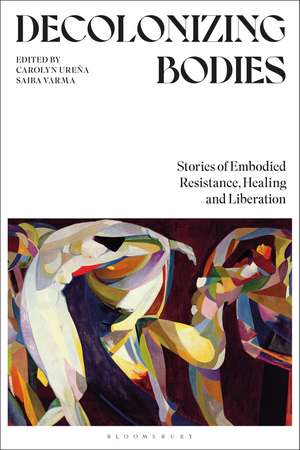
Decolonizing Bodies: Stories of Embodied Resistance, Healing and Liberation
Editat de Carolyn Ureña, Saiba Varmaen Limba Engleză Hardback – 20 feb 2025
The volume powerfully demonstrates how racism and colonialism sediment in bodily and habitual registers that are active, ongoing, made and remade. Bodies, the contributors argue, powerfully register the impacts of colonial and racialized violence, but through practices of embodiment, they also digest, expel, and transform them. In centering non-normative subjective experiences and making space for different kinds of embodied knowledge, Decolonizing Bodies also takes a step toward decolonizing academic knowledge.
This exciting and urgent book offers readers new ways of imagining, choreographing and enacting the body. Beyond connecting distant geographies of harm, it celebrates polymorphous decolonial repertoires that record, creatively narrate, and heal.
| Toate formatele și edițiile | Preț | Express |
|---|---|---|
| Paperback (1) | 149.78 lei 22-36 zile | +35.31 lei 6-12 zile |
| Bloomsbury Publishing – 20 feb 2025 | 149.78 lei 22-36 zile | +35.31 lei 6-12 zile |
| Hardback (1) | 416.35 lei 43-57 zile | |
| Bloomsbury Publishing – 20 feb 2025 | 416.35 lei 43-57 zile |
Preț: 416.35 lei
Preț vechi: 467.81 lei
-11%
Puncte Express: 625
Preț estimativ în valută:
73.71€ • 85.83$ • 64.03£
73.71€ • 85.83$ • 64.03£
Carte tipărită la comandă
Livrare economică 23 februarie-09 martie
Preluare comenzi: 021 569.72.76
Specificații
ISBN-13: 9781350374881
ISBN-10: 1350374881
Pagini: 208
Dimensiuni: 238 x 164 x 16 mm
Greutate: 0.42 kg
Editura: Bloomsbury Publishing
Colecția Bloomsbury Academic
Locul publicării:London, United Kingdom
ISBN-10: 1350374881
Pagini: 208
Dimensiuni: 238 x 164 x 16 mm
Greutate: 0.42 kg
Editura: Bloomsbury Publishing
Colecția Bloomsbury Academic
Locul publicării:London, United Kingdom
Cuprins
Acknowledgements
Introduction
Part I: Decolonizing Research
Kali (tongues) by Bhasha Chakrabarti (2016-2020)
Complex Connections: Coloniality, Embodiment, and Children of Color in the Archives - Isabelle Higgins, University of Cambridge, UK
Burnout: A Queer Femme of Color Auto-Ethnography - Alexia Arani, California Polytechnic State University, San Luis Obispo
Part II: Decolonizing Collectives
The Intertwining I by Bhasha Chakrabarti (2022)
Existing Beyond Time and Place: Understanding Queer Muslim Visibilities Online - Mardiya Siba Yahaya
Decolonized Bodies of Land and Children: Sarah Winnemucca's Landback Project in Life Among the Piutes - Kristine A. Koyama, University of Wisconsin-Milwaukee, USA
Embodying Azadi: Conscious and Unconscious Womanhood in Indian Occupied Kashmir - Inshah Malik, New Vision University, Georgia
Fragments Contain Worlds: Encounters Between Narrative Practice and Filmmaking - Xiaolu Wang & Poh Lin Lee, University of Melbourne, Australia
Part III: Sovereignties, Autonomies, Liberation
Sowing Seeds by Bhasha Chakrabarti (2018)
"Ele gosta do samba resguardo" ("He likes a rough samba"): Ceremonial Embodiments of Bahian Candomblé Caboclo - Mika Lior, York University, Canada
A Garden in a Lake of Im/Possibility - Saiba Varma
Quyca chiahac chixisqua (Sowing ourselves in the territory): Embodied Experiences of Indigenous Urban Gardens and the Coloniality of Nature - Andrea Sánchez-Castañeda (Florida International University, USA), Erika Nivia, and Jorge Yopasá (Muysca Indigenous community of Suba)
Notes on Contributors
Introduction
Part I: Decolonizing Research
Kali (tongues) by Bhasha Chakrabarti (2016-2020)
Complex Connections: Coloniality, Embodiment, and Children of Color in the Archives - Isabelle Higgins, University of Cambridge, UK
Burnout: A Queer Femme of Color Auto-Ethnography - Alexia Arani, California Polytechnic State University, San Luis Obispo
Part II: Decolonizing Collectives
The Intertwining I by Bhasha Chakrabarti (2022)
Existing Beyond Time and Place: Understanding Queer Muslim Visibilities Online - Mardiya Siba Yahaya
Decolonized Bodies of Land and Children: Sarah Winnemucca's Landback Project in Life Among the Piutes - Kristine A. Koyama, University of Wisconsin-Milwaukee, USA
Embodying Azadi: Conscious and Unconscious Womanhood in Indian Occupied Kashmir - Inshah Malik, New Vision University, Georgia
Fragments Contain Worlds: Encounters Between Narrative Practice and Filmmaking - Xiaolu Wang & Poh Lin Lee, University of Melbourne, Australia
Part III: Sovereignties, Autonomies, Liberation
Sowing Seeds by Bhasha Chakrabarti (2018)
"Ele gosta do samba resguardo" ("He likes a rough samba"): Ceremonial Embodiments of Bahian Candomblé Caboclo - Mika Lior, York University, Canada
A Garden in a Lake of Im/Possibility - Saiba Varma
Quyca chiahac chixisqua (Sowing ourselves in the territory): Embodied Experiences of Indigenous Urban Gardens and the Coloniality of Nature - Andrea Sánchez-Castañeda (Florida International University, USA), Erika Nivia, and Jorge Yopasá (Muysca Indigenous community of Suba)
Notes on Contributors
Recenzii
Decolonizing Bodies reveals both resilience and vulnerabilities of the sensuous bodies as the foundation of meaning, experience, and transformation. The rich collection of personal, scholarly, and artistic stories invites the readers to engage their own bodily awareness to sense and feel with the authors. The book is a call for reimagining the way we embody our communities and relationships through decolonial healing.
Ureña & Varma's generative, wide-ranging, multi-genre collection puts flesh and blood on decolonizing as a mode of being-perceiving-theorizing that reorients our attunement to self and world and conclusively transforms our creative and scholarly practice. Whether analyzing urban gardens in Kashmir and Colombia, reading racist US archives or mapping a process-driven exploration for a film in progress, each contribution enacts a vital aspect of the reclamation and reinterpretation integral to decolonizing knowledge.
Ureña & Varma's generative, wide-ranging, multi-genre collection puts flesh and blood on decolonizing as a mode of being-perceiving-theorizing that reorients our attunement to self and world and conclusively transforms our creative and scholarly practice. Whether analyzing urban gardens in Kashmir and Colombia, reading racist US archives or mapping a process-driven exploration for a film in progress, each contribution enacts a vital aspect of the reclamation and reinterpretation integral to decolonizing knowledge.