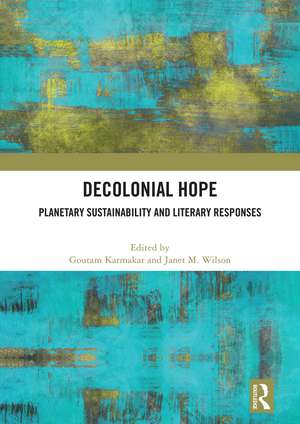
Decolonial Hope: Planetary Sustainability and Literary Responses
Editat de Goutam Karmakar, Janet Wilsonen Limba Engleză Hardback – 19 oct 2026
This book is intended for students, academics, independent scholars, and researchers in postcolonial literature, decolonial studies, environmental humanities, ecocriticism, and related interdisciplinary fields. It will also appeal to those engaged with climate justice, ecological philosophy, and alternative epistemologies seeking to understand how literary and cultural practices can contribute to transformative social and environmental change.
The chapters in this book were originally published as a special issue of Journal of Postcolonial Writing.
Preț: 1342.98 lei
Preț vechi: 1637.78 lei
-18% Nou
Puncte Express: 2014
Carte tipărită la comandă
Livrare economică 02-16 decembrie
Livrare prin curier în România Termenul estimat este afișat lângă disponibilitate.
Transport gratuit pentru acest produs Plată online sau ramburs, în funcție de opțiunile comenzii.
Retur gratuit în 14 zile Comandă securizată și suport în română.
Specificații
ISBN-13: 9781041407591
ISBN-10: 1041407599
Pagini: 164
Dimensiuni: 174 x 246 mm
Greutate: 0.47 kg
Ediția:1
Editura: Taylor & Francis
Colecția Routledge
Locul publicării:Oxford, United Kingdom
ISBN-10: 1041407599
Pagini: 164
Dimensiuni: 174 x 246 mm
Greutate: 0.47 kg
Ediția:1
Editura: Taylor & Francis
Colecția Routledge
Locul publicării:Oxford, United Kingdom
Public țintă
Postgraduate, Undergraduate Advanced, and Undergraduate CoreCuprins
Introduction: Contextualizing decolonial hope: Thinking for coexistence and planetary sustainability 1. The hopeful possibilities of “sideways” time: Louise Erdrich’s Future Home of the Living God 2. “This grief not only ours to bear”: Hope in shalan joudry’s Km+tkinu (Homeland) 3. Hopegoing: Animist metaphor as deferred hope in Yaa Gyasi’s Homegoing 4. To hope or to weep? Slow hope in Rohan Chakravarty’s green humour series 5. Making it hot: Eco-militancy and survivance in Helon Habila’s Oil on Water and Imbolo Mbue’s How Beautiful We Were 6. Entangled futures: Energy production, ecospirituality, and decolonial hope in Indian solarpunk fiction 7. Love and landscape: Decolonial resistance, solidarity, and hope in The God of Small Things 8. Dismantling cyborg politics: Decolonial hope in Chinese science fiction 9. Countering capitalist ethics: Ecological empathy, hope, and environmental education in Robin Wall Kimmerer’s Braiding Sweetgrass
Notă biografică
Goutam Karmakar teaches in the Department of English at the University of Hyderabad, India, with affiliations and research positions at Multidisciplinary Environmental Studies in the Humanities (MESH), University of Cologne, Germany, and the Faculty of Arts and Design, Durban University of Technology, South Africa. He has received several fellowships, including the Alexander von Humboldt Fellowship in Germany, National Research Foundation awards in South Africa, and the MIASA Individual Fellowship in Ghana. His research spans Global South literature, postcolonial and decolonial studies, cultural studies, and environmental humanities. Karmakar edits the journal Global South Literary Studies and the Routledge book series South Asian Literature in Focus.
Janet M. Wilson is Emeritus Professor of English and Postcolonial Studies at the University of Northampton, UK. She earlier taught for a decade in the Department of English at the University of Otago, New Zealand. Her research spans postcolonial memory, diaspora, authorship, trans-culturalism, and the cultural politics of Aotearoa/New Zealand. She is Editor-in-Chief of the Journal of Postcolonial Writing and has co-edited volumes on postcolonial writing, transnationalism, and diaspora. She is Co-Editor of the series Studies in World Literature, Chair of Challenging Precarity: A Global Network, and recently co-edited Ecocritical Explorations of the Climate Crisis: Planetary Precarity and Future Habitability (2025).
Janet M. Wilson is Emeritus Professor of English and Postcolonial Studies at the University of Northampton, UK. She earlier taught for a decade in the Department of English at the University of Otago, New Zealand. Her research spans postcolonial memory, diaspora, authorship, trans-culturalism, and the cultural politics of Aotearoa/New Zealand. She is Editor-in-Chief of the Journal of Postcolonial Writing and has co-edited volumes on postcolonial writing, transnationalism, and diaspora. She is Co-Editor of the series Studies in World Literature, Chair of Challenging Precarity: A Global Network, and recently co-edited Ecocritical Explorations of the Climate Crisis: Planetary Precarity and Future Habitability (2025).
Descriere
This book advances the cultivation of decolonial hope as a transformative framework for reimagining development through kinship, accountability, and ecological care. It offers a critical intervention that challenges imperial legacies while advocating for just and equitable societies that honor human and non-human agencies alike.