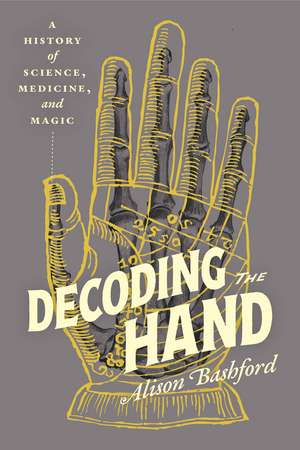
Decoding the Hand: A History of Science, Medicine, and Magic
Autor Alison Bashforden Limba Engleză Hardback – 23 dec 2025
The astonishing history of palmistry and biometrics—from occult physicians to the very foundations of modern science and medicine.
Why did Isaac Newton read books on chiromancy, the occult science of hand reading that revealed the secrets of the soul? Why did Charles Darwin claim that the hand gave humans dominion over all other species? Why did psychoanalyst Charlotte Wolff climb into the primate cages of the London Zoo, taking hundreds of delicate palm prints? Why did Francis Galton, the father of fingerprinting, take palm prints too? And why did world-leading geneticists study the geometry of palm lines in their search for the secrets of chromosomal syndromes?
Decoding the Hand is an astounding history of magic, medicine, and science, of an enduring search for how our bodily surfaces might reveal an inner self—a soul, a character, an identity. From sixteenth-century occult physicians influenced by the Kabbalah to twentieth-century geneticists, and from criminologists to eugenicists, award-winning historian Alison Bashford takes us on a remarkable journey into the strange world of hand readers, revealing how signs on the hand—its shape, lines, marks, and patterns—have been elaborately decoded over the centuries. Sometimes learned, sometimes outrageously deceptive, sometimes earnest, and, more often than we ever expected, medically and scientifically trained, these palm readers of the past prove to be essential links in the human quest to peer into bodies, souls, minds, and selves. Not only for fortune-telling palmists were the future and the past, health, and character laid bare in the hand, but for other experts in bodies and minds as well: anatomists, psychiatrists, embryologists, primatologists, evolutionary biologists, geneticists, and more.
Drawing telling parallels between the divination promised by palmistry and the appeal to self-knowledge offered by modern genetic testing, Decoding the Hand also makes clear that palm-reading is far from a relic or simple charlatanism. Bashford’s sagacious history of human hands touching and connecting opens wide the essential human pursuit of what lies within and beyond.
Preț: 223.60 lei
Puncte Express: 335
Carte disponibilă
Livrare economică 09-23 noiembrie
Livrare express 24-30 octombrie pentru 66.41 lei
Livrare prin curier în România Termenul estimat este afișat lângă disponibilitate.
Transport gratuit de la 400.00 lei Plată online sau ramburs, în funcție de opțiunile comenzii.
Retur gratuit în 14 zile Comandă securizată și suport în română.
Specificații
ISBN-13: 9780226831152
ISBN-10: 0226831159
Pagini: 400
Ilustrații: 75 halftones
Dimensiuni: 152 x 229 x 38 mm
Greutate: 0.78 kg
Ediția:First Edition
Editura: University of Chicago Press
Colecția University of Chicago Press
ISBN-10: 0226831159
Pagini: 400
Ilustrații: 75 halftones
Dimensiuni: 152 x 229 x 38 mm
Greutate: 0.78 kg
Ediția:First Edition
Editura: University of Chicago Press
Colecția University of Chicago Press
V-ar putea interesa
-
 HandsDarian Leader-24%Preț: 58.66 lei77.59 lei
 -
 Art of Palm ReadingMendoza StaciPreț: 53.66 lei
 -
 Handbook of PalmistryRosa Baughan-30%Preț: 73.59 lei105.39 lei
 -
 PalmistryJohnny FinchamPreț: 65.72 lei
 -
 Palmistry, Orion Plain and SimpleSasha Fenton-28%Preț: 50.72 lei70.14 lei
 -
 A Little Bit of Palmistry: An Introduction to Palm ReadingCassandra Eason-31%Preț: 48.24 lei69.63 lei
 -
 The Expression of the Emotions in Man and AnimalsCharles DarwinPreț: 50.39 lei
 -
 PalmistryOlga LempiinskaPreț: 55.56 lei
 -
 -24%Preț: 164.18 lei216.92 lei
 -
 The Palm Reading Guide: Reveal the secrets of the tell tale handFrank C. CliffordPreț: 82.77 lei
 -
 The Little Guide to PalmistryJohnny FinchamPreț: 93.01 lei
 -
 -24%Preț: 33.89 lei44.44 lei
 -
 What My Hands RevealAren McCartneyPreț: 62.56 lei
 -
 Handwritten: Remarkable People on the PageLesley SmithPreț: 320.71 lei
 -
 -26%Preț: 42.25 lei57.40 lei
 -
 Palmistry: The art of reading palmsAnna Comerford-18%Preț: 100.84 lei123.09 lei
 -
 -19%Preț: 104.50 lei128.98 leiRecomandat
 -
 Palmistry for Happiness: The Transformational Power of Vedic Hand ReadingGhanshyam Singh Birla-23%Preț: 95.75 lei124.63 lei
 -
 Palmistry for Love: A Guide to the Vedic Science of CompatibilityGhanshyam Singh Birla-24%Preț: 105.07 lei137.68 lei
Notă biografică
Alison Bashford is Scientia Professor of History and Director of the Laureate Centre for History and Population at the University of New South Wales in Australia. She is a fellow of the British Academy and an honorary fellow of Jesus College, Cambridge. Bashford is the author, most recently, of The Huxleys: An Intimate History of Evolution.
Cuprins
List of Illustrations
List of Abbreviations
Author’s Note on Terminology
Secrets Disclosed: Taken by the Hand
Part I: The Early Languages of the Hand
01
Origins: Physiognomy and Chiromancy
02
Reading the Palm Across Indo-European Worlds
03
The Hand in Victorian Science and Medicine
Part II: The Modernization and Medicalization of Palmistry
04
The Cheirosophy of Edward Heron-Allen
05
Fortune and the Law: Cheiro and Keiro
06
Commercial Hands: The Ellis Family
07
The Medical Palmistry of Katharine St. Hill
Part III: Decoding the Hand in Twentieth-Century Biosciences
08
Fingerprints: Francis Galton’s Doctrine of Signatures
09
Anatomists of Race and the Simian Line
10
The Hand That Speaks: Charlotte Wolff
11
The Hand in the Age of Human Genetics: Lionel Penrose
Conclusion
Occult Medicine and the Lines of Fate
Acknowledgments
Notes
Select Bibliography
Index
List of Abbreviations
Author’s Note on Terminology
Secrets Disclosed: Taken by the Hand
Part I: The Early Languages of the Hand
01
Origins: Physiognomy and Chiromancy
02
Reading the Palm Across Indo-European Worlds
03
The Hand in Victorian Science and Medicine
Part II: The Modernization and Medicalization of Palmistry
04
The Cheirosophy of Edward Heron-Allen
05
Fortune and the Law: Cheiro and Keiro
06
Commercial Hands: The Ellis Family
07
The Medical Palmistry of Katharine St. Hill
Part III: Decoding the Hand in Twentieth-Century Biosciences
08
Fingerprints: Francis Galton’s Doctrine of Signatures
09
Anatomists of Race and the Simian Line
10
The Hand That Speaks: Charlotte Wolff
11
The Hand in the Age of Human Genetics: Lionel Penrose
Conclusion
Occult Medicine and the Lines of Fate
Acknowledgments
Notes
Select Bibliography
Index
Recenzii
“Decoding the Hand tells a story, extending from the deep past to the near present, about the way the hand has been read, the meanings that have been discerned, the different sorts of people who have interpreted the signs, the links between hand-reading and philosophy, science and medicine, and the stances taken on these matters by law, religion and government. Bashford is an Australian historian whose previous books have included a close study of Malthus’s Essay on the Principle of Population and a remarkable biography of the Huxley family, but here she has produced something altogether surprising and hard to categorise—a story which is, on the one hand, just about a bit of the human body and, on the other, about the changing, contested and consequential practices through which we have sought to know ourselves and others.”
“[A] delightful book. The idea that meaning is concealed within the lines, folds and creases of palms, as well as the size, texture and structure of hands, has a long history. Since its origins in ancient physiognomic traditions, expertise in reading hands has criss-crossed ‘registers of knowledge’ from market-square commerce to the most arcane of learned traditions. As Bashford shows, nineteenth-century palmistry also had a significant past, and future, in the history of science and medicine.”
“Over the centuries some of the finest minds of a given age have been drawn to reading palms and just what the lines may signify. Bashford . . . traces the long and colourful story of palm reading in what she calls a ‘history of bodily semiotics’ and what these signs might tell us medically, scientifically or psychologically. . . . An intriguing history of the human quest to discover the inner life in the outer signs through the prism of palmistry.”
“In the mid-twentieth century, geneticist Lionel Penrose observed correlations between genetic abnormalities and the creases of the hand, publishing his final paper ‘Fingerprints and palmistry’ in The Lancet in 1973. The hand has long intrigued physicians, embryologists, endocrinologists, psychiatrists and physical anthropologists, notes historian Bashford. This fascinating, well-illustrated history explores the ‘mysterious, curious, and often complex codes by which signs of the hand have been interpreted.’”
"A very nice book by Alison Bashford about chiromancy, analyzing the hand, reading your palm. She follows this story through from ancient practices, ideas of magic and so on, through to modern analyses that get into genetics. It makes the case very nicely that this is the kind of old idea we now want to invest in our genome—that this somehow tells us deep truths about ourselves."
“[A] delightful book. The idea that meaning is concealed within the lines, folds and creases of palms, as well as the size, texture and structure of hands, has a long history. Since its origins in ancient physiognomic traditions, expertise in reading hands has criss-crossed ‘registers of knowledge’ from market-square commerce to the most arcane of learned traditions. As Bashford shows, nineteenth-century palmistry also had a significant past, and future, in the history of science and medicine.”
“A lot of what, and who, we think we are as individuals and social beings is concentrated in our hands. . . . In Decoding the Hand, Bashford is alive to the multiplicity of meanings held by these extremities. There are many stories to be told here, and Bashford tells them well.”
“Over the centuries some of the finest minds of a given age have been drawn to reading palms and just what the lines may signify. Bashford . . . traces the long and colourful story of palm reading in what she calls a ‘history of bodily semiotics’ and what these signs might tell us medically, scientifically or psychologically. . . . An intriguing history of the human quest to discover the inner life in the outer signs through the prism of palmistry.”
“In the mid-twentieth century, geneticist Lionel Penrose observed correlations between genetic abnormalities and the creases of the hand, publishing his final paper ‘Fingerprints and palmistry’ in The Lancet in 1973. The hand has long intrigued physicians, embryologists, endocrinologists, psychiatrists and physical anthropologists, notes historian Bashford. This fascinating, well-illustrated history explores the ‘mysterious, curious, and often complex codes by which signs of the hand have been interpreted.’”
"A very nice book by Alison Bashford about chiromancy, analyzing the hand, reading your palm. She follows this story through from ancient practices, ideas of magic and so on, through to modern analyses that get into genetics. It makes the case very nicely that this is the kind of old idea we now want to invest in our genome—that this somehow tells us deep truths about ourselves."
“Full of delightful historical twists and insights, Bashford argues that the practice of reading signs in the hand has been part of medical diagnostics from chiromancy in late medieval times to modern genetics. She shows how the lines and ridges on our hands have served as a language to those who can read it—a language that tells a story about the inner secrets of the body. Ingenious and fascinating, this is history at its best.”
“In this compelling and wide-ranging book, Bashford journeys through centuries of interpreters’ fascinations with the hand, the lessons about personality and about fate that its shape and size, its marks and forms, might carry. Questioning and often subverting received distinctions between scientific reason and allegedly occult skill and knowledge, these stories show how histories of palm-reading and fingerprinting, of fortune-telling and of genetics, were often entangled. The book will be an indispensable guide for anyone interested in how the sciences and practices of self-knowledge emerged in modernity, and the many intriguing lives and careers on which they have depended.”
“An unexpected joy. Decoding the Hand is a fabulous book that charts a history of the hand from ancient sources to twentieth-century genetics, with both learning and lightness. It offers a broad history, lavishly illustrated, and is built around a series of individually interesting case studies that will appeal to readers interested in the history of the occult and magic as well as those interested in the history of science and medicine. And it is all framed within a broader historiographical argument about the development of medical knowledge and the contested process of disenchantment. As Bashford herself puts it toward the end of the book: ‘This isn’t (just) a history of fun and quirky medicine, it is the history of medicine.’ Excellent.”
“A daring and joyously intelligent book.”
“A masterpiece."
“Wonderfully ambitious.”
“A crowning achievement. . . . Magnificent.”
“A tour de force of popular science writing.”
Best Books of 2022